


Page 55 - EETEurope FlipBook February
P. 55
EE|Times EUROPE   55
                                                        Will Fan-Out Wafer-Level Packaging Keep Moore’s Law Valid?


               as the back of the chip is fully exposed, facil-  as logic speeds rise and can dramatically   assembly and test outfits to verify the full
               itating heat removal. The RDL-first approach   alter signal timing and characteristics. Thus,   packaged chip design. The EDA companies
               allows the use of known-good die in its fabri-  developers seeking to use advanced packag-  are also stepping up to develop design and
               cation, increasing yield.           ing techniques will need to ensure that their   verification tools that can support these
                 In performance, the face-down approach has   simulations and design verification efforts   advanced packaging requirements.
               a shorter connection path than the face-up and   include the package as well as the chip design   Either way, the role of advanced packaging
               RDL-first approaches (Figure 2). The two latter   to ensure success.    will continue to grow as the industry keeps
               approaches have copper pillars, which extend   Chip vendors are starting to develop    pushing to keep Moore’s Law valid as long as
               the connection to the RDL, as well as a layer   their own in-house tools that integrate    possible. The demand for smaller, faster, more
               of material under the chip that adds parasitic   the package and chip design into a single   capable chips and systems will continue, and
               capacitance between the connections, affecting   process flow for their customers. However,   packaging now looks to be the new frontier
               their high-frequency performance.   in-house tools may limit designer choices   that developers will need to explore. ■
                                                   for the chips made with vendor processes.
               NEW TOOLS FOR ADVANCED PACKAGING    Those who want to mix chips from different   Richard Quinnell is a retired engineer and
               Such subtle parasitic effects due to the pack-  processes may need to depend instead on   writer and the former editor-in-chief of EDN.
               age’s fabrication are increasingly important   tools that are available through outsourced   This article was originally published on EDN.


                SPECIAL REPORT: ADVANCED IC PACKAGING
               Five Keys to Next-Generation

               IC Packaging Design


               By Keith Felton

                    or many applications, next-generation IC packaging is the best
                    path to achieve silicon scaling, functional density, and hetero-
                    geneous integration while reducing the overall package size.
              F Heterogeneous and homogeneous integration technologies offer
               a path to enhanced device functionality, faster time to market, and
               silicon yield resiliency.
                 Multiple integration technology platforms have emerged that allow
               for cost, size, performance, and power optimizations to satisfy the
               needs of multiple markets, such as mobile computing, automotive, 5G,
               artificial intelligence, augmented reality and virtual reality, high-
               performance computing, IoT, medical, and aerospace. However, these
               packages present unique challenges for traditional package design
               tools and methodologies. Design teams must work together to verify
               and optimize the entire system, not just the individual elements.
                 Traditional IC packaging substrate design is typically very simi-
               lar to a small-scale laminate and/or buildup-based PCB. It is often
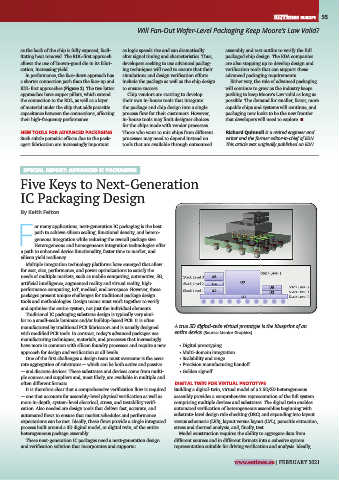
               manufactured by traditional PCB fabricators and is usually designed   A true 3D digital-twin virtual prototype is the blueprint of an
               with modified PCB tools. In contrast, today’s advanced packages use   entire device. (Source: Mentor Graphics)
               manufacturing techniques, materials, and processes that increasingly
               have more in common with silicon foundry processes and require a new   • Digital prototyping
               approach for design and verification at all levels.     • Multi-domain integration
                 One of the first challenges a design team must overcome is the accu-  • Scalability and range
               rate aggregation of substrates — which can be both active and passive   • Precision manufacturing handoff
               — and discrete devices. These substrates and devices come from multi-  • Golden signoff
               ple sources and suppliers and, most likely, are available in multiple and
               often different formats.                              DIGITAL TWIN FOR VIRTUAL PROTOTYPE
                 It is therefore clear that a comprehensive verification flow is required   Building a digital-twin, virtual model of a 2.5D/3D heterogeneous
               — one that accounts for assembly-level physical verification as well as   assembly provides a comprehensive representation of the full system
               more in-depth, system-level electrical, stress, and testability verifi-  comprising multiple devices and substrates. The digital twin enables
               cation. Also needed are design tools that deliver fast, accurate, and   automated verification of heterogeneous assemblies beginning with
               automated flows to ensure that market schedules and performance   substrate-level design rule checking (DRC) and expanding into layout
               expectations can be met. Ideally, these flows provide a single integrated   versus schematic (LVS), layout versus layout (LVL), parasitic extraction,
               process built around a 3D digital model, or digital twin, of the entire   stress and thermal analysis, and, finally, test.
               heterogeneous package assembly.                         Model construction requires the ability to aggregate data from
                 These next-generation IC packages need a next-generation design   different sources and in different formats into a cohesive system
               and verification solution that incorporates and supports:  representation suitable for driving verification and analysis. Ideally,


                                                                                          www.eetimes.eu | FEBRUARY 2021

