


Page 54 - EETEurope FlipBook February
P. 54
54 EE|Times EUROPE


                SPECIAL REPORT: ADVANCED IC PACKAGING
               Will Fan-Out Wafer-Level Packaging Keep

               Moore’s Law Valid?


               By Richard Quinnell


                       oore’s Law in process technology
                       is on its last legs, so advanced
                       packaging is taking up the baton.
              MAdvanced techniques such as
               fan-out wafer-level packaging (FOWLP) allow
               increased component density, boost perfor-
               mance, and help solve chip I/O limitations.
               The key to using such techniques successfully,
               however, is to include the package in the chip
               design from the start.
                 For decades, semiconductor processing
               technology has steadily pushed feature sizes
               down from tens of microns to single-digit
               nanometers, effectively doubling component
               density every 18 months. At the same time,
               however, design and fabrication costs have
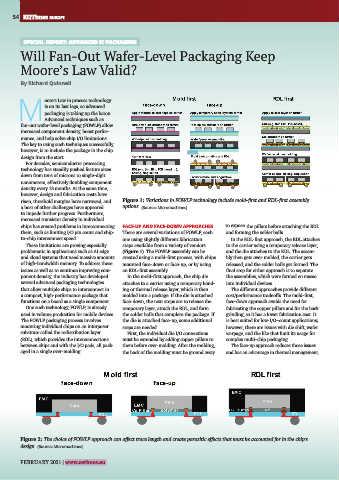
               risen, threshold margins have narrowed, and   Figure 1: Variations in FOWLP technology include mold-first and RDL-first assembly
               a host of other challenges have appeared   options. (Source: Micromachines)
               to impede further progress. Furthermore,
               increased transistor density in individual
               chips has created problems in interconnecting   FACE-UP AND FACE-DOWN APPROACHES  to expose the pillars before attaching the RDL
               them, such as limiting I/O pin count and chip-  There are several variations of FOWLP, each   and forming the solder balls.
               to-chip interconnect speed.         one using slightly different fabrication   In the RDL-first approach, the RDL attaches
                 These limitations are proving especially   steps available from a variety of vendors   to the carrier using a temporary release layer,
               problematic in applications such as AI edge   (Figure 1). The FOWLP assembly can be   and the die attaches to the RDL. The assem-
               and cloud systems that need massive amounts   created using a mold-first process, with chips   bly then gets over-molded, the carrier gets
               of high-bandwidth memory. To address these   mounted face-down or face-up, or by using   released, and the solder balls get formed. The
               issues as well as to continue improving com-  an RDL-first assembly.    final step for either approach is to separate
               ponent density, the industry has developed   In the mold-first approach, the chip die   the assemblies, which were formed en masse
               several advanced packaging technologies   attaches to a carrier using a temporary bond-  into individual devices.
               that allow multiple chips to interconnect in   ing or thermal release layer, which is then   The different approaches provide different
               a compact, high-performance package that   molded into a package. If the die is attached   cost/performance tradeoffs. The mold-first,
               functions on a board as a single component.  face-down, the next steps are to release the   face-down approach avoids the need for
                 One such technology, FOWLP, is already   temporary layer, attach the RDL, and form   fabricating the copper pillars and for the back
               used in volume production for mobile devices.   the solder balls that complete the package. If   grinding, so it has a lower fabrication cost. It
               The FOWLP packaging process involves   the die is attached face-up, some additional   is best suited for low-I/O–count applications;
               mounting individual chips on an interposer   steps are needed.          however, there are issues with die shift, wafer
               substrate called the redistribution layer   First, the individual die I/O connections   warpage, and the like that limit its usage for
               (RDL), which provides the interconnections   must be extended by adding copper pillars to   complex multi-chip packaging.
               between chips and with the I/O pads, all pack-  them before over-molding. After the molding,   The face-up approach reduces those issues
               aged in a single over-molding.      the back of the molding must be ground away   and has an advantage in thermal management,


               Figure 2: The choice of FOWLP approach can affect trace length and create parasitic effects that must be accounted for in the chip’s
               design. (Source: Micromachines)

               FEBRUARY 2021 | www.eetimes.eu

