


Page 50 - EETEurope FlipBook February
P. 50
50 EE|Times EUROPE


                SPECIAL REPORT: ADVANCED IC PACKAGING
               Heterogeneous Integration and the Evolution

               of IC Packaging


               By Gareth Kenyon


                      eterogeneous integration tech-
                      nology refers to the integration of
                      separately manufactured compo-
              Hnents into a higher-level assembly,
               or system-in-package, that in the aggre-
               gate provides enhanced functionality and
               improved operating characteristics. In this
               context, a component can be taken to mean
               any unit, such as a microelectromechanical
               system, assembled package for high-
               bandwidth memory — such as passive compo-
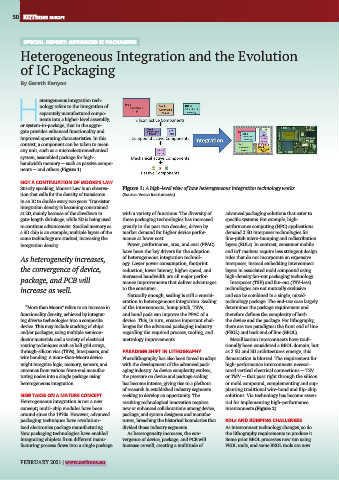
               nents — and others (Figure 1).

               NOT A CONTINUATION OF MOORE’S LAW
               Strictly speaking, Moore’s Law is an observa-  Figure 1: A high-level view of how heterogeneous integration technology works
               tion that calls for the density of transistors   (Source: Veeco Instruments)
               in an IC to double every two years. Transistor
               integration density is becoming constrained
               at 2D, mainly because of the slowdown in   with a variety of functions. The diversity of   advanced packaging solutions that cater to
               gate-length shrinkage, while 3D is being used   these packaging technologies has increased   specific systems. For example, high-
               to continue advancement. Stacked memory as   greatly in the past two decades, driven by   performance computing (HPC) applications
               a 3D chip is an example; multiple layers of the   market demand for higher device perfor-  demand 2.5D interposer technologies for
               same technology are stacked, increasing the   mance at lower cost.      fine-pitch micro-bumping and redistribution
               integration density.                  Power, performance, area, and cost (PPAC)   layers (RDLs). In contrast, consumer mobile
                                                   have been the key drivers for the adoption   and IoT markets require less stringent design
               As heterogeneity increases,         of heterogeneous integration technol-  rules that do not incorporate an expensive
                                                                                       interposer, instead embedding interconnect
                                                   ogy. Lower power consumption, footprint
               the convergence of device,          reduction, lower latency, higher speed, and   layers in associated mold compound using
               package, and PCB will               increased bandwidth are all major perfor-  high-density fan-out packaging technology.
                                                   mance improvements that deliver advantages
                                                                                         Interposer (TSV) and fan-out (TSV-less)
               increase as well.                   to the consumer.                    technologies are not mutually exclusive
                                                     Naturally enough, scaling is still a consid-  and can be combined in a single, mixed-
                                                   eration in heterogeneous integration. Scaling   technology package. The end-use case largely
                 “More than Moore” refers to an increase in   of the interconnects, bump pitch, TSVs,   determines the package requirement and
               functionality density, achieved by integrat-  and bond pads can improve the PPAC of a   therefore defines the complexity of both
               ing diverse technologies into a composite   device. This, in turn, creates important chal-  the device and the package. For lithography,
               device. This may include stacking of chips   lenges for the advanced packaging industry   there are two paradigms: the front end of line
               and/or packages, using multiple semicon-  regarding the required process, tooling, and   (FEOL) and back end of line (BEOL).
               ductor materials and a variety of electrical   metrology improvements.    Metallization interconnects have tradi-
               routing techniques such as ball grid arrays,                            tionally been considered a BEOL domain, but
               through-silicon vias (TSVs), interposers, and   PARADIGM SHIFT IN LITHOGRAPHY  as 2.5D and 3D architectures emerge, this
               wire bonding. A more-than-Moore device   Photolithography has also been forced to adapt   demarcation is blurred. The requirement for
               might integrate logic, memory, sensors, and   with the development of the advanced pack-  high-performance interconnects necessi-
               antennas from various front-end manufac-  aging industry. As device complexity evolves,   tated vertical electrical connections — TSV
               turing nodes into a single package using   the pressure on device and package scaling   or TMV — that pass right through the silicon
               heterogeneous integration.          has become intense, giving rise to a plethora   or mold compound, complementing and sup-
                                                   of research in established industry segments   planting traditional wire-bond and flip-chip
               NEW TAKES ON A MATURE CONCEPT       seeking to develop an opportunity. The   solutions. Via technology has become essen-
               Heterogeneous integration is not a new   resulting technological innovation requires   tial for implementing high-performance
               concept; multi-chip modules have been   new or enhanced collaborations among device,   interconnects (Figure 2).
               around since the 1970s. However, advanced   package, and system designers and manufac-
               packaging techniques have revolution-  turers, breaching the historical boundaries that   RDLs AND BUMPING CHALLENGES
               ized electronics package manufacturing.   divided those industry segments.  As interconnect technology changes, so do
               New packaging technologies have enabled   As heterogeneity increases, the con-  the lithography requirements to produce it.
               integrating chiplets from different manu-  vergence of device, package, and PCB will   Some prior BEOL processes now run using
               facturing process flows into a single package   increase as well, creating a multitude of   FEOL tools, and some BEOL tools are now


               FEBRUARY 2021 | www.eetimes.eu

