


Page 53 - EETEurope FlipBook February
P. 53
EE|Times EUROPE   53
                                                    Tighter Integration Between Process Technologies and Packaging


               this definition simply means that the interconnects between the active
               silicon do not pass through the package, and hence, their design and
               performance do not directly depend on the package architecture.
               INTERCONNECT DENSITY
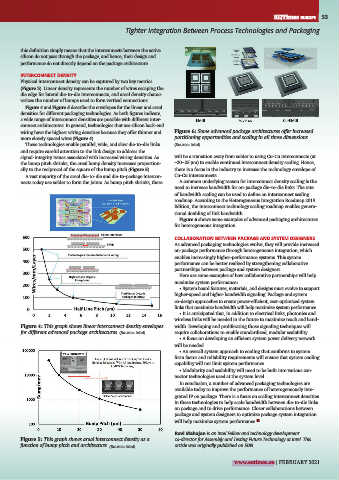
               Physical interconnect density can be captured by two key metrics
               (Figure 3). Linear density represents the number of wires escaping the
               die edge for lateral die-to-die interconnects, and areal density charac-
               terizes the number of bumps used to form vertical connections.
                 Figure 4 and Figure 5 describe the envelopes for the linear and areal
               densities for different packaging technologies. As both figures indicate,
               a wide range of interconnect densities are possible with different inter-
               connect architectures. In general, technologies that use silicon back-end
               wiring have the highest wiring densities because they offer thinner and   Figure 6: Some advanced package architectures offer increased
               more closely spaced wires (Figure 4).                 partitioning opportunities and scaling in all three dimensions.
                 These technologies enable parallel, wide, and slow die-to-die links   (Source: Intel)
               and require careful attention to the link design to address the
               signal-integrity issues associated with increased wiring densities. As   will be a transition away from solder to using Cu-Cu interconnects (at
               the bump pitch shrinks, the areal bump density increases proportion-  ~20–25 μm) to enable continued interconnect density scaling. Hence,
               ally to the reciprocal of the square of the bump pitch (Figure 5).  there is a focus in the industry to increase the technology envelope of
                 A vast majority of the areal die-to-die and die-to-package intercon-  Cu-Cu interconnects.
               nects today use solder to form the joints. As bump pitch shrinks, there   A common underlying reason for interconnect density scaling is the
                                                                     need to increase bandwidth for on-package die-to-die links. The rate
                                                                     of bandwidth scaling can be used to define an interconnect scaling
                                                                     roadmap. According to the Heterogeneous Integration Roadmap 2019
                                                                     Edition, the interconnect technology scaling roadmap enables genera-
                                                                     tional doubling of link bandwidth.
                                                                       Figure 6 shows some examples of advanced packaging architectures
                                                                     for heterogeneous integration.

                                                                     COLLABORATION BETWEEN PACKAGE AND SYSTEM DESIGNERS
                                                                     As advanced packaging technologies evolve, they will provide increased
                                                                     on-package performance through heterogeneous integration, which
                                                                     enables increasingly higher-performance systems. This system
                                                                     performance can be better realized by strengthening collaborative
                                                                     partnerships between package and system designers.
                                                                       Here are some examples of how collaborative partnerships will help
                                                                     maximize system performance:
                                                                       • System board features, materials, and designs must evolve to support
                                                                     higher-speed and higher-bandwidth signaling. Package and system
                                                                     co-design approaches to create power-efficient, cost-optimized system
                                                                     links that maximize bandwidth will help maximize system performance.
                                                                       • It is anticipated that, in addition to electrical links, photonics and
                                                                     wireless links will be needed in the future to maximize reach and band-
               Figure 4: This graph shows linear interconnect density envelopes   width. Developing and proliferating those signaling techniques will
               for different advanced package architectures. (Source: Intel)  require collaborations to enable standardized, modular scalability.
                                                                       • A focus on developing an efficient system power delivery network
                                                                     will be needed.
                                                                       • An overall system approach to cooling that conforms to system
                                                                     form factor and reliability requirements will ensure that system cooling
                                                                     capability will not limit system performance.
                                                                       • Modularity and scalability will need to be built into various con-
                                                                     nector technologies used at the system level.
                                                                       In conclusion, a number of advanced packaging technologies are
                                                                     available today to improve the performance of heterogeneously inte-
                                                                     grated IP on package. There is a focus on scaling interconnect densities
                                                                     in these technologies to help scale bandwidth between die-to-die links
                                                                     on package and to drive performance. Closer collaborations between
                                                                     package and system designers to optimize package system integration
                                                                     will help maximize system performance. ■

                                                                     Ravi Mahajan is an Intel Fellow and technology development
               Figure 5: This graph shows areal interconnect density as a    co-director for Assembly and Testing Future Technology at Intel. This
               function of bump pitch and architecture. (Source: Intel)  article was originally published on EDN.

                                                                                          www.eetimes.eu | FEBRUARY 2021

