


Page 56 - EETEurope FlipBook February
P. 56
56 EE|Times EUROPE
               Five Keys to Next-Generation IC Packaging Design


                                                                                        design is also a significant challenge to
                                                                                        first-time–right success. Heterogeneous
                                                                                        multi-substrate packages exhibit multiple
                                                                                        chip-package interactions. One of the
                                                                                        largest is thermal dissipation, especially of
                                                                                        the non-linearly generated heat typical in
                                                                                        such packages.
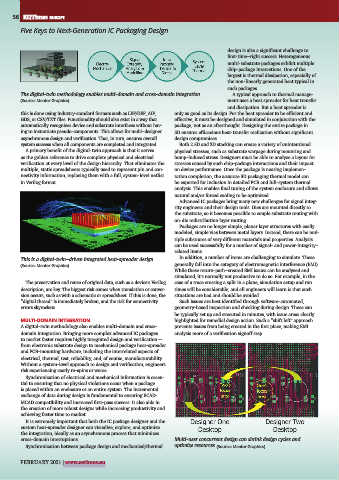
               The digital-twin methodology enables multi-domain and cross-domain integration.   A typical approach to thermal manage-
               (Source: Mentor Graphics)                                                ment uses a heat spreader for heat transfer
                                                                                        and dissipation. But a heat spreader is
               this is done using industry-standard formats such as LEF/DEF, AIF,   only as good as its design. For the heat spreader to be efficient and
               GDS, or CSV/TXT files. Functionality should also exist in a way that   effective, it must be designed and simulated in conjunction with the
               automatically recognizes device and substrate interfaces without hav-  package, not as an afterthought. Designing the entire package in
               ing to instantiate pseudo-components. This allows for multi-designer    3D ensures efficacious heat-transfer realization without significant
               asynchronous design and verification. That, in turn, ensures overall   design compromises.
               system success when all components are completed and integrated.  Both 2.5D and 3D stacking can create a variety of unintentional
                 A primary benefit of the digital-twin approach is that it serves   physical stresses, such as substrate warpage during mounting and
               as the golden reference to drive complete physical and electrical   bump-induced stress. Designers must be able to analyze a layout for
               verification at every level of the design hierarchy. That eliminates the   stresses caused by such chip-package interactions and their impact
               multiple, static spreadsheets typically used to represent pin and con-  on device performance. Once the package is nearing implemen-
               nectivity information, replacing them with a full, system-level netlist   tation completion, the accurate 3D packaging thermal model can
               in Verilog format.                                    be exported for inclusion in detailed PCB and full-system thermal
                                                                     analysis. This enables final tuning of the system enclosure and allows
                                                                     natural and/or forced cooling to be optimized.
                                                                       Advanced IC packages bring many new challenges for signal integ-
                                                                     rity engineers and their design tools. Dies are mounted directly to
                                                                     the substrate, so it becomes possible to couple substrate routing with
                                                                     on-die redistribution layer routing.
                                                                       Packages are no longer simple, planar layer structures with easily
                                                                     modeled, simple vias between metal layers. Instead, there can be mul-
                                                                     tiple substrates of very different materials and properties. Analysis
                                                                     can be used successfully for a number of signal- and power-integrity–
                                                                     related items.
               This is a digital-twin–driven integrated heat-spreader design.   In addition, a number of items are challenging to simulate. These
               (Source: Mentor Graphics)                             generally fall into the category of electromagnetic interference (EMI).
                                                                     While these return-path–created EMI issues can be analyzed and
                                                                     simulated, it’s normally not productive to do so. For example, in the
                 The preservation and reuse of original data, such as a device’s Verilog   case of a trace crossing a split in a plane, simulation setup and run
               description, are key. The biggest risk comes when translation or conver-  times will be considerable, and all engineers will learn is that such
               sion occurs, such as with a schematic or spreadsheet. If this is done, the   situations are bad and should be avoided.
               “digital thread” is immediately broken, and the risk for connectivity   Such issues are best identified through software-automated,
               errors skyrockets.                                    geometry-based inspection and checking during design. These can
                                                                     be typically set up and executed in minutes, with issue areas clearly
               MULTI-DOMAIN INTEGRATION                              highlighted for remedial design action. Such a “shift left” approach
               A digital-twin methodology also enables multi-domain and cross-   prevents issues from being created in the first place, making EMI
               domain integration. Bringing more complex advanced IC packages   analysis more of a verification signoff step.
               to market faster requires highly integrated design and verification —
               from electronic substrate design to mechanical package heat-spreader
               and PCB-mounting hardware, including the interrelated aspects of
               electrical, thermal, test, reliability, and, of course, manufacturability.
               Without a system-level approach to design and verification, engineers
               risk experiencing costly re-spins or worse.
                 Synchronization of electrical and mechanical information is essen-
               tial to ensuring that no physical violations occur when a package
               is placed within an enclosure or an entire system. The incremental
               exchange of data during design is fundamental to ensuring ECAD-
               MCAD compatibility and increased first-pass success. It also aids in
               the creation of more robust designs while increasing productivity and
               achieving faster time to market.
                 It is extremely important that both the IC package designer and the
               custom heat-spreader designer can visualize, explore, and optimize
               the integration, ideally as an asynchronous process that minimizes
               cross-domain interruptions.                           Multi-user concurrent design can shrink design cycles and
                 Synchronization between package design and mechanical/thermal   optimize resources. (Source: Mentor Graphics)


               FEBRUARY 2021 | www.eetimes.eu

