


Page 20 - EETEurope FlipBook February
P. 20
20 EE|Times EUROPE — CES 2021
               Mercedes-Benz: In-Cabin AI First, Software-Defined Car Next


                 Nvidia isn’t alone in its pursuit of enabling software-defined or “user
               defined” vehicles.
                 NXP just announced BlueBox 3.0, a new development platform for
               car OEMs looking to add a wider portfolio of user-defined applications
               and AI (see “NXP BlueBox 3.0 Lets Carmakers Build Safety, Portfolio of
               Apps,” below).
                 Nvidia has been on that path since late 2019, when it unveiled Orin.
               According to the company, Orin is designed to handle myriad appli-
               cations and deep neural networks while achieving systematic safety
               standards such as ISO 26262 ASIL-D.
                 Leading up to CES 2021, Nvidia disclosed that leading Chinese EV
               makers Nio, Li Auto, and Xpeng were developing their intelligent elec-
               tric fleets on Nvidia Drive. Nio and Li Auto will use Orin in their future
               vehicles; Xpeng is producing new EVs based on Nvidia’s Xavier SoC.
                 At a recent event, Nio unwrapped its ET7 sedan, slated to ship
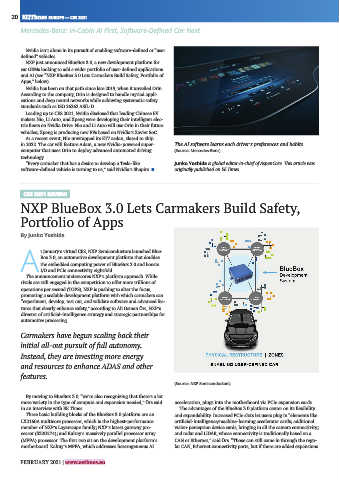
               in 2022. The car will feature Adam, a new Nvidia-powered super-  The AI software learns each driver’s preferences and habits.
               computer that uses Orin to deploy advanced automated driving   (Source: Mercedes-Benz)
               technology.
                 “Every carmaker that has a desire to develop a Tesla-like    Junko Yoshida is global editor-in-chief of AspenCore. This article was
               software-defined vehicle is turning to us,” said Nvidia’s Shapiro. ■    originally published on EE Times.


                CES 2021 REVIEW
               NXP BlueBox 3.0 Lets Carmakers Build Safety,

               Portfolio of Apps


               By Junko Yoshida


                      t January’s virtual CES, NXP Semiconductors launched Blue-
                      Box 3.0, an automotive development platform that doubles
                      the embedded computing power of BlueBox 2.0 and boosts
               A I/O and PCIe connectivity eightfold.
                 The announcement underscores NXP’s platform approach. While
               rivals are still engaged in the competition to offer more trillions of
               operations per second (TOPS), NXP is pushing to alter the focus,
               promoting a scalable development platform with which carmakers can
               “experiment, develop, test out, and validate software and advanced fea-
               tures that clearly enhance safety,” according to Ali Osman Örs, NXP’s
               director of artificial-intelligence strategy and strategic partnerships for
               automotive processing.

               Carmakers have begun scaling back their
               initial all-out pursuit of full autonomy.
               Instead, they are investing more energy

               and resources to enhance ADAS and other
               features.
                                                                     (Source: NXP Semiconductors)
                 By moving to BlueBox 3.0, “we’re also recognizing that there’s a lot
               more variety in the type of compute and expansion needed,” Örs said   acceleration, plugs into the motherboard via PCIe expansion cards.
               in an interview with EE Times.                          The advantages of the BlueBox 3.0 platform center on its flexibility
                 Three basic building blocks of the BlueBox 3.0 platform are an   and expandability. Increased PCIe slots let users plug in “elements like
               LX2160A multicore processor, which is the highest-performance   artificial-intelligence/machine-learning accelerator cards; additional
               member of NXP’s Layerscape family; NXP’s latest gateway pro-  vision-perception device cards, bringing in all the camera connectivity;
               cessor (S32G274); and Kalray’s massively parallel processor array   and radar and LiDAR, whose connectivity is traditionally based on a
               (MPPA) processor. The first two sit on the development platform’s   CAN or Ethernet,” said Örs. “Those can still come in through the regu-
               motherboard. Kalray’s MPPA, which addresses heterogeneous AI   lar CAN, Ethernet connectivity ports, but if there are added expansions


               FEBRUARY 2021 | www.eetimes.eu

