


Page 16 - EETEurope FlipBook February
P. 16
16 EE|Times EUROPE
                                                                                                                                      To Conquer SoC Design Challenges, Change EDA Methods and Tools

                EMBEDDED
               To Conquer SoC Design Challenges,

               Change EDA Methods and Tools


               By Chouki Aktouf


                     ystems-on-chip are everywhere,
                     especially in electronics serving
                     emerging market segments such as
               S5G, autonomous vehicles, and artificial
               intelligence. These complex activities require
               real-time processing at billions of operations
               per second. As system complexity continues
               to rise, SoC design groups are under mounting
               pressure to deliver more efficient products at
               lower costs and with shorter times to deliver-
               ables than ever before — and they’re finding
               that traditional design methodologies and
               tools are reaching their limits. Breakthroughs
               are needed if EDA is to keep ahead of evolving
               SoC design challenges.

               With SoC design groups
               under pressure to deliver
               more efficient products at

               lower costs, breakthroughs
               are needed if EDA is to keep
               ahead of evolving SoC design
               challenges.


                 SoC design starts with the integration
               process, in which the selected
               intellectual-property blocks must be inter-
               connected. The challenge is reaching the best
               possible power, performance, and area (PPA)
               combination within tight deadlines while
               keeping engineering costs under control. In the
               traditional EDA design flow, each task — power
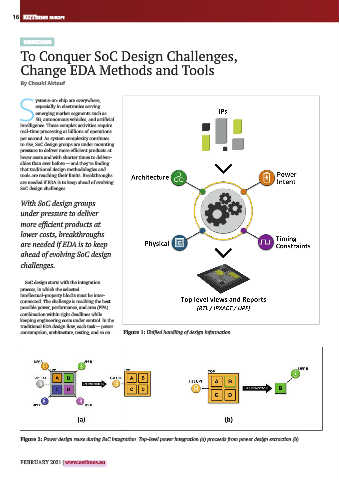
               consumption, architecture, testing, and so on   Figure 1: Unified handling of design information


               Figure 2: Power design reuse during SoC integration. Top-level power integration (a) proceeds from power design extraction (b).


               FEBRUARY 2021 | www.eetimes.eu

