


Page 19 - EETEurope FlipBook February
P. 19
EE|Times EUROPE — CES 2021  19


                CES 2021 REVIEW
               Mercedes-Benz: In-Cabin AI First,

               Software-Defined Car Next


               By Junko Yoshida


                      ES 2021 has clarified an emerging theme among automakers:
                      First comes in-cabin AI, then software-defined cars. Typifying
                      the trend, Mercedes-Benz is integrating in-cabin AI into its
               C upcoming EV model with a user interface that qualifies as
               state of the art (for the time being).
                 The company showed off a single gigantic Gorilla Glass display at
               CES that unifies three screens: instrument cluster, infotainment, and
               passenger displays. Called the Mercedes-Benz User Experience (MBUX)
               Hyperscreen, the 141-cm (about 4.5-foot) screen extends pillar to pillar
               across the cabin.
                 However, as Mercedes-Benz chief Ola Källenius claimed during the
               company’s CES press conference, size isn’t everything. “This is a user
               interface that does not distract the driver,” he said.
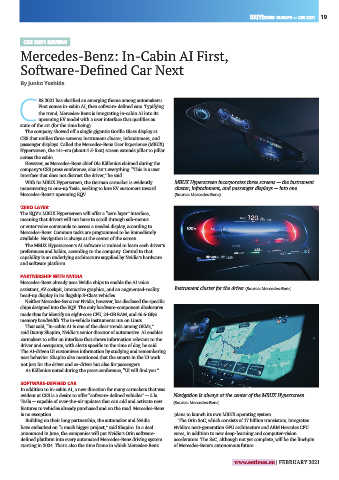
                 With its MBUX Hyperscreen, the German carmaker is evidently   MBUX Hyperscreen incorporates three screens — the instrument
               maneuvering to one-up Tesla, seeking to lure EV customers toward   cluster, infotainment, and passenger displays — into one.
               Mercedes-Benz’s upcoming EQV.                         (Source: Mercedes-Benz)

               ‘ZERO LAYER’
               The EQV’s MBUX Hyperscreen will offer a “zero layer” interface,
               meaning that drivers will not have to scroll through sub-menus
               or enter voice commands to access a needed display, according to
               Mercedes-Benz. Common tasks are programmed to be immediately
               available. Navigation is always at the center of the screen.
                 The MBUX Hyperscreen’s AI software is trained to learn each driver’s
               preferences and habits, according to the company. Central to that
               capability is an underlying architecture supplied by Nvidia’s hardware
               and software platform.
               PARTNERSHIP WITH NVIDIA
               Mercedes-Benz already uses Nvidia chips to enable the AI voice
               assistant, AV cockpit, interactive graphics, and an augmented-reality   Instrument cluster for the driver (Source: Mercedes-Benz)
               head-up display in its flagship S-Class vehicles.
                 Neither Mercedes-Benz nor Nvidia, however, has disclosed the specific
               chips designed into the EQV. The only hardware-component disclosures
               made thus far identify an eight-core CPU, 24-GB RAM, and 46.6-GB/s
               memory bandwidth. The in-vehicle instruments run on Linux.
                 That said, “in-cabin AI is one of the clear trends among OEMs,”
               said Danny Shapiro, Nvidia’s senior director of automotive. AI enables
               carmakers to offer an interface that shows information relevant to the
               driver and occupants, with alerts specific to the time of day, he said.
               The AI-driven UI customizes information by studying and remembering
               user behavior. Shapiro also mentioned that the smarts in the UI work
               not just for the driver and co-driver but also for passengers.
                 As Källenius noted during the press conference, “UI will find you.”

               SOFTWARE-DEFINED CAR
               In addition to in-cabin AI, a new direction for many carmakers that was
               evident at CES is a desire to offer “software-defined vehicles” — à la   Navigation is always at the center of the MBUX Hyperscreen.
               Tesla — capable of over-the-air updates that can add and activate new   (Source: Mercedes-Benz)
               features to vehicles already purchased and on the road. Mercedes-Benz
               is no exception.                                      plans to launch its own MBUX operating system.
                 Building on their long partnership, the automaker and Nvidia   The Orin SoC, which consists of 17 billion transistors, integrates
               have embarked on “a much bigger project,” said Shapiro. In a deal   Nvidia’s next-generation GPU architecture and ARM Hercules CPU
               announced in June, the companies will put Nvidia’s Orin software-   cores, in addition to new deep-learning and computer-vision
               defined platform into every automated Mercedes-Benz driving system   accelerators. The SoC, although not yet complete, will be the linchpin
               starting in 2024. That’s also the time frame in which Mercedes-Benz   of Mercedes-Benz’s autonomous future.


                                                                                          www.eetimes.eu | FEBRUARY 2021

