


Page 22 - EETEurope FlipBook February
P. 22
22 EE|Times EUROPE — CES 2021
               NXP BlueBox 3.0 Lets Carmakers Build Safety, Portfolio of Apps


                                                                                          make the ‘server on the wheels’ concept
                                                                                          more of a reality by deploying [BlueBox
                                                                                          3.0] in the automotive realm, where
                                                                                          safety and security are fundamental
                                                                                          pillars of NXP’s portfolio.”

                                                                                          SOFTWARE ORCHESTRATION
                                                                                          All of the hardware building blocks for
                                                                                          BlueBox 3.0 are ready, according to NXP,
                                                                                          but it will take until the end of the first
                                                                                          quarter for the company to finalize all
                                                                                          the software elements that sit above the
                                                                                          basic SDK layer. Those software elements
                                                                                          are essential for BlueBox 3.0 to orches-
                                                                                          trate data movement among multiple
                                                                                          devices on the platform, said Örs.
                                                                                           For example, the data stream input for
                                                                                          the cameras goes to the Kalray accelerator
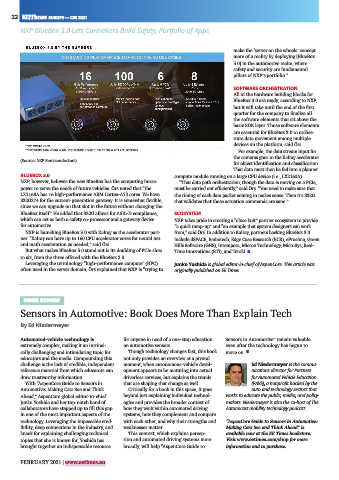
               (Source: NXP Semiconductors)
                                                                                          for object identification and classification.
                                                                                          That data must then be fed into a planner
               BLUEBOX 3.0                                           compute module running on a large CPU device (i.e., LX2160A).
               NXP, however, believes the new BlueBox has the computing horse-  “That data path orchestration, though the data is moving on a PCIe,
               power to serve the needs of future vehicles. Örs noted that “the   must be carried out efficiently,” said Örs. “You need to make sure that
               LX2168A has 16 high-performance ARM Cortex-A72 cores. We have   the timing of each data packet coming in makes sense. Then it’s S32G
               S32G274 for the current-generation gateway. It is somewhat flexible,   that validates that those actuation commands are sane.”
               since we can upgrade on that slot in the future without changing the
               BlueBox itself.” He added that S32G allows for ASIL-D compliance,   ECOSYSTEM
               which can act as both a safety co-processor and a gateway device    NXP takes pride in creating a “close knit” partner ecosystem to provide
               for automotive.                                       “a quick ramp-up” and “an example that system designers can work
                 NXP is launching BlueBox 3.0 with Kalray as the accelerator part-  from,” said Örs. In addition to Kalray, partners backing BlueBox 3.0
               ner. “Kalray can have up to 160 CPU accelerator cores for neural net   include dSPACE, Embotech, Edge Case Research (ECR), eProsima, Green
               and math acceleration as needed,” said Örs.           Hills Software (GHS), Intempora, Micron Technology, MicroSys, Real-
                 But what makes BlueBox 3.0 stand out is its doubling of PCIe slots   Time Innovations (RTI), and Teraki. ■
               to six, from the three offered with the BlueBox 2.0.
                 Leveraging the terminology “high-performance compute” (HPC)   Junko Yoshida is global editor-in-chief of AspenCore. This article was
               often used in the server domain, Örs explained that NXP is “trying to   originally published on EE Times.


                BOOK REVIEW

               Sensors in Automotive: Book Does More Than Explain Tech

               By Ed Niedermeyer

               Automated-vehicle technology is     for anyone in need of a one-stop education   Sensors in Automotive” remain valuable
               extremely complex, making it an intrinsi-  on automotive sensors.       even after the technology has begun to
               cally challenging and intimidating topic for   Though technology changes fast, this book   move on. ■
               educators and the media. Compounding this   not only provides an overview at a pivotal
               challenge is the lack of credible, independent   moment, when autonomous-vehicle devel-  Ed Niedermeyer is the commu-
               reference material from which educators can   opment appears to be maturing into actual   nications director for Partners
               draw trustworthy information.       driverless services, but explains the trends   for Automated Vehicle Education
                 With “AspenCore Guide to Sensors in   that are shaping that change as well.    (PAVE), a nonprofit backed by the
               Automotive: Making Cars See and Think   Critically for a book in this space, it goes   auto and technology sectors that
               Ahead,” AspenCore global editor-in-chief   beyond just explaining individual technol-  works to educate the public, media, and policy-
               Junko Yoshida and her top-notch band of   ogies and provides the broader context of   makers. Niedermeyer is also the co-host of The
               collaborators have stepped up to fill this gap   how they work within automated driving   Autonocast mobility technology podcast.
               in one of the most important aspects of the   systems, how they complement and compare
               technology. Leveraging the impeccable cred-  with each other, and why their strengths and   “AspenCore Guide to Sensors in Automotive:
               ibility, deep connections in the industry, and   weaknesses matter.     Making Cars See and Think Ahead” is
               knack for explaining challenging technical   This context, which explains percep-  available now at the EE Times bookstore.
               topics that she is known for, Yoshida has   tion and automated driving systems more   Visit www.eetimes.com/shop for more
               brought together an indispensable resource   broadly, will help “AspenCore Guide to   information and to purchase.


               FEBRUARY 2021 | www.eetimes.eu

