


Page 25 - EETEurope FlipBook February
P. 25
EE|Times EUROPE — CES 2021  25


                CES 2021 REVIEW
               Automation, AI Sow the Seeds of Farming Future


               By Anne-Françoise Pelé


                    arming is as old as civilization itself and has journeyed through
                    numerous revolutions over the centuries. Today, autonomous
                    vehicles and artificial intelligence are marking the dawn of the
              F next agricultural revolution. In a spotlight session at CES 2021,
               Illinois-based machinery producer John Deere described how farmers
               are embracing the latest technologies to maximize crop yields, profit-
               ability, and a sustainable business model.
                 CES has become the transportation exhibition that sets the tone for
               the new year. OEMs and carmakers showcase innovations for electric,
               self-driving, and advanced driver-assistance systems, and for the third
               consecutive year, John Deere has rallied the community with AI-
               powered combine harvesters and sensor-fueled planters.
                 “Every day, as farmers go to the field across the world, they are
               leveraging technologies like GPS, connectivity, computer vision, and
               machine learning to make sure they can sustainably grow the food that   With self-driving tractors, John Deere aims to shift some of the detail
               everybody eats,” said Deanna Kovar, vice president of production and   work from the farmer to the machinery, freeing farmers to concentrate
               precision agriculture production at John Deere, in the CES session.   on their business priorities. Automated farm equipment is also about
                                                                     making the whole farming operation more effective and productive.
               OPERATING AUTONOMOUSLY                                With John Deere’s AutoTrack steering system, the farmer can enter the
               The concept of fully autonomous agricultural vehicles is far from   field, get started, and never touch the steering wheel the entire time
               new. “We’ve had self-driving tractors for almost 20 years,” said Jahmy   the field is being planted, according to Kovar.
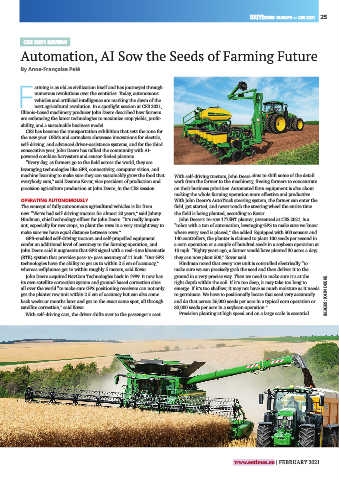
               Hindman, chief technology officer for John Deere. “It’s really import-  John Deere’s 16-row 1775NT planter, presented at CES 2021, is a
               ant, especially for row crops, to plant the rows in a very straight way to   “robot with a ton of automation, leveraging GPS to make sure we know
               make sure we have equal distance between rows.”       where every seed is placed,” she added. Equipped with 300 sensors and
                 GPS-enabled self-driving tractors and self-propelled equipment   140 controllers, the planter is claimed to plant 100 seeds per second in
               confer an additional level of accuracy to the farming operation, and   a corn operation or a couple of hundred seeds in a soybean operation at
               John Deere said it augments that GPS signal with a real-time kinematic   10 mph. “Eighty years ago, a farmer would have planted 30 acres a day;
               (RTK) system that provides pass-to-pass accuracy of ±1 inch. “Our GPS   they can now plant 500,” Kovar said.
               technologies have the ability to get us to within 2.5 cm of accuracy,”   Hindman noted that every row unit is controlled electrically “to
               whereas cellphones get to within roughly 5 meters, said Kovar.   make sure we can precisely grab the seed and then deliver it to the
                 John Deere acquired NavCom Technologies back in 1999. It now has   ground in a very precise way. Then we need to make sure it’s at the
               its own satellite correction system and ground-based correction sites   right depth within the soil. If it’s too deep, it may take too long to
               all over the world “to make sure GPS positioning receivers can not only   emerge. If it’s too shallow, it may not have as much moisture as it needs
               get the planter row unit within 2.5 cm of accuracy but can also come   to germinate. We have to positionally locate that seed very accurately   IMAGES: JOHN DEERE
               back weeks or months later and get to the exact same spot, all through   and do that across 36,000 seeds per acre in a typical corn operation or
               satellite correction,” said Kovar.                    80,000 seeds per acre in a soybean operation.”
                 With self-driving cars, the driver shifts over to the passenger’s seat.   Precision planting at high speed and on a large scale is essential


                                                                                          www.eetimes.eu | FEBRUARY 2021

