


Page 15 - EETEurope FlipBook February
P. 15
EE|Times EUROPE   15
                                                             Industrial Computing Moves to the Mission-Critical Edge


               heterogeneous, interconnected, virtualized
               set of computing resources, which can host
               the applications where needed and when
               needed. These will be deployed in the form
               of virtual machines and containers orches-
               trated from the cloud or locally.
                 Let’s discuss a specific use case at an Audi
               manufacturing plant, more specifically for
               the Audi A3. Audi’s plant in Neckarsulm,
               Germany, has 2,500 autonomous robots on its
               production line. Each robot is equipped with a
               tool of some kind, from glue guns to screw-
               drivers, and performs a specific task required
               to assemble an Audi automobile.
                 Audi assembles up to approximately 1,000
               vehicles every day at the Neckarsulm factory,
               and there are 5,000 welds in each car. To
               ensure the quality of its welds, Audi performs
               manual quality-control inspections. It is
               impossible to inspect 1,000 cars every day
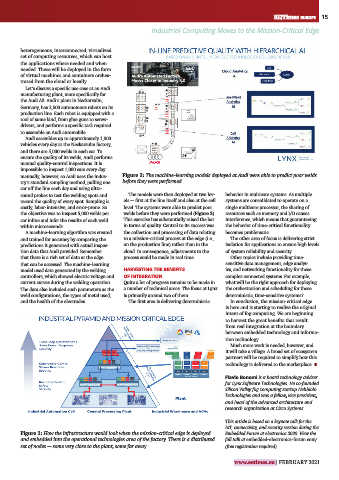
               manually, however, so Audi uses the indus-  Figure 3: The machine-learning models deployed at Audi were able to predict poor welds
               try’s standard sampling method, pulling one   before they were performed.
               car off the line each day and using ultra-
               sound probes to test the welding spots and   The models were then deployed at two lev-  behavior in multicore systems. As multiple
               record the quality of every spot. Sampling is   els — first at the line itself and also at the cell   systems are consolidated to operate on a
               costly, labor-intensive, and error-prone. So   level. The systems were able to predict poor   single multicore processor, the sharing of
               the objective was to inspect 5,000 welds per   welds before they were performed (Figure 3).   resources such as memory and I/O causes
               car inline and infer the results of each weld   This exercise has substantially raised the bar   interference, which means that guaranteeing
               within microseconds.                in terms of quality. Central to its success was   the behavior of time-critical functionality
                 A machine-learning algorithm was created   the collection and processing of data relating   becomes problematic.
               and trained for accuracy by comparing the   to a mission-critical process at the edge (i.e.,   The other area of focus is delivering strict
               predictions it generated with actual inspec-  on the production line) rather than in the   isolation for applications to ensure high levels
               tion data that Audi provided. Remember   cloud. In consequence, adjustments to the   of system reliability and security.
               that there is a rich set of data at the edge   process could be made in real time.  Other topics include providing time-
               that can be accessed. The machine-learning                              sensitive data management, edge analyt-
               model used data generated by the welding   HARVESTING THE BENEFITS      ics, and networking functionality for these
               controllers, which showed electric voltage and   OF INTEGRATION         complex connected systems. For example,
               current curves during the welding operation.   Quite a lot of progress remains to be made in   what will be the right approach for deploying
               The data also included such parameters as the   a number of technical areas. The focus at Lynx   the orchestration and scheduling for these
               weld configurations, the types of metal used,   is primarily around two of them.   deterministic, time-sensitive systems?
               and the health of the electrodes.     The first area is delivering deterministic   In conclusion, the mission-critical edge
                                                                                       is here and is starting to realize the original
                                                                                       intent of fog computing. We are beginning
                                                                                       to harvest the great benefits that result
                                                                                       from real integration at the boundary
                                                                                       between embedded technology and informa-
                                                                                       tion technology.
                                                                                         Much more work is needed, however, and
                                                                                       it will take a village. A broad set of ecosystem
                                                                                       partners will be required to simplify how this
                                                                                       technology is delivered to the marketplace. ■

                                                                                       Flavio Bonomi is a board technology adviser
                                                                                       for Lynx Software Technologies. He co-founded
                                                                                       Silicon Valley fog computing startup Nebbiolo
                                                                                       Technologies and was a fellow, vice president,
                                                                                       and head of the advanced architecture and
                                                                                       research organization at Cisco Systems.

                                                                                       This article is based on a keynote talk for the
                                                                                       IoT, connectivity, and security session during the
               Figure 2: How the infrastructure would look when the mission-critical edge is deployed   Embedded Forum at electronica 2020. View the
               and embedded into the operational technologies area of the factory. There is a distributed   full talk at embedded-electronics-forum.com/
               set of nodes — some very close to the plant, some far away.             (free registration required).


                                                                                          www.eetimes.eu | FEBRUARY 2021

