


Page 14 - EETEurope FlipBook February
P. 14
14 EE|Times EUROPE


                EMBEDDED
               Industrial Computing Moves to the

               Mission-Critical Edge


               By Flavio Bonomi


                      cross a range of industries and
                      specifically in the industrial
                      automation vertical, there is
               A broad agreement that the deploy-
               ment of modern computing resources with
               cloud-native models of software life-
               cycle management will become ever-more
               pervasive. Placing virtualized computing
               resources nearer to where multiple streams
               of data are created is well-established as the
               path to address system latency, privacy, cost,
               and resiliency challenges that a pure cloud
               computing approach cannot address. This
               paradigm shift was initiated at Cisco Systems
               around 2010 under the label “fog computing”
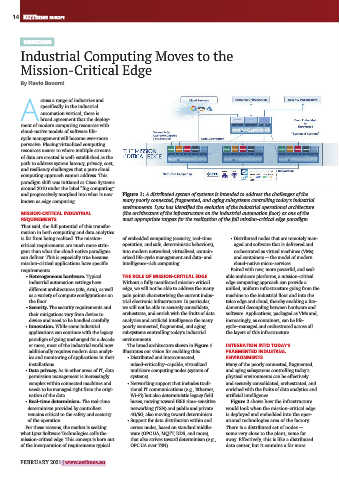
               and progressively morphed into what is now   Figure 1: A distributed system of systems is intended to address the challenges of the
               known as edge computing.            many poorly connected, fragmented, and aging subsystems controlling today’s industrial
                                                   environments. Lynx has identified the evolution of the industrial operational architecture
               MISSION-CRITICAL INDUSTRIAL         (the architecture of the infrastructure on the industrial automation floor) as one of the
               REQUIREMENTS                        most appropriate targets for the realization of the full mission-critical edge paradigm.
               That said, the full potential of this transfor-
               mation in both computing and data analytics
               is far from being realized. The mission-   of embedded computing (security, real-time   •  Distributed nodes that are remotely man-
               critical requirements are much more strin-  operation, and safe, deterministic behaviors),   aged and software that is delivered and
               gent than what the cloud-native paradigms   into modern networked, virtualized, contain-  orchestrated as virtual machines (VMs)
               can deliver. This is especially true because   erized life-cycle management and data- and   and containers — the model of modern
               mission-critical applications have specific   intelligence-rich computing.  cloud-native micro-services
               requirements:                                                             Paired with new, more powerful, and scal-
                 •  Heterogeneous hardware. Typical   THE ROLE OF MISSION-CRITICAL EDGE  able multicore platforms, a mission- critical
                  industrial automation settings have   Without a fully manifested mission-critical   edge computing approach can provide a
                  different architectures (x86, Arm), as well   edge, we will not be able to address the many   unified, uniform infrastructure going from the
                  as a variety of compute configurations on   pain points characterizing the current indus-  machine to the industrial floor and into the
                  the floor.                       trial electronic infrastructure. In particular,   telco edge and cloud, thereby enabling a fun-
                 •  Security. The security requirements and   we will not be able to securely consolidate,   damental decoupling between hardware and
                  their mitigations vary from device to   orchestrate, and enrich with the fruits of data   software. Applications, packaged as VMs and,
                  device and need to be handled carefully.  analytics and artificial intelligence the many   increasingly, as containers, can be life-
                 •  Innovation. While some industrial   poorly connected, fragmented, and aging   cycle–managed and orchestrated across all
                  applications can continue with the legacy   subsystems controlling today’s industrial   the layers of this infrastructure.
                  paradigm of going unchanged for a decade   environments.
                  or more, most of the industrial world now   The broad architecture shown in Figure 1   INTEGRATION INTO TODAY’S
                  additionally requires modern data analyt-  illustrates our vision for enabling this:  FRAGMENTED INDUSTRIAL
                  ics and monitoring of applications in their   •  Distributed and interconnected,   ENVIRONMENTS
                  installations.                      mixed-criticality–capable, virtualized   Many of the poorly connected, fragmented,
                 •  Data privacy. As in other areas of IT, data   multicore computing nodes (system of   and aging subsystems controlling today’s
                  permission management is increasingly   systems)                     physical environments can be effectively
                  complex within connected machines and   •  Networking support that includes tradi-  and securely consolidated, orchestrated, and
                  needs to be managed right from the origi-  tional IT communications (e.g., Ethernet,   enriched with the fruits of data analytics and
                  nation of the data.                 Wi-Fi) but also deterministic legacy field   artificial intelligence.

                 • Real-time determinism. The real-time   buses, moving toward IEEE time-sensitive   Figure 2 shows how the infrastructure
                  determinism provided by controllers   networking (TSN) and public and private   would look when the mission-critical edge
                  remains critical to the safety and security   4G/5G, also moving toward determinism  is deployed and embedded into the oper-
                  of the operation.                  •  Support for data distribution within and   ational technologies area of the factory.
                 For these reasons, the market is seeking   across nodes, based on standard middle-  There is a distributed set of nodes —
               what Lynx Software Technologies calls the   ware (OPC UA, MQTT, DDS, and more),   some very close to the plant, some far
               mission-critical edge. This concept is born out   that also strives toward determinism (e.g.,   away. Effectively, this is like a distributed
               of the incorporation of requirements typical   OPC UA over TSN)         data center, but it contains a far more


               FEBRUARY 2021 | www.eetimes.eu

