


Page 41 - PEN eBook May 2023
P. 41
SEMICONDUCTORS                                                                                    SEMICONDUCTORS

 THE PRICE OF ENTRY  EVERY DROP IS PRECIOUS  “upstream” category of “Scope 3” emissions, as defined   highly popular with customers. “Four out of four of
 The baseline technical standards required for   With dried-up lakes and rivers making worldwide   by the widely used Greenhouse Gas Protocol. Factors   the customers I spoke with today inquired about
 the infrastructure in a semiconductor fab are   news last summer, it has never been more obvious that   like energy use for production or transportation on   this capability, which significantly decreases overall
 high to begin with. The slightest contamination   responsible use of water is essential. To continue and   the part of a supplier are part of the purchaser’s   construction duration,” Sinclair said.
 from dust can jeopardize product quality, so fabs   even increase water-hungry semiconductor production,   responsibility, even though they have no direct control
 typically operate under the cleanest of “cleanroom”   it will be equally essential to adopt a recycling mindset   over those activities. The large-scale investment   To facilitate the construction process for customers,
 conditions (ISO Class 1). High purity standards must   from when shovels hit the ground.  required by a new fab therefore also calls for close   GF has invested in off-site fabrication shops close to
 also be applied to the lifeblood of a semiconductor   review of supplier sustainability practices in addition to   major construction sites and is continuing to grow the
 fab: its water supply. As the millions of transistors,   Dominik Roth, global business development manager   their technical competence.  network. With subassembly work conducted at the
 resistors and capacitors in a chip’s integrated circuit   of sustainability at GF Piping Systems, pointed out   prefabrication site, GF can deliver “laterals,” or partial
 are built up on the substrate of a silicon wafer, layer   that “circulating water to reduce consumption is   In this context, products that do not need to be   assemblies that can be transported a shorter distance
 by layer, rinsing is required at many points. This part   paramount.” And for reasons of both economics and   transported long distances to the construction site   to the factory and quickly installed on-site. Existing
 of the process is essential, as even trace amounts   community relations, semiconductor manufacturers   have great appeal. In addition to other sustainability   GF prefabrication sites in the United States include
 of impurities remaining could change the wafer’s   are taking note. Reuse of wastewater for cooling   benefits, such as lighter plastic materials and the   Shawnee, Oklahoma; Irvine, California; and Dallas.
 electrical properties.  purposes is a common first step, but interest in the   company’s ongoing progress on fronts like recycling
 more complex process of reclaiming waste streams as   and renewable electricity, GF Piping Systems’   BUILD FOR THE FUTURE
 To succeed in removing contaminants without   feedwater for UPW systems is increasing.  worldwide network of prefabrication has thus become   The major crises in human history differ in the details,
 adding new ones, fabs must use ultrapure water               but they all have one thing in common: They call for a
 (UPW) for rinsing. UPW has been purified of all other   At one time, it was common for semiconductor   reappraisal of the way things have always been done.
 molecules to the point that it very nearly approaches   manufacturers to recycle only about 40% of their   Semiconductors may be here to stay, but when, where
 100% H O. Approximately 1,400–1,600 gallons of   wastewater, forcing them to find less sustainable   and how they are made will continue to evolve. Every
 2
 municipal water are needed to create 1,000 gallons   treatment and disposal strategies for large volumes   element in the process, right down to the pipes moving
 of UPW. The resulting product’s chemical properties   of water contaminated with toxic solvents or heavy   water though the factory, will come under increased
 are so different from tap water (including its   metals. But by the mid-2010s, TSMC was able to report   scrutiny in years to come. But as a generational
 resistivity of 18.2 MΩ) that it is not safe for humans   process-water–recycling rates of over 85%. Similarly,   investment in capacity takes place across the U.S.,
 to consume.  for 2021, Intel reported using 16 billion gallons of fresh,   another rare chance presents itself as well—the
 reclaimed or desalinated water for manufacturing—but         chance to build a more sustainable future, right from
 Given the effort and expense involved in buying or   also reported returning 13 billion gallons to surrounding   the ground up.
 creating UPW (which requires an elaborate three-  communities or the environment.
 stage process to make), semiconductor fabs must
 also ensure that their fluid transport systems   Planning for on-site water recycling at the
 meet equally high standards to avoid reintroducing   construction stage can thus build sustainability into
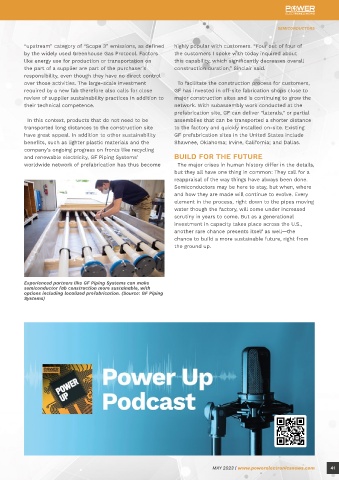
 unwanted substances. A single fab site may include   a plant’s operations right from the beginning, and   Experienced partners like GF Piping Systems can make
 up to 40 km of piping for the transport of UPW, and   here again, an experienced design partner can help.   semiconductor fab construction more sustainable, with
          options including localized prefabrication. (Source: GF Piping
 the conditions under which that piping was made   With expertise in both process automation and fluid   Systems)
 matter just as much as conditions in the fab itself.  transport, “GF has been supporting the semiconductor
 industry’s efforts to build the most sustainably
 As noted by Ted Sinclair, global sales manager for   managed fabrication factories for more than 30 years,”
 microelectronics at GF Piping Systems, any source   Sinclair said. “Thoughtful collaboration and system
 of contamination is unacceptable “in a process   modeling from early in the project, with a vertically
 where the distance between each transistor is   integrated single partner from system design through
 measured in nanometers. Our components make   product manufacturing—that can really elevate the
 sure that nothing impure makes its way into the   final result.”
 manufacturing process on a molecular basis. The
 reality is, it’s both the high-purity resin we use and   MAKE IT WHERE YOU NEED IT
 the purity of the pipe-extrusion environment, the   Perhaps unsurprisingly, the overall energy demands
 cleanroom in which we extrude the pipe, that deliver   of semiconductor manufacturing are considerable.
 the high-purity results our customers demand.”  A typical fab might use as much power in a year as
 50,000 homes. A “megafab” might draw power more on
 The Sygef Plus fluoropolymer piping system   the scale of an auto plant or oil refinery. To find ways
 is manufactured by GF from carefully screened   to limit emissions, creative thinking may be required,
 materials under ISO Class 5 cleanroom conditions.   and examining all aspects of the supply chain is a
 Rigorous testing, special packaging measures and   must.
 highly reliable jointing technologies for assembly
 also serve to ensure the high purity of final   Typically, about 20% of the greenhouse gas emissions
 installations.  associated with a semiconductor fab belong to the

 40  MAY 2023 | www.powerelectronicsnews.com                                MAY 2023 | www.powerelectronicsnews.com  41

