


Page 37 - PEN eBook May 2023
P. 37
DESIGN                                                                                                   DESIGN

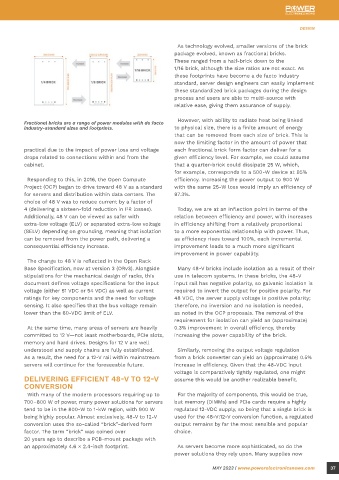
                                                               As technology evolved, smaller versions of the brick
                                                              package evolved, known as fractional bricks.
                                                              These ranged from a half-brick down to the
                                                              1/16 brick, although the size ratios are not exact. As
                                                              these footprints have become a de facto industry
                                                              standard, server design engineers can easily implement
                                                              these standardized brick packages during the design
                                                              process and users are able to multi-source with
                                                              relative ease, giving them assurance of supply.


                                                               However, with ability to radiate heat being linked
          Fractional bricks are a range of power modules with de facto
          industry-standard sizes and footprints.             to physical size, there is a finite amount of energy
                                                              that can be removed from each size of brick. This is
 Supporting 48-V   practical due to the impact of power loss and voltage   now the limiting factor in the amount of power that
                                                              each fractional brick form factor can deliver for a
                                                              given efficiency level. For example, we could assume
          drops related to connections within and from the
 Conversion in Data   cabinet.                                that a quarter-brick could dissipate 25 W, which,
                                                              for example, corresponds to a 500-W device at 95%
                                                              efficiency. Increasing the power output to 900 W
           Responding to this, in 2016, the Open Compute
 Center Computing,   Project (OCP) began to drive toward 48 V as a standard   with the same 25-W loss would imply an efficiency of
                                                              97.3%.
          for servers and distribution within data centers. The
          choice of 48 V was to reduce current by a factor of
                                                               Today, we are at an inflection point in terms of the
 Telecoms  4 (delivering a sixteen-fold reduction in I2R losses).   relation between efficiency and power, with increases
          Additionally, 48 V can be viewed as safer with
          extra-low voltage (ELV) or separated extra-low voltage
                                                              in efficiency shifting from a relatively proportional
          (SELV) depending on grounding, meaning that isolation   to a more exponential relationship with power. Thus,
 System architects are looking for improved   can be removed from the power path, delivering a   as efficiency rises toward 100%, each incremental
          consequential efficiency increase.
                                                              improvement leads to a much more significant
 power-conversion efficiencies that support higher   The change to 48 V is reflected in the Open Rack   improvement in power capability.

                                                               Many 48-V bricks include isolation as a result of their
 rack-power ratings while driving down energy use,   Base Specification, now at version 3 (ORv3). Alongside   use in telecom systems. In these bricks, the 48-V
          stipulations for the mechanical design of racks, this
 minimizing thermal dissipation and reducing ongoing   document defines voltage specifications for the input   input rail has negative polarity, so galvanic isolation is
          voltage (either 51 VDC or 54 VDC) as well as current
                                                              required to invert the output for positive polarity. For
 operating costs.  ratings for key components and the need for voltage   48 VDC, the server supply voltage is positive polarity;
          sensing. It also specifies that the bus voltage remain
                                                              therefore, no inversion and no isolation is needed,
          lower than the 60-VDC limit of ELV.                 as noted in the OCP proposals. The removal of the
 By Andy Brown, director of technical marketing for DC/DC products for industrial   requirement for isolation can yield an (approximate)
 power at Advanced Energy  At the same time, many areas of servers are heavily   0.3% improvement in overall efficiency, thereby
          committed to 12 V—not least motherboards, PCIe slots,   increasing the power capability of the brick.
          memory and hard drives. Designs for 12 V are well
 The requirements for powering a modern server are   is to reduce the total cost of ownership of the entire   understood and supply chains are fully established.   Similarly, removing the output voltage regulation
 largely defined by the computing capability of that   system and increase the functionality and performance   As a result, the need for a 12-V rail within mainstream   from a brick converter can yield an (approximate) 0.5%
 server. As the servers become more capable, their   of the server.  servers will continue for the foreseeable future.  increase in efficiency. Given that the 48-VDC input
 power requirements also increase. Efficiency is critical,    voltage is comparatively tightly regulated, one might
 as it not only reduces operating expenses but allows   Traditionally, data center power solutions convert   DELIVERING EFFICIENT 48-V TO 12-V   assume this would be another realizable benefit.
 for smaller power solutions with enhanced power   incoming grid supply voltage to lower-voltage   CONVERSION
 density.  three-phase mains voltage that is converted locally   With many of the modern processors requiring up to   For the majority of components, this would be true,
 in rack-mounted servers to 12 VDC (the preferred   700–800 W of power, many power solutions for servers   but memory (DIMMs) and PCIe cards require a highly
 With high capital costs for equipment and space and   voltage for many components, including motherboards   tend to be in the 800-W to 1-kW region, with 900 W   regulated 12-VDC supply, so being that a single brick is
 rising energy costs, incremental efficiency gains make   and peripherals like hard drives). However, with some   being highly popular. Almost exclusively, 48-V to 12-V   used for the 48-V:12-V conversion function, a regulated
 a significant impact for server farms, where thousands   19-inch rack cabinets now requiring 30 kW, a 12-V   conversion uses the so-called “brick”-derived form   output remains by far the most sensible and popular
 of servers are deployed simultaneously. Increased   distribution voltage presents challenges for distributing   factor. The term “brick” was coined over   choice.
 efficiency also reduces the load for air conditioning   and converting power from AC/DC converters mounted   20 years ago to describe a PCB-mount package with
 for cooling the building, saving capital and operating   in a sub-rack, which is remote from the server. Current,   an approximately 4.6 × 2.4-inch footprint.  As servers become more sophisticated, so do the
 expenses. Ultimately, the goal for any power solution   for example, can reach 2,500 A, which is far from   power solutions they rely upon. Many supplies now

 36  MAY 2023 | www.powerelectronicsnews.com                                MAY 2023 | www.powerelectronicsnews.com  37

