


Page 43 - PEN eBook May 2023
P. 43
SEMICONDUCTORS                                                                                    SEMICONDUCTORS

           Compared with D2PAK technology, based on wire      exponentially more transistors while reducing the
          bond, LFPAK offers the following benefits:          supply voltage. Because the standard SO-8 transistor
                                                              package couldn’t handle it all, power supply designs
           ▶  Prevents localized current crowding             had to become more complex, using larger packages
                                                              like DPAK and even D2PAK.
           ▶  Allows for a more uniform current spread
                                                               To replace DPAK or D2PAK, LFPAK56 was developed
           ▶  Acts as a heatsink to the die                   to provide greater power from the widespread SO-8
                                                              package footprint. Despite having less than half the
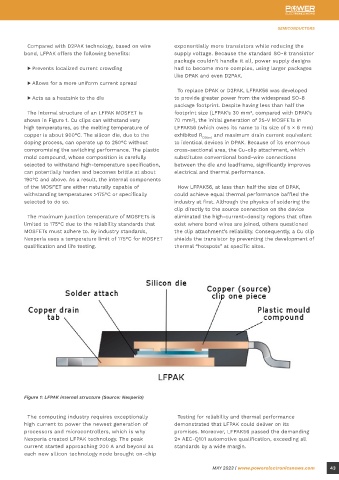
           The internal structure of an LFPAK MOSFET is       footprint size (LFPAK’s 30 mm2, compared with DPAK’s
          shown in Figure 1. Cu clips can withstand very      70 mm2), the initial generation of 25-V MOSFETs in
          high temperatures, as the melting temperature of    LFPAK56 (which owes its name to its size of 5 × 6 mm)
          copper is about 900°C. The silicon die, due to the   exhibited R DS(on)  and maximum drain current equivalent
          doping process, can operate up to 250°C without     to identical devices in DPAK. Because of its enormous
          compromising the switching performance. The plastic   cross-sectional area, the Cu-clip attachment, which
          mold compound, whose composition is carefully       substitutes conventional bond-wire connections
          selected to withstand high-temperature specification,   between the die and leadframe, significantly improves
          can potentially harden and becomes brittle at about   electrical and thermal performance.
          190°C and above. As a result, the internal components
          of the MOSFET are either naturally capable of        How LFPAK56, at less than half the size of DPAK,
 Cu-Clip Package   withstanding temperatures >175°C or specifically   could achieve equal thermal performance baffled the
          selected to do so.
                                                              industry at first. Although the physics of soldering the
                                                              clip directly to the source connection on the device
 Technology Empowers   limited to 175°C due to the reliability standards that   eliminated the high-current–density regions that often
           The maximum junction temperature of MOSFETs is
                                                              exist where bond wires are joined, others questioned
          MOSFETs must adhere to. By industry standards,
                                                              the clip attachment’s reliability. Consequently, a Cu clip
 WBG Devices  Nexperia uses a temperature limit of 175°C for MOSFET   shields the transistor by preventing the development of
          qualification and life testing.
                                                              thermal “hotspots” at specific sites.


 By Maurizio Di Paolo Emilio, editor-in-chief of Power Electronics News

 Strengthened by the innovations introduced with   wires. Over 400 devices spanning seven design
 copper (Cu)-clip package (CCPAK) technology, Nexperia   variants, or about 90% of Nexperia’s product line, are
 brings its long-time experience producing high-quality   LFPAK-based and contribute to a design’s overall
 and robust SMD packaging to its gallium nitride FET   efficiency.
 portfolio. Based on proven technology, CCPAK provides
 industry-leading performance in a   IT ALL STARTED WITH LFPAK
 wire-bond–free package optimized for thermal and   In automotive and industrial applications, the need
 electrical performance, simplifying the design of   for high power has increased in modern electronics.
 cascode configuration and eliminating the need for   Kilowatt power output is a typical requirement for
 complicated drivers and controls.  applications like motor drives, inverters or on-board
 chargers. This means the need to handle greater
 Nexperia introduced LFPAK technology in 2002.   power is being transferred to the components,
 This was a remarkable and radical departure from   especially MOSFETs, due to existing space constraints
 the designs of the day because of the characteristic   in modules.
 continuous clip and gull-wing terminal pins. Very low
 electrical and thermal resistance at the PCB level,   LFPAK technology was designed to address the   Figure 1: LFPAK internal structure (Source: Nexperia)
 along with a new low level of R DS(on) , has been made   challenging requirements coming from power
 possible thanks to this technology.  electronics applications. Compared with conventional
 wire-bond devices, LFPAK offers several advantages,   The computing industry requires exceptionally   Testing for reliability and thermal performance
 Surprisingly, it required some persuading to convince   including compact size, higher power density and   high current to power the newest generation of   demonstrated that LFPAK could deliver on its
 the industry that a device just half as big as its   reduced parasitic inductance. Based on Cu-clip bond   processors and microcontrollers, which is why   promises. Moreover, LFPAK56 passed the demanding
 predecessor (DPAK) could have the same thermal   technology, these packages have played an essential   Nexperia created LFPAK technology. The peak   2× AEC-Q101 automotive qualification, exceeding all
 performance but better electrical performance and   role in allowing silicon-based MOSFETs to achieve   current started approaching 200 A and beyond as   standards by a wide margin.
 that the novel Cu clip was more reliable than bond   very high-current capability.  each new silicon technology node brought on-chip

 42  MAY 2023 | www.powerelectronicsnews.com                                MAY 2023 | www.powerelectronicsnews.com  43

