


Page 23 - PEN eBook May 2022
P. 23
DESIGN                                                                                              Design


            THERMAL MANAGEMENT OF POWER DEVICES

            The  power-electronic  market  requires  increasingly  smaller,  more  efficient,  and  more  reliable
            devices. Key factors to meet these stringent requirements are a high power density (able to reduce

            both the footprint and the costs of the solution) and excellent thermal management (able to keep
            the device temperatures under control). The three main requirements of a thermal management
            system for power semiconductors are the following:


            1.  Heat shall be conducted from the device to the ambient environment with a thermal
                resistance low enough to prevent the junction temperature (T ) from increasing beyond a
                                                                            J
                specified limit. Due to the derating factor, T  is usually lower than the datasheet value.
                                                           J

            2.  Electrical isolation between the power circuit and the ambient environment shall be provided.


            3.  Thermally induced mechanical stress resulting from material coefficient of thermal expansion
                mismatch shall be absorbed.


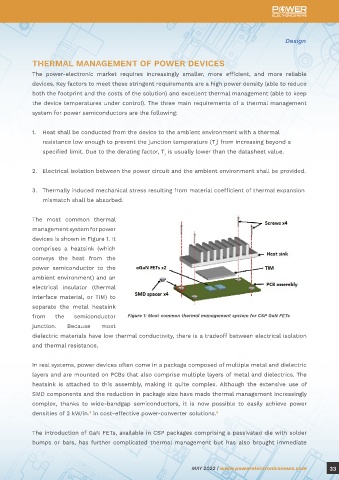
            The most common  thermal

 Simple and   management system for power
            devices is shown in Figure 1. It

            comprises a heatsink (which
 Performant Thermal   conveys the  heat  from the

            power  semiconductor to the
 Management Solution   ambient environment) and an
            electrical insulator (thermal
 for CSP GaN FETs  interface material, or TIM) to   Figure 1: Most common thermal management system for CSP GaN FETs
            separate  the metal heatsink
            from
                    the
                           semiconductor
            junction.    Because     most
 By Stefano Lovati, technical writer for EEWeb
            dielectric materials have low thermal conductivity, there is a tradeoff between electrical isolation
            and thermal resistance.
 Thanks to a better figure of merit,  wide-bandgap semiconductors such as gallium nitride offer a
 1
 higher power density than silicon, occupying less area on the die and therefore requiring a package   In real systems, power devices often come in a package composed of multiple metal and dielectric
 with smaller size. Assuming that the area occupied by the device is the main factor that determines   layers and are mounted on PCBs that also comprise multiple layers of metal and dielectrics. The
 thermal performance, it is reasonable  to assume  that a smaller power device leads  to higher   heatsink  is  attached  to  this  assembly,  making  it  quite  complex. Although  the  extensive  use  of
 thermal resistance.  This article will demonstrate how chip-scale–packaging (CSP) GaN FETs offer   SMD components and the reduction in package size have made thermal management increasingly
 3,4
 thermal performance at least equal to, if not superior to, that of silicon MOSFETs. Due to their   complex,  thanks  to  wide-bandgap  semiconductors,  it  is  now  possible  to  easily  achieve  power
 superior electrical performance, the size of GaN FETs can be reduced, increasing the power density   densities of 2 kW/in.  in cost-effective power-converter solutions. 5
                                3
 while respecting temperature limits. This behavior will be shown through detailed 3D finite element
 simulations of the PCB layout while also providing experimental verification to support the analysis.   The introduction of GaN FETs, available in CSP packages comprising a passivated die with solder
 Read the original article here. 2  bumps or bars, has further complicated thermal management but has also brought immediate


 32  MAY 2022 | www.powerelectronicsnews.com                        MAY 2022 | www.powerelectronicsnews.com          33

