


Page 28 - PEN eBook May 2022
P. 28
SEMICONDUCTORS                                                                                                                                                                                       Semiconductors


                                                                                                                                   GaN: THE ANSWER TO SILICON FOR POWER ELECTRONICS

                                                                                                                                   For decades, silicon-based power transistors such as MOSFETs formed the backbone of power-
                                                                                                                                   conversion systems that convert alternating current (AC) into direct current (DC) and vice versa, or

                                                                                                                                   DC from low voltage to high voltage and vice versa. In the quest for alternatives that can drive up
                                                                                                                                   the switching speed, gallium nitride quickly came forward as one of the leading candidate materials.
                                                                                                                                   The  GaN/AlGaN  materials  system  exhibits  a  higher  electron  mobility  and  higher  critical  electric
                                                                                                                                   field for breakdown. Combined with the high-electron–mobility transistor (HEMT) architecture, it
                                                                                                                                   results in devices and ICs that feature higher breakdown strength, faster switching speed, lower
                                                                                                                                   conductance losses, and a smaller footprint than comparable silicon solutions.
            Monolithic Integration


            of GaN Components


            Boosts Power


            Integrated Circuits


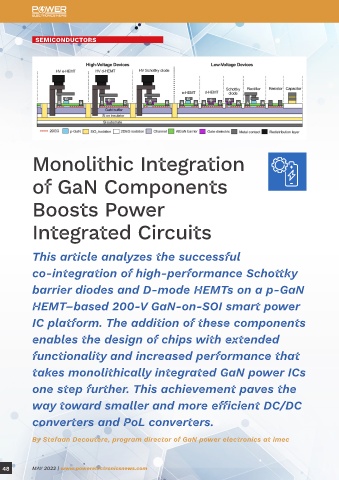
            This article analyzes the successful


            co-integration of high-performance Schottky                                                                            Schematic cross-section of imec’s 200-V GaN-on-SOI power IC technology and components. The process features
                                                                                                                                   monolithic co-integration of E-/D-mode HEMTs, Schottky diodes, resistors, and capacitors and includes advanced
                                                                                                                                   process modules (deep-trench isolation, substrate contact, redistribution layer, etc.).
            barrier diodes and D-mode HEMTs on a p-GaN

            HEMT–based 200-V GaN-on-SOI smart power                                                                                Today, most GaN power systems are formed from multiple chips. GaN-based devices are assembled
                                                                                                                                   as discrete components before they are united on a printed-circuit board. The downside of that

            IC platform. The addition of these components                                                                          approach is the presence of parasitic inductances that affect the performance of the devices.

            enables the design of chips with extended                                                                              Take a driver, for example. Discrete transistors with drivers on a separate chip suffer a lot from

                                                                                                                                   parasitic inductances between the output stages of the driver and the input of the transistor and
            functionality and increased performance that                                                                           in the switching node of half-bridges. GaN HEMTs have very high switching speed, which leads to


            takes monolithically integrated GaN power ICs                                                                          ringing — an unwanted oscillation of the signal — when the parasitic inductance is not suppressed.
                                                                                                                                   The best way to reduce the parasitics and exploit the superior switching speed of GaN is to integrate
            one step further. This achievement paves the                                                                           both driver and HEMT on the same chip.


            way toward smaller and more efficient DC/DC                                                                            At the same time, it reduces the dead-time control between two transistors in a half-bridge, wherein

            converters and PoL converters.                                                                                         one transistor has to switch off just as the other one switches on. During the time in between,
                                                                                                                                   there is a short-circuit between the power source and the ground, or dead time. Integrating all
                                                                                                                                   components on-chip will address the ringing, reduce dead time, and ultimately improve the power
            By Stefaan Decoutere, program director of GaN power electronics at imec                                                efficiency of your converter.


  48        MAY 2022 | www.powerelectronicsnews.com                                                                                                                                        MAY 2022 | www.powerelectronicsnews.com          49

