


Page 19 - PEN eBook May 2022
P. 19
SEMICONDUCTORS                                                                            Semiconductors


            However, the electrification agenda will not begin and end with cars. Wider transport applications
            will soon come into view, including trucks and buses, marine and shipping, the further electrification
            of trains, and even airplanes. On the supply side, grid-connected solar power systems and the

            transport of energy via high-voltage DC (HVDC) links will also be critical to the generation and
            distribution of low-carbon energy.


            A  common  theme  across  these  applications  is  the  potential  role  for  higher  system  voltages
            and, hence, higher-voltage power devices. In EVs, the benefit of the shift from 400 to 800 V is
            predominantly the faster charging rate possible. In solar inverters, an ongoing shift from 1,000-V to
            1,500-V systems is reducing the number of PV strings, inverters, cables, and DC junction boxes, all
            of which result in efficiency and cost savings. In gigawatt HVDC installations, in which the nominal
            voltage is several hundred kilovolts, a higher individual device rating reduces the number of devices

            required in a multilevel stack, reducing maintenance and overall system size.


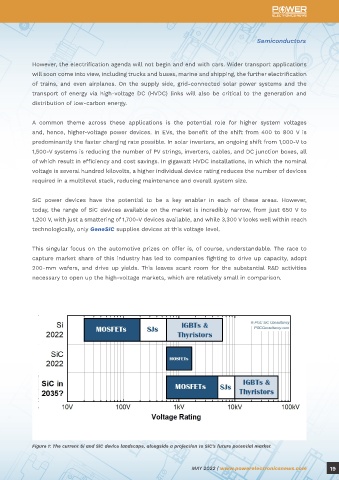
            SiC  power  devices  have  the  potential  to  be  a  key  enabler  in  each  of  these  areas.  However,
            today, the range of SiC devices available on the market is incredibly narrow, from just 650 V to
            1,200 V, with just a smattering of 1,700-V devices available, and while 3,300 V looks well within reach
            technologically, only GeneSiC supplies devices at this voltage level.


            This singular focus on the automotive prizes on offer is, of course, understandable. The race to
            capture market share of this industry has led to companies fighting to drive up capacity, adopt
            200-mm wafers,  and  drive  up yields. This  leaves  scant  room for the  substantial  R&D  activities
            necessary to open up the high-voltage markets, which are relatively small in comparison.
 SiC Power Electronics:


 Looking Beyond


 Automotive


 By Peter Gammon, professor of SiC Power Devices at the University of Warwick
 and founder of PGC Consultancy; Arne Benjamin Renz, researcher at the
 University of Warwick; and Guy Baker, researcher at the University of Warwick


 There remains little doubt  that silicon carbide, a so-called  third-generation,  wide-bandgap
 semiconductor is fulfilling its long-known potential, with the automotive industry having been the
 very public proving ground for the material in the last five years. SiC-based drivetrain inverters —
 power converters that convert DC electricity from the battery side into AC required from the motor
 side — are smaller, lighter, and more efficient than their Si IGBT–based ancestors.
            Figure 1: The current Si and SiC device landscape, alongside a projection to SiC’s future potential market


 18  MAY 2022 | www.powerelectronicsnews.com                        MAY 2022 | www.powerelectronicsnews.com          19

