


Page 21 - PEN eBook May 2022
P. 21
ENERGY                                                                                              Energy


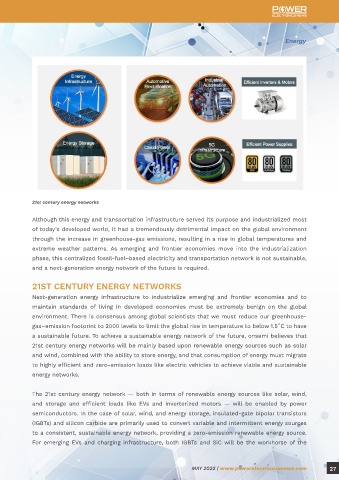
            21st century energy networks

            Although this energy and transportation infrastructure served its purpose and industrialized most
            of today’s developed world, it had a tremendously detrimental impact on the global environment
            through the increase in greenhouse-gas emissions, resulting in a rise in global temperatures and
 Addressing   extreme weather  patterns. As  emerging  and frontier  economies  move  into the  industrialization


            phase, this centralized fossil-fuel–based electricity and transportation network is not sustainable,
 Electrification Needs   and a next-generation energy network of the future is required.

            21ST CENTURY ENERGY NETWORKS
 for the 21st Century to   Next-generation  energy  infrastructure  to  industrialize  emerging  and  frontier  economies  and  to


            maintain  standards  of  living  in  developed  economies  must  be  extremely  benign  on  the  global
 Achieve a Net-Zero Future  environment. There is consensus among global scientists that we must reduce our greenhouse-
            gas–emission footprint to 2000 levels to limit the global rise in temperature to below 1.5˚C to have

            a sustainable future. To achieve a sustainable energy network of the future, onsemi believes that
 By Asif Jakwani, senior vice president and general manager of the Advance   21st century energy networks will be mainly based upon renewable energy sources such as solar
 Power Division at onsemi   and wind, combined with the ability to store energy, and that consumption of energy must migrate

            to highly efficient and zero-emission loads like electric vehicles to achieve viable and sustainable
 20TH CENTURY ENERGY NETWORKS  energy networks.

 In the 20th century, electricity was generated centrally at large power-generating stations primarily
 by burning  fossil  fuels such as coal.  The electricity  was  then  transported over long-distance   The 21st century energy network — both in terms of renewable energy sources like solar, wind,

 transmission networks and supplied  to users  via local distribution networks. Similar energy   and  storage  and  efficient  loads  like  EVs  and  inverterized  motors  —  will  be  enabled  by  power
 infrastructure emerged for transportation networks due to the proliferation of internal combustion   semiconductors. In the case of solar, wind, and energy storage, insulated-gate bipolar transistors
 engines, with fossil fuel as the primary source of energy transported over long distances across   (IGBTs) and silicon carbide are primarily used to convert variable and intermittent energy sources
 unstable and tenuous geographies.  to a consistent, sustainable energy network, providing a zero-emission renewable energy source.
            For emerging EVs and charging infrastructure, both IGBTs and SiC will be the workhorse of the


 26  MAY 2022 | www.powerelectronicsnews.com                        MAY 2022 | www.powerelectronicsnews.com          27

