


Page 24 - Power Electronics News - December 2020
P. 24
Smart Energy                                                                                                                                                                                                  Smart Energy


          Designing for energy automation (Fig. 1) introduc-   over electrical power grid functions at the dis-                  TECHNOLOGY ENABLERS                                  escalate to the controller, thereby improving

          es issues related to energy efficiency, solution     tribution level and beyond. Electric utilities with               Distribution automation (DA) systems use a va-       throughput and reaction time.
          size, system safety, and reliability of the electron-  supervisory control and data acquisition (SCADA)                riety of wired and wireless communication me-
          ics used. This whitepaper reviews the megatrends     systems have extensive control over transmis-                     dia, depending on the particular segment of the
          underlying the energy distribution automation        sion-level equipment and have increasing control                  communication network. Intelligence, networking,     CHALLENGES
          evolution and its associated system challeng-        over distribution-level equipment via distribu-                   and control are enabled by phenomenal advances       The proliferation of intelligent, internet-con-
          es, from networking protocols all the way to the     tion automation. Energy distribution automation                   in hardware and software.                            nected equipment places new requirements on
          hardware. It then examines new solutions for the     results in higher availability, serviceability, and                                                                    system hardware: reduced component size to
          power management of field devices used in ener-      predictive maintenance, as well as fault detec-                   At the field level, it is manifested through con-    fit additional electronics in the same chassis or
          gy applications through several case studies.        tion, isolation, and mitigation.                                  trollers, sensors, I/Os, and actuators. A control-   even smaller chassis, improved energy efficien-

                                                                                                                                 ler can include a programmable logic controller      cy to perform within the same or lower thermal
                                                                                                                                 (PLC), motor/motion controller, or a distributed     budget, and increased electrical/mechanical
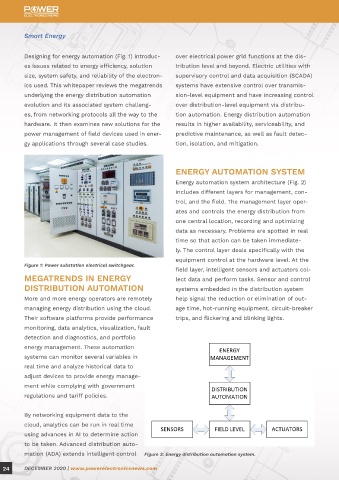
                                                               ENERGY AUTOMATION SYSTEM                                          control system (DCS) using advanced proces-          safety and reliability to reduce downtime.

                                                               Energy automation system architecture (Fig. 2)                    sors and microcontrollers. Sensors can be either
                                                               includes different layers for management, con-                    digital or analog and be used to measure tem-        In summary, the challenges for the electronic
                                                               trol, and the field. The management layer oper-                   perature, humidity, vibrations, opens, and shorts.   components are:
                                                               ates and controls the energy distribution from                    Actuators can control energy flow, temperature,

                                                               one central location, recording and optimizing                    humidity, and other parameters. Sensors and           1.   Higher energy efficiency
                                                               data as necessary. Problems are spotted in real                   actuators communicate on wire or wireless gate-
                                                               time so that action can be taken immediate-                       ways to the control center. They are powered by       2.   Reduced solution size
                                                               ly. The control layer deals specifically with the                 batteries or wired DC voltages, typically in the
                                                                                                                                                                                          I
                                                               equipment control at the hardware level. At the                   5-V to 24-V+ range. Fig. 3 shows a transformer        3.   ncreased safety and reliability
          Figure 1: Power substation electrical switchgear.
                                                               field layer, intelligent sensors and actuators col-               substation control panel with its switches, signa-
          MEGATRENDS IN ENERGY                                 lect data and perform tasks. Sensor and control                   ling lamps, sensors, and scales.
          DISTRIBUTION AUTOMATION                              systems embedded in the distribution system                                                                            In the following sections, we will present a few
          More and more energy operators are remotely          help signal the reduction or elimination of out-                  The controller receives inputs from sensors in       examples of how power management electronics

          managing energy distribution using the cloud.        age time, hot-running equipment, circuit-breaker                  the field, processes them, and drives the prop-      can come to the rescue in each case.
          Their software platforms provide performance         trips, and flickering and blinking lights.                        er actuators. Today’s sensors and actuators are
          monitoring, data analytics, visualization, fault                                                                       equipped with internal processors that make
          detection and diagnostics, and portfolio                                                                               simple decisions locally without the need to         SOLUTIONS
          energy management. These automation                                                                                                                                         High Energy Efficiency
          systems can monitor several variables in                                                                                                                                    The smaller PCB size that results from miniatur-
          real time and analyze historical data to                                                                                                                                    ization presents a challenge for thermal dissipa-

          adjust devices to provide energy manage-                                                                                                                                    tion. Thermal management options, such as heat
          ment while complying with government                                                                                                                                        sinks, are ruled out because board space is at a
          regulations and tariff policies.                                                                                                                                            premium. Fans for forced airflow cannot be used
                                                                                                                                                                                      due to sealed enclosures that prevent dust and
          By networking equipment data to the                                                                                                                                         pollutants from entering. Therefore, it is crucial
          cloud, analytics can be run in real time                                                                                                                                    that the power-supply solution is extremely effi-
          using advances in AI to determine action                                                                                                                                    cient while delivering higher power and occupying
          to be taken. Advanced distribution auto-                                                                                                                                    an area that is smaller than ever before.
          mation (ADA) extends intelligent control   Figure 2: Energy distribution automation system.                            Figure 3: Transformer substation with switches and sensors.


  24      DECEMBER 2020 | www.powerelectronicsnews.com                                                                                                                                  DECEMBER 2020 | www.powerelectronicsnews.com        25

