


Page 22 - Power Electronics News - December 2020
P. 22
Semiconductors                                                                                                                                                                                            SMART ENERGY


                                                                                                                                 Meeting the power

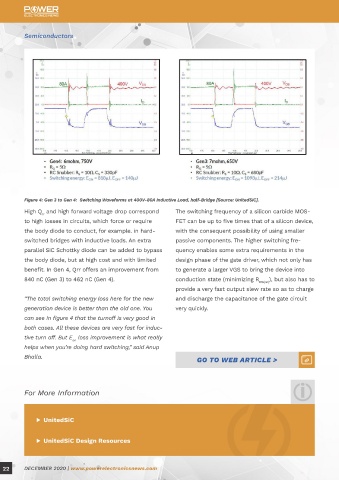
          Figure 4: Gen 3 to Gen 4:  Switching Waveforms at 400V-80A Inductive Load, half-Bridge [Source: UnitedSiC].
          High Q  and high forward voltage drop correspond     The switching frequency of a silicon carbide MOS-
                rr
          to high losses in circuits, which force or require   FET can be up to five times that of a silicon device,             challenges of the smart
          the body diode to conduct, for example. in hard-     with the consequent possibility of using smaller
          switched bridges with inductive loads. An extra      passive components. The higher switching fre-                     grid
          parallel SiC Schottky diode can be added to bypass   quency enables some extra requirements in the
          the body diode, but at high cost and with limited    design phase of the gate driver, which not only has               By Anthony T. Huynh and Nazzareno Rossetti, Maxim Integrated
          benefit. In Gen 4, Qrr offers an improvement from    to generate a larger VGS to bring the device into
          840 nC (Gen 3) to 462 nC (Gen 4).                    conduction state (minimizing R DS(on) ), but also has to
                                                               provide a very fast output slew rate so as to charge              Power grid modernization is progressing at a         ing, and management of outages, over- and un-
          “The total switching energy loss here for the new    and discharge the capacitance of the gate circuit                 steady pace. Modern control and automation tech-     der-voltages, and power factor correction.

          generation device is better than the old one. You    very quickly.                                                     niques can have significant energy savings, protect
          can see in figure 4 that the turnoff is very good in                                                                   the environment, and enhance quality of life by      Automation can improve the speed, cost, and
          both cases. All these devices are very fast for induc-                                                                 improving the health and safety of citizens. Energy   accuracy of these key distribution functions to de-
          tive turn off. But E  loss improvement is what really                                                                  distribution automation uses digital sensors and     liver reliability improvements and cost savings to
                          on
          helps when you’re doing hard switching,” said Anup                                                                     switches with advanced control and communica-        customers. This requires control of field devices to
          Bhalla.                                                     GO TO WEB ARTICLE >                                        tion technologies to automate functions including    enable automated decision-making in the field and
                                                                                                                                 electric power generation and switching, as well as   to relay critical information to the utility control

                                                                                                                                 real-time adjustments to load changes, monitor-      center.

          For More Information


                 ▶ UnitedSiC


                 ▶ UnitedSiC Design Resources


  22      DECEMBER 2020 | www.powerelectronicsnews.com                                                                                                                                  DECEMBER 2020 | www.powerelectronicsnews.com        23

