


Page 27 - Power Electronics News - December 2020
P. 27
Smart Energy                                                                                    Smart Energy


 age range must be carefully considered due to   ture sensors provide multiple benefits, including   As an example, once a fault is detected, an ac-

 tolerances and abnormal transient voltages that   identification of fault locations and causes to   tuator like the three-phase relay shown in Fig. 5
 cumulate to the maximum operating voltage. 28-  support quicker restoration efforts and proactive   can automatically break the power line.
 V, 36-V, 42-V, or 60-V input power management   actions to avoid future unplanned outages. An
 solutions are available on the market today. With   intelligent sensor provides fault detection, cap-
 a margin of only 4 V, 28 V is too close to 24 V to   tures key power quality data for day-to-day grid   SENSOR SYSTEM
 provide a reliable margin for most applications.   management, and supports renewable energy   Sensors may be located anywhere on the field.
 Many standards require 60-V tolerance, eliminat-  integration with the ability to detect and report   The sensor “box” includes a front-end transceiver
 ingg the need to make a choice. It is tempting for   on reverse power flows.   that handles data and routes power to a step-
 many designers to choose a device with a 36-V                 down voltage regulator. This delivers the appro-

 maximum input. However, using a 36-V input is                 priate voltage to the ASIC/microcontroller/FPGA,
 a high-risk approach for sensors and encoders                 the sensing element, and communication device.
 working on a 24-V rail. Even if transient voltage             A smart-grid sensor or overhead powerline sen-
 suppressor (TVS) diodes are used for surge pro-               sor uses wireless or powerline communication.
 Figure 4: Fully integrated synchronous buck converter.
 tection, they have a wide tolerance and could still           Fig. 6 shows an overhead sensor in a three-phase
 Wired energy distribution field applications are   expose equipment to excessive voltages.   powerline.
 characterized by a 24-V nominal DC voltage

 bus that has its history in old analog relays and   Unless you know and have modeled every pos-
 remains the de facto industry standard. How-  sible surge scenario resulting from long cables   SAFE LOW-VOLTAGE OPERATION
 ever, the maximum operating voltage for these   and PCB traces, use devices with a 42-V or 60-V   Most sensors are powered by a 24-VDC pow-
 applications is expected to be 36 V to 40 V for   maximum operating voltage even if the standard   er source. However, the field can be a very
 non-critical equipment, while critical equipment,   does not require it.   challenging environment, with long cables and
 such as controllers, actuators, and safety mod-               strong electromagnetic interference that result
 ules, must support 60 V (IEC 61131-2, 60664-1,   Reduced solution size  in high-voltage transients. Accordingly, the step-
 and 61508 SIL standards).   Sensors have become ubiquitous in the control   down converter inside the sensor must withstand
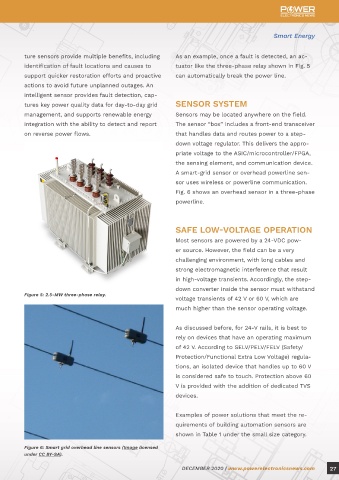
          Figure 5: 2.5-MW three-phase relay.
 environment. As they increase in sophistication               voltage transients of 42 V or 60 V, which are
 Popular output voltages are 3.3 V and 5 V with   and shrink in size, sensors are becoming more   much higher than the sensor operating voltage.
 currents that vary from 10 mA in small sensors   complex, requiring on-board voltage regulators to
 to tens of amps in motion control, computer   deliver power more efficiently with minimal heat   As discussed before, for 24-V rails, it is best to
 numerical control (CNC), and PLC applications.   generation.   rely on devices that have an operating maximum
 Thus, the obvious choice for control applications             of 42 V. According to SELV/PELV/FELV (Safety/
 is a step-down (buck) voltage regulator (Fig. 4).   How do you safely deliver low-voltage power to   Protection/Functional Extra Low Voltage) regula-
 tiny sensors in high-voltage environments while               tions, an isolated device that handles up to 60 V

 Buck converters that achieve high efficiency for   minimizing solution size and maximizing efficien-  is considered safe to touch. Protection above 60
 high-performance energy systems are shown un-  cy? In this section, we will review a typical sensor   V is provided with the addition of dedicated TVS
 der the energy efficiency category in Table 1.  architecture and provide a simple solution to this   devices.
 challenge.
                                                               Examples of power solutions that meet the re-
 A WORD OF CAUTION ON                                          quirements of building automation sensors are
 MAXIMUM INPUT VOLTAGE   FIELD SENSOR APPLICATIONS             shown in Table 1 under the small size category.
 While 24 V is the nominal rail for many applica-  Strategically placed throughout the distribution
          Figure 6: Smart grid overhead line sensors (Image licensed
 tions, for energy distribution, the operating volt-  network, current, voltage, power, and tempera-  under CC BY-SA).


 26  DECEMBER 2020 | www.powerelectronicsnews.com                DECEMBER 2020 | www.powerelectronicsnews.com        27

