


Page 29 - Power Electronics News - December 2020
P. 29
Smart Energy                                                                                    Smart Energy


 However, if strong electromagnetic interference is   converters from consideration. Examples of

 present, more severe measures are in order.  60-V-rated buck converters are shown in Table 1
          under safety and reliability.
 A typical sensor power management solution uti-
 lizes TVS devices to limit the input voltage (VCC)   Increased safety and reliability:
 of the front-end buck converter. The associated   isolation
 input current peaks are reduced by the resistor   Isolated DC/DC voltage regulators are found in
 RP, a parasitic or physical element in the electric   the most diverse applications. Although an iso-
 path between the voltage transientsource (V BUS )   lated solution is more complex than a non-iso-
 and the sensor.  lated one, there is still an expectation for it to fit

          in a small space and be highly efficient. In this
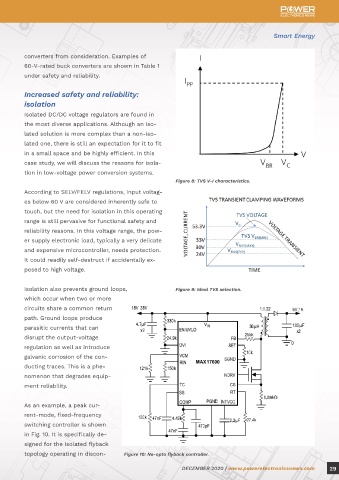
 Let’s see how to select a TVS out of the LitteI-  case study, we will discuss the reasons for isola-
 fuse catalog as an example. The general charac-  tion in low-voltage power conversion systems.
 teristics of a TVS are shown in Fig. 8.                       Figure 8: TVS V-I characteristics.
          According to SELV/FELV regulations, input voltag-
 The TVS device is an open circuit until the volt-  es below 60 V are considered inherently safe to
 age across it reaches V . At this point, it starts   touch, but the need for isolation in this operating
 BR
 to conduct current while its voltage rises slightly   range is still pervasive for functional safety and
 up to its maximum clamping voltage, V , which   reliability reasons. In this voltage range, the pow-
 C
 Table 1: Automation Sensors.  corresponds to the maximum peak pulse current   er supply electronic load, typically a very delicate
 The power path of a typical sensor system is   allowed, IPP. The product of V  × I  is the maxi-  and expensive microcontroller, needs protection.
 PP
 C
 shown in Fig. 7.  mum peak power that the TVS can handle (400   It could readily self-destruct if accidentally ex-
 W for this TVS family). For effective protection,   posed to high voltage.
 If the 24-V bus is clean or has an electric noise   the TVS V  must be above V CC(MAX) , while V  must
 C
 BR
 level below the operating voltage of the front-end   be below the switching regulator input voltage   Isolation also prevents ground loops,    Figure 9: Ideal TVS selection.
 switching regulator, no protection is necessary   breakdown.   which occur when two or more

 (no TVS in Fig. 7) and a buck converter with a   circuits share a common return
 typical max input voltage of 36 V or 42 V is suffi-  Our V BUS  supply is 24 V +25%, –20%, with 30 V   path. Ground loops produce
 cient for this sensor design.  maximum (V BUS(MAX) ). Ideally, with a 60-V-rated   parasitic currents that can
 buck converter, a SMAJ33A   disrupt the output-voltage
 with a minimum VBR of 33   regulation as well as introduce
 V can be used (as well as a   galvanic corrosion of the con-
 clamp voltage VC of 53.3 V,   ducting traces. This is a phe-

 which is well below 60 V). This   nomenon that degrades equip-
 gives an operating margin of 3   ment reliability.
 V above V BUS(MAX)  and 6.7 V below
 60 V (Fig. 9).  As an example, a peak cur-
          rent-mode, fixed-frequency
 The fact that the buck con-  switching controller is shown
 verter must withstand 24 VDC   in Fig. 10. It is specifically de-
 and at least a 53.3-V transient   signed for the isolated flyback

 Figure 7: Sensor power system.  removes a large group of buck   topology operating in discon-  Figure 10: No-opto flyback controller.

 28  DECEMBER 2020 | www.powerelectronicsnews.com                DECEMBER 2020 | www.powerelectronicsnews.com        29

