


Page 21 - Power Electronics News - December 2020
P. 21
Semiconductors                                                                               Semiconductors


 longer; it matured with diodes

 in power factor correction (PFC)
 circuits very rapidly.


 Silicon carbide (SiC) is a
 next-generation material that
 plans to significantly reduce
 power losses and enable higher
 power density, voltages, tem-
 peratures, and frequencies

 while reducing heat dissipation.
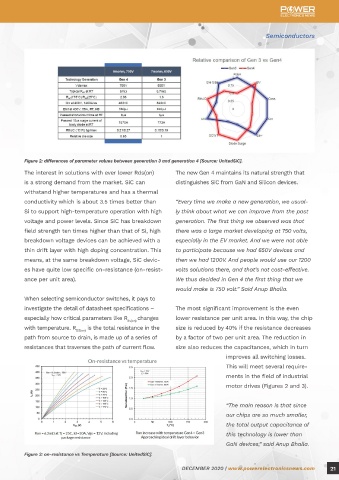
 Figure 1: SiC device market projection. [Source: Yole developpement/UnitedSiC].  High-temperature operability   Figure 2: differences of parameter values between generation 3 and generation 4 [Source: UnitedSiC].
 Major advantages of Wide Bandgap semiconductor   reduces the complexity of cooling systems and   The interest in solutions with ever lower Rds(on)   The new Gen 4 maintains its natural strength that
 power switches include high current density, faster   therefore, the overall architecture of the power   is a strong demand from the market. SiC can   distinguishes SiC from GaN and Silicon devices.
 switching, and lower drain-source on-resistance   supply system.  withstand higher temperatures and has a thermal
 (R DS(on) ). These device performance improvements   conductivity which is about 3.5 times better than   “Every time we make a new generation, we usual-
 lead to significant system-level benefits from an   UnitedSiC is focusing on some main areas such as   Si to support high-temperature operation with high   ly think about what we can improve from the past

 end-customer perspective. In real-life applications,   automotive traction inverters, the onboard chargers,   voltage and power levels. Since SiC has breakdown   generation. The first thing we observed was that
 customers can achieve high-temperature oper-  DC-to-DC converters. “We are still doing all the bat-  field strength ten times higher than that of Si, high   there was a large market developing at 750 volts,
 ation, along with overall system size and weight   tery charging business. We are pushing very hard with   breakdown voltage devices can be achieved with a   especially in the EV market. And we were not able
 reductions. A tangible difference between SiC and   our 650-volt products in the computer server busi-  thin drift layer with high doping concentration. This   to participate because we had 650V devices and
 GaN is in packaging; SiC parts are commonly avail-  ness and the 5G business. Although 5G did see some   means, at the same breakdown voltage, SiC devic-  then we had 1200V. And people would use our 1200
 able in the TO-247 and T0-220 styles. As a result,   slow down last year, hopefully, it will recover strongly   es have quite low specific on-resistance (on-resist-  volts solutions there, and that’s not cost-effective.
 they can replace Si MOSFET in existing projects.   this year. We have been pushing in the energy storage   ance per unit area).  We thus decided in Gen 4 the first thing that we
 Comparing silicon carbide (SiC) to gallium nitride   business even more than solar for renewables,” said   would make is 750 volt.” Said Anup Bhalla.
 (GaN) in particular, SiC has simply been around   Anup Bhalla, VP of Engineering at UnitedSiC.  When selecting semiconductor switches, it pays to

          investigate the detail of datasheet specifications –   The most significant improvement is the even
          especially how critical parameters like R ds(on)  changes   lower resistance per unit area. In this way, the chip
          with temperature. R DS(on)  is the total resistance in the   size is reduced by 40% if the resistance decreases
          path from source to drain, is made up of a series of   by a factor of two per unit area. The reduction in
          resistances that traverses the path of current flow.   size also reduces the capacitances, which in turn
                                                                                improves all switching losses.
                                                                                This will meet several require-

                                                                                ments in the field of industrial
                                                                                motor drives (Figures 2 and 3).


                                                                                “The main reason is that since
                                                                                our chips are so much smaller,
                                                                                the total output capacitance of
                                                                                this technology is lower than
                                                                                GaN devices,” said Anup Bhalla.

          Figure 3: on-resistance vs Temperature [Source: UnitedSiC].

 20  DECEMBER 2020 | www.powerelectronicsnews.com                DECEMBER 2020 | www.powerelectronicsnews.com        21

