


Page 13 - EE Times Europe Magazine - June 2025
P. 13
EE|Times EUROPE   13

                                        WeRide’s Robobus Reaches Barcelona as Level 4 Ambitions Accelerate


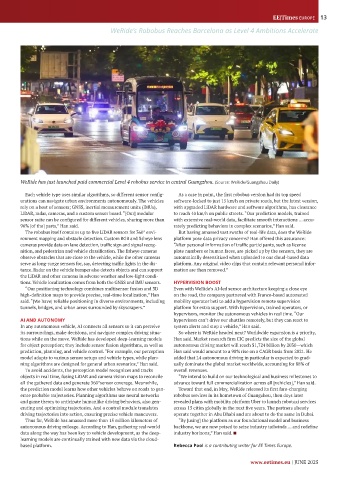
        WeRide has just launched paid commercial Level 4 robobus service in central Guangzhou. (Source: WeRide/Guangzhou Daily)

          Each vehicle type uses similar algorithms, so different sensor config-  As a case in point, the first robobus version had its top speed
        urations can navigate urban environments autonomously. The vehicles   software-locked to just 15 km/h on private roads, but the latest version,
        rely on a host of sensors; GNSS, inertial measurement units (IMUs),   with upgraded LiDAR hardware and software algorithms, has clearance
        LiDAR, radar, cameras, and a custom sensor board. “[Our] modular   to reach 40 km/h on public streets. “Our prediction models, trained
        sensor suite can be configured for different vehicles, sharing more than   with extensive real-world data, facilitate smooth interactions … accu-
        90% [of the] parts,” Han said.                        rately predicting behaviors in complex scenarios,” Han said.
          The robobus itself contains up to five LiDAR sensors for 360° envi-  But having amassed vast swaths of real-life data, does the WeRide
        ronment mapping and obstacle detection. Custom RGB and fisheye lens   platform pose data privacy concerns? Han offered this assurance:
        cameras provide data on lane detection, traffic sign and signal recog-  “After personal information of traffic participants, such as license
        nition, and pedestrian and vehicle classification. The fisheye cameras   plate numbers or human faces, are picked up by the sensors, they are
        observe obstacles that are close to the vehicle, while the other cameras   automatically desensitized when uploaded to our cloud-based data
        serve as long-range sensors for, say, detecting traffic lights in the dis-  platform. Any original video clips that contain relevant personal infor-
        tance. Radar on the vehicle bumper also detects objects and can support   mation are then removed.”
        the LiDAR and other cameras in adverse weather and low-light condi-
        tions. Vehicle localization comes from both the GNSS and IMU sensors.  HYPERVISION BOOST
          “Our positioning technology combines multisensor fusion and 3D   Even with WeRide’s AI-led sensor architecture keeping a close eye
        high-definition maps to provide precise, real-time localization,” Han   on the road, the company partnered with France-based automated
        said. “[We have] reliable positioning in diverse environments, including   mobility operator beti to add a hypervision remote supervision
        tunnels, bridges, and urban areas surrounded by skyscrapers.”  platform for extra support. With hypervision, trained operators, or
                                                              hypervisors, monitor the autonomous vehicles in real time. “Our
        AI AND AUTONOMY                                       hypervisors can’t drive our shuttles remotely, but they can react to
        In any autonomous vehicle, AI connects all sensors so it can perceive   system alerts and stop a vehicle,” Han said.
        its surroundings, make decisions, and navigate complex driving situa-  So where is WeRide headed next? Worldwide expansion is a priority,
        tions while on the move. WeRide has developed deep-learning models   Han said. Market research firm CIC predicts the size of the global
        for object perception; they include sensor fusion algorithms, as well as   autonomous driving market will reach $1,724 billion by 2030—which
        prediction, planning, and vehicle control. “For example, our perception   Han said would amount to a 98% rise on a CAGR basis from 2021. He
        model adapts to various sensor setups and vehicle types, while plan-  added that L4 autonomous driving in particular is expected to grad-
        ning algorithms are designed for general urban scenarios,” Han said.  ually dominate the global market worldwide, accounting for 88% of
          To avoid accidents, the perception model recognizes and tracks   overall revenues.
        objects in real time, fusing LiDAR and camera vision maps to reconcile   “We intend to build on our technological and business milestones to
        all the gathered data and generate 360°sensor coverage. Meanwhile,   advance toward full commercialization across all [vehicles],” Han said.
        the prediction model learns how other vehicles behave on roads to gen-  Toward that end, in May, WeRide released its first fare-charging
        erate probable trajectories. Planning algorithms use neural networks   robobus services in its hometown of Guangzhou, then days later
        and game theory to anticipate humanlike driving behaviors, also gen-  revealed plans with mobility platform Uber to launch robotaxi services
        erating and optimizing trajectories. And a control module translates   across 15 cities globally in the next five years. The partners already
        driving trajectories into action, ensuring precise vehicle maneuvers.  operate together in Abu Dhabi and are about to do the same in Dubai.
          Thus far, WeRide has amassed more than 15 million kilometers of   “By [using] the platform as our foundational model and business
        autonomous driving mileage. According to Han, gathering real-world   backbone, we are now poised to seize industry tailwinds … and redefine
        data along the way has been key to vehicle development, as the deep-   industry horizons,” Han said. ■
        learning models are continually trained with new data via the cloud-
        based platform.                                       Rebecca Pool is a contributing writer for EE Times Europe.


                                                                                         www.eetimes.eu | JUNE 2025

