


Page 11 - EE Times Europe Magazine - June 2025
P. 11
EE|Times EUROPE   11

                                                                Level 2+ Could Be a Long-Term Middle Ground


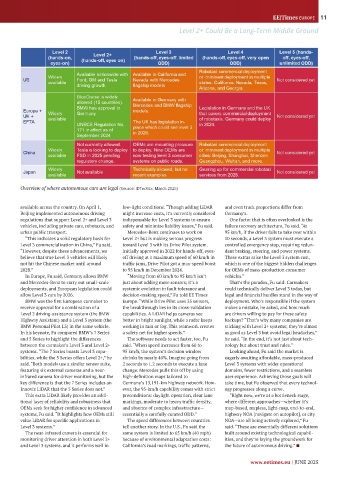
        Overview of where autonomous cars are legal (Source: IDTechEx, March 2025)


        available across the country. On April 1,   low-light conditions. “Though adding LiDAR   and even truck proportions differ from
        Beijing implemented autonomous driving   might increase costs, it’s currently considered   Germany’s.
        regulations that support Level 2+ and Level 3   indispensable for Level 3 systems to ensure   One factor that is often overlooked is the
        vehicles, including private cars, robotaxis, and   safety and minimize liability issues,” Fu said.  failure recovery architecture, Fu said. “At
        urban public transport.               Mercedes-Benz continues to work on    95 km/h, if the driver fails to take over within
          “This indicates a solid regulatory basis for   Level 2+ but is making serious progress   10 seconds, a Level 3 system must execute a
        Level 3 commercialization in China,” Fu said.   toward Level 3 with its Drive Pilot system.   controlled emergency stop, requiring redun-
        “However, despite these advancements, we   Initially approved in 2022 for hands-off, eyes-  dant braking, steering, and power systems.
        believe that true Level 3 vehicles will likely   off driving at a maximum speed of 60 km/h in   These extras raise the Level 3 system cost,
        not hit the Chinese market until around   traffic jams, Drive Pilot got a max-speed boost   which is one of the biggest hidden challenges
        2028.”                              to 95 km/h in December 2024.        for OEMs of mass-production consumer
          In Europe, Fu said, Germany allows BMW   “Moving from 60 km/h to 95 km/h isn’t   vehicles.”
        and Mercedes-Benz to carry out small-scale   just about adding more sensors; it’s a   That’s the paradox, Fu said: Carmakers
        deployments, and European legislation could   systemic evolution in fault tolerance and   could technically deliver Level 3 today, but
        allow Level 3 cars by 2026.         decision-making speed,” Fu told EE Times   legal and financial hurdles stand in the way of
          BMW was the first European carmaker to   Europe. “While Drive Pilot uses 35 sensors,   deployment. Who’s responsible if the system
        receive approval for a combination of a    the breakthrough lies in its cross-validation   makes a mistake, he asked, and how much
        Level 2 driving-assistance system (the BMW   capabilities. A LiDAR helps cameras see   are drivers willing to pay for these safety
        Highway Assistant) and a Level 3 system (the   better in bright sunlight, while a radar keeps   backups? “That’s why many companies are
        BMW Personal Pilot L3) in the same vehicle.   working in rain or fog. This teamwork creates   sticking with Level 2+ systems; they’re almost
        In his keynote, Fu compared BMW’s 7 Series   a safety net for higher speeds.”  as good as Level 3 but avoid legal headaches,”
        and 5 Series to highlight the differences   The software needs to act faster, too, Fu   he said. “In the end, it’s not just about tech-
        between the carmaker’s Level 3 and Level 2+   said. “When speed increases from 60 to    nology but about trust and rules.”
        systems. “The 7 Series boasts Level 3 capa-  95 km/h, the system’s decision window   Looking ahead, Fu said the market is
        bilities, while the 5 Series offers Level 2+,” he   shrinks by nearly 40%. Imagine going from   eagerly awaiting affordable, mass-produced
        said. “Both models use a similar sensor suite,   2 seconds to 1.2 seconds to execute a lane   Level 3 systems with wider operational
        featuring six external cameras and a near-   change. Mercedes pulls this off by using   domains, fewer restrictions, and a seamless
        infrared camera for driver monitoring, but the   high-definition maps tailored to    user experience. Achieving those goals will
        key difference is that the 7 Series includes an   Germany’s 13,191-km highway network. How-  take time, but Fu observed that every technol-
        Innoviz LiDAR that the 5 Series does not.”  ever, the 95-km/h capability comes with strict   ogy progresses along a curve.
          This extra LiDAR likely provides an addi-  preconditions: daylight operation, clear lane   “Right now, we’re at a bottleneck stage,
        tional layer of reliability and robustness that   markings, moderate to heavy traffic density,   where different approaches—whether it’s
        OEMs seek for higher confidence in advanced   and absence of complex infrastructure—  map-based, mapless, light-map, end-to-end,
        systems, Fu said. “It highlights how OEMs still   essentially a carefully curated ODD.”  highway NOA [navigate on autopilot], or city
        value LiDAR for specific applications in    The speed differences between countries   NOA—are all being actively explored,” Fu
        Level 3 systems.”                   tell another story. In the U.S., Fu said the   said. “These are essentially different solutions
          The near-infrared camera is essential for   same system is limited to 65 km/h (40 mph)   built around existing technological capabil-
        monitoring driver attention in both Level 2+   because of environmental adaptation costs:   ities, and they’re laying the groundwork for
        and Level 3 systems. and it performs well in   California’s road markings, traffic patterns,   the future of autonomous driving.” ■


                                                                                         www.eetimes.eu | JUNE 2025

