


Page 58 - EE Times Europe March 2022
P. 58
58 EE|Times EUROPE

           The Roots of Silicon Valley, Part 1: Founders, Legend, Legacy


           laid them carefully on the table. “Each of us   The capital was divided into 1,325 shares,   the following year, but by then, time had been
           should sign every bill,” he said. “These dollar   with each member of the California Group of   lost and competitors were already close to
           bills covered with signatures would be our   eight receiving 100 shares, 225 shares going   developing integrated circuits. In April 1960,
           contracts with each other.”         to Hayden Stone & Co., and the remaining   Beckman sold the unprofitable Shockley Labs
             In August of that year, in a final throw   300 shares held in reserve. Fairchild provided   to the Clevite Company, based in Waltham,
           of the funding dice, Rock and Coyle met   a loan of US$1.38 million and, to secure the   Massachusetts, bringing his association with
           with inventor and businessman Sherman   loan, the eight gave Fairchild the voting rights   the semiconductor industry to an end.
           Fairchild, founder of Fairchild Aircraft and   on their shares with the option of buying them   On July 23, 1961, Shockley was seriously
           Fairchild Camera and Instrument Co. The son   back at a fixed total price of US$3 million.  injured in a car crash and, after recovery,
           of a wealthy entrepreneurial father who had                             left the company and returned to teaching
           made his fortune as an early investor in IBM,   THE ‘TRAITOROUS EIGHT’  at Stanford. Four years later, Clevite was
           Fairchild was a bright and equally entrepre-  The eight left Shockley on Sept. 18, 1957, and   acquired by ITT. In 1969, ITT decided to move
           neurial engineer who had amassed a small   Fairchild Semiconductor was born. While   the lab to West Palm Beach, Florida, where
           fortune during World War II selling cameras   there is no documentary evidence, the group   it had an already-established semiconductor
           for reconnaissance planes. Given that he had   quickly became known as the “Traitorous   plant. When the staff refused to move, the lab
           already developed an interest in semiconduc-  Eight.” Shockley never understood the reasons   ceased to exist. ■
           tors, Fairchild sent Rock to meet his deputy,   for their defection, considering it a betrayal,
           Richard Hodgson. Risking his reputation,   and allegedly never again spoke to Noyce or   Malcolm Penn is the founder and CEO of
           Hodgson accepted Rock’s offer. Within weeks,   the others.              Future Horizons. This article was originally
           paperwork and funding for the new company,   With the help of a new team, Shockley   published on EE Times and may be viewed at
           Fairchild Semiconductor, had been completed.  brought his own diode to mass production   bit.ly/3GevfAn.


            EE TIMES 50TH ANNIVERSARY
           The Roots of Silicon Valley, Part 2:


           Planar Technology, The Fairchildren


           By Malcolm Penn, Future Horizons
           Part 2 of this three-part series looks at the evolution of planar technology; the “family
           tree” of semiconductor startups that evolved from Fairchild (the “Fairchildren”),
           including Intel; and the competition with Texas Instruments.


                                                                 to be among the top semiconductor industry leaders, spurred on by
                                                                  the successful development of the silicon planar transistor.
                                                                   Transistors, however, were already presenting a new challenge,
                                                                 dubbed the “tyranny of numbers.” If you wanted to make a simple
                                                                 flip-flop, it needed four transistors. About 10 wires were needed to
                                                                 connect them. Interconnecting two flip-flops required not only twice
                                                                 the number of transistors and wires but also four or five additional
                                                                 wires to connect the two devices. So four transistors needed 10 wires,
                                                                 eight needed 25, and 16 needed 60 to 70 wires. In other words, as the
                                                                 transistor count increased linearly, the number of connections grew
                                                                 exponentially, whereby the exponential was greater than one but less
                                                                 than two.
                                                                   While transistors were relatively easy to mass-produce, connections
                                                                 were much more difficult, as wires had to be soldered by hand and
                                                                 took up a lot of space. The industry’s desire to build bigger and more
                                                                 complex systems was stymied by the difficulty in wiring everything
                                                                 together. To this point, few had paid much attention to wiring, but
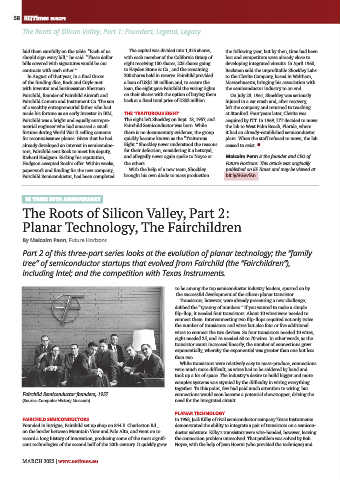
           Fairchild Semiconductor founders, 1957                connections would soon become a potential showstopper, driving the
           (Source: Computer History Museum)                     need for the integrated circuit.

                                                                 PLANAR TECHNOLOGY
           FAIRCHILD SEMICONDUCTORS                              In 1958, Jack Kilby of rival semiconductor company Texas Instruments
           Founded in intrigue, Fairchild set up shop on 844 E. Charleston Rd.,   demonstrated the ability to integrate a pair of transistors on a semicon-
           on the border between Mountain View and Palo Alto, and went on to   ductor substrate. Kilby’s transistors were wire-bonded, however, leaving
           record a long history of innovation, producing some of the most signifi-  the connection problem unresolved. That problem was solved by Bob
           cant technologies of the second half of the 20th century. It quickly grew   Noyce, with the help of Jean Hoerni (who provided the technique) and

           MARCH 2022 | www.eetimes.eu

