


Page 57 - EE Times Europe March 2022
P. 57
EE|Times EUROPE   57

                                                     The Roots of Silicon Valley, Part 1: Founders, Legend, Legacy


           Stanford — approached David Webster, head
           of Stanford’s Physics Department, for help in
           developing the Varian brothers’ idea of using
           radio-based microwaves for aircraft detec-
           tion in poor weather conditions and at night.
           Webster agreed to hire them to work at the
           university in exchange for lab space, supplies,
           and half the royalties from any patents they
           obtained. The group’s work eventually led to
           the August 1937 development of the klystron,
           subsequently adopted by Sperry, and the
           formation of Varian Associates in 1948.
             In 1938, shortly after the klystron’s devel-
           opment, Bill Hewlett and David Packard, who
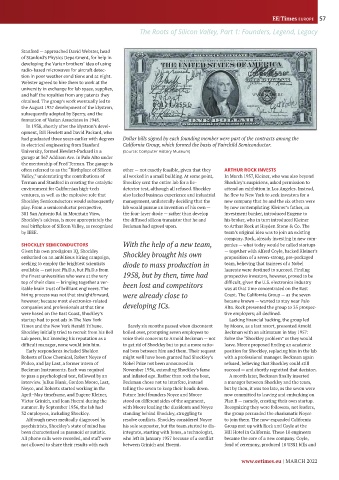
           had graduated three years earlier with degrees   Dollar bills signed by each founding member were part of the contracts among the
           in electrical engineering from Stanford    California Group, which formed the basis of Fairchild Semiconductor.
           University, formed Hewlett-Packard in a   (Source: Computer History Museum)
           garage at 367 Addison Ave. in Palo Alto under
           the mentorship of Fred Terman. The garage is
           often referred to as the “Birthplace of Silicon   other — not exactly feasible, given that they   ARTHUR ROCK INVESTS
           Valley,” understating the contributions of   all worked in a small building. At some point,   In March 1957, Kleiner, who was also beyond
           Terman and Stanford in creating the catalytic   Shockley sent the entire lab for a lie-   Shockley’s suspicions, asked permission to
           environment for Californian high-tech   detector test, although all refused. Shockley   attend an exhibition in Los Angeles. Instead,
           ventures, as well as the explosive role that   also lacked business experience and industrial   he flew to New York to seek investors for a
           Shockley Semiconductors would subsequently   management, unilaterally deciding that the   new company that he and the six others were
           play. From a semiconductor perspective,    lab would pursue an invention of his own —   by now contemplating. Kleiner’s father, an
           381 San Antonio Rd. in Mountain View,   the four-layer diode — rather than develop   investment banker, introduced Eugene to
           Shockley’s address, is more appropriately the   the diffused silicon transistor that he and   his broker, who in turn introduced Kleiner
           real birthplace of Silicon Valley, as recognized   Beckman had agreed upon.  to Arthur Rock at Hayden Stone & Co. The
           by IEEE.                                                                team’s original idea was to join an existing
                                                                                   company. Rock, already investing in new com-
           SHOCKLEY SEMICONDUCTORS             With the help of a new team,        panies — what today would be called startups
           Given his own prodigious IQ, Shockley   Shockley brought his own        — together with Alfred Coyle, backed Kleiner’s
           embarked on an ambitious hiring campaign,                               proposition of a seven-strong, pre-packaged
           seeking to employ the brightest scientists   diode to mass production in   team, believing that trainees of a Nobel
           available — not just Ph.D.s, but Ph.D.s from                            laureate were destined to succeed. Finding
           the finest universities who were at the very   1958, but by then, time had   prospective investors, however, proved to be
           top of their class — bringing together a ver-  been lost and competitors   difficult, given the U.S. electronics industry
           itable brain trust of brilliant engineers. The                          was at that time concentrated on the East
           hiring process was not that straightforward,   were already close to    Coast. The California Group — as the seven
           however; because most electronics-related                               became known — wanted to stay near Palo
           companies and professionals at that time   developing ICs.              Alto. Rock presented the group to 35 prospec-
           were based on the East Coast, Shockley’s                                tive employers; all declined.
           startup had to post ads in The New York                                   Lacking financial backing, the group led
           Times and the New York Herald Tribune.   Barely six months passed when discontent   by Moore, as a last resort, presented Arnold
           Shockley initially tried to recruit from his Bell   boiled over, prompting seven employees to   Beckman with an ultimatum in May 1957:
           Lab peers, but knowing his reputation as a   voice their concerns to Arnold Beckman — not   Solve the “Shockley problem” or they would
           difficult manager, none would join him.  to get rid of Shockley but to put a more ratio-  leave. Moore proposed finding an academic
             Early respondents included Sheldon    nal boss between him and them. Their request   position for Shockley, replacing him in the lab
           Roberts of Dow Chemical, Robert Noyce of   might well have been granted had Shockley’s   with a professional manager. Beckman again
           Philco, and Jay Last, a former intern of    Nobel Prize not been announced in    refused, believing that Shockley could still
           Beckman Instruments. Each was required   November 1956, extending Shockley’s fame   succeed — and shortly regretted that decision.
           to pass a psychological test, followed by an   and inflated ego. Rather than rock the boat,   A month later, Beckman finally inserted
           interview. Julius Blank, Gordon Moore, Last,   Beckman chose not to interfere, instead   a manager between Shockley and the team,
           Noyce, and Roberts started working in the   telling the seven to keep their heads down.   but by then, it was too late, as the seven were
           April–May timeframe, and Eugene Kleiner,   Future Intel founders Noyce and Moore   now committed to leaving and embarking on
           Victor Grinich, and Jean Hoerni during the   stood on different sides of the argument,   Plan B — namely, creating their own startup.
           summer. By September 1956, the lab had    with Moore leading the dissidents and Noyce   Recognizing they were followers, not leaders,
           32 employees, including Shockley.   standing behind Shockley, struggling to   the group persuaded the charismatic Noyce
             Although never medically diagnosed by   resolve conflicts. Shockley considered Noyce   to join them. The now-expanded California
           psychiatrists, Shockley’s state of mind has   his sole supporter, but the team started to dis-  Group met up with Rock and Coyle at the
           been characterized as paranoid or autistic.   integrate, starting with Jones, a technologist,   Hill Hotel in California. These 10 engineers
           All phone calls were recorded, and staff were   who left in January 1957 because of a conflict   became the core of a new company. Coyle,
           not allowed to share their results with each   between Grinich and Hoerni.  fond of ceremony, produced 10 US$1 bills and

                                                                                         www.eetimes.eu | MARCH 2022

