


Page 62 - EE Times Europe March 2022
P. 62
62 EE|Times EUROPE

           The Roots of Silicon Valley, Part 3: Startup Fever and Venture Capital


           IC markets, first with its µLogic RTL family   expense of the semiconductor division. The   more complex, large-scale parts with 30 gates
           and then with its 930 series DTL. In April   company suffered its ultimate humiliation in   or more, instead of simpler, small- and
           1965, Gordon Moore famously published his   July 1967, when the semiconductor industry   medium-scale devices under 30 gates — a
           article “Cramming More Components onto   fell victim to the first of its cyclical recessions,   strategy that was proving popular and suc-
           Integrated Circuits” in Electronics. Later to   during which the company lost money and   cessful with engineers. The move forced Texas
           be known as Moore’s Law, it was basically an   was forced to concede its technology leader-  Instruments to recognize the threat and copy
           extrapolation of four plots on a graph show-  ship to Texas Instruments.  all of Fairchild’s 9300 Series parts under
           ing IC transistor density over time.                                    74 series numbers (for example, the 9300
             Fairchild’s digital technology lead was,                              became the 74195 and the 9341 the 74181.)
           however, being overtaken by Texas Instru-                                 Sanders’s entire strategy collapsed, how-
           ments. Having fallen behind in RTL and                                  ever, when Hogan capitulated to Ken Olsen,
           DTL, Fairchild’s chief rival decided to copy                            founder and CEO of Digital Equipment Corp.
           Sylvania’s ultra-high performance (SHUL)                                and a key Fairchild customer. Olsen wanted
           transistor–transistor logic (TTL) circuit                               Fairchild to give up on its proprietary TTL
           design, adapting it to its own process to                               technology and instead second-source Texas
           counter the announcement of Fairchild’s                                 Instruments’ 74 Series TTL. Against
           third-generation 9000 series TTL logic.                                 Sanders’s wishes, Hogan agreed, signing the
             Headed up by Stewart Carroll, Texas                                   death warrant for Fairchild’s TTL strategy.
           Instruments set up a “design factory” that                              Sanders was, understandably, livid. “You’ve
           could churn out several new designs a week,                             just killed the company, Ken,” he fumed.
           mostly by guessing the W/L ratios, laying out                             Hogan’s betrayal was the last straw for
           the circuits, correcting them if the prototypes                         Sanders. He, together with a group of Fair-
           did not work, and zeroing in on a specifica-                            child engineers, quit to start Advanced Micro
           tion that manufacturing could support. The                              Devices. When Sanders was installed as pres-
           design factory was supported by an optical                              ident, one of his first moves was to establish
           photomask generator, as opposed to a manual                             the mantra: “People first, revenues and profits
           rubylith layout, that could quickly create a                            will follow.” Sanders also gave every employee
           photographic chip layout, as well as a “quick                           stock options in the new company, an innova-
           turn” fab line to churn out parts.                                      tion at the time.
                                                                                     Wilf Corrigan, who had moved with Hogan
           TTL DATA BOOK                                                           to Fairchild as director of Discrete Product
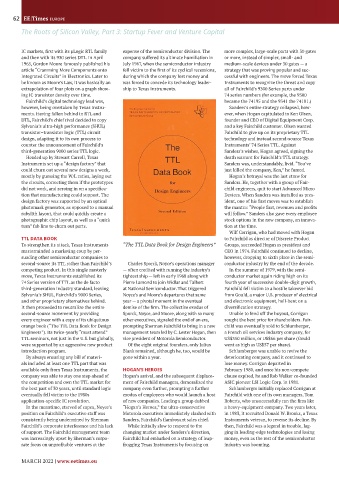
           To strengthen its attack, Texas Instruments   “The TTL Data Book for Design Engineers”  Groups, succeeded Hogan as president and
           masterminded a marketing coup by per-                                   CEO in 1974. Fairchild continued to decline,
           suading other semiconductor companies to                                however, dropping to sixth place in the semi-
           second-source its TTL rather than Fairchild’s   Charles Sporck, Noyce’s operations manager   conductor industry by the end of the decade.
           competing product. In this single masterly   — often credited with running the industry’s   In the summer of 1979, with the semi-
           move, Texas Instruments established its   tightest ship — left in early 1968 along with   conductor market again riding high on its
           74 Series version of TTL as the de facto   Pierre Lamond to join Widlar and Talbert   fourth year of successive double-digit growth,
           third-generation industry standard, leaving   at National Semiconductor. That triggered   Fairchild fell victim to a hostile takeover bid
           Sylvania’s SHUL, Fairchild’s 9000 Series,   Noyce’s and Moore’s departures that same   from Gould, a major U.S. producer of electrical
           and other proprietary alternatives behind.   year — a pivotal moment in the eventual   and electronic equipment, hell-bent on a
           It then proceeded to neutralize the entire   demise of the firm. The collective exodus of   diversification strategy.
           second-source movement by providing   Sporck, Noyce, and Moore, along with so many   Unable to fend off the buyout, Corrigan
           every engineer with a copy of its ubiquitous   other executives, signaled the end of an era,   sought the best price for shareholders. Fair-
           orange book (“The TTL Data Book for Design   prompting Sherman Fairchild to bring in a new   child was eventually sold to Schlumberger,
           Engineers”). Its twice-yearly “must attend”   management team led by C. Lester Hogan, then   a French oil services industry company, for
           TTL seminars, not just in the U.S. but globally,   vice president of Motorola Semiconductor.  US$350 million, or US$66 per share (Gould
           were supported by an aggressive new product   Of the eight original founders, only Julius   went as high as US$57 per share).
           introduction program.               Blank remained, although he, too, would be   Schlumberger was unable to revive the
             By always ensuring any bill of materi-  gone within a year.           deteriorating company, and it continued to
           als included at least one TTL part that was                             lose money. Corrigan departed in
           available only from Texas Instruments, the   HOGAN’S HEROES             February 1980, and once his non-compete
           company was able to stay one step ahead of   Hogan’s arrival, and the subsequent displace-  clause expired, he and Rob Walker co-founded
           the competition and own the TTL market for   ment of Fairchild managers, demoralized the   ASIC pioneer LSI Logic Corp. in 1981.
           the best part of 30 years, until standard logic   company even further, prompting a further   Schlumberger initially replaced Corrigan at
           eventually fell victim to the 1980s    exodus of employees who would launch a host   Fairchild with one of its own managers, Tom
           application-specific IC revolution.  of new companies. Leading a group dubbed   Roberts, who unsuccessfully ran the firm like
             In the meantime, starved of capex, Noyce’s   “Hogan’s Heroes,” the ultra-conservative   a heavy-equipment company. Two years later,
           position on Fairchild’s executive staff was   Motorola executives immediately clashed with   in 1983, it recruited Donald W. Brooks, a Texas
           consistently being undermined by Sherman   Sanders, Fairchild’s flamboyant sales chief.  Instruments veteran, to reverse its decline. By
           Fairchild’s corporate interference and his lack   While initially slow to respond to the   then, Fairchild was a legend in trouble, lag-
           of support. The Fairchild management team   changing market under Sanders’s direction,   ging in leading-edge technologies and losing
           was increasingly upset by Sherman’s corpo-  Fairchild had embarked on a strategy of leap-  money, even as the rest of the semiconductor
           rate focus on unprofitable ventures at the   frogging Texas Instruments by focusing on   industry was booming.

           MARCH 2022 | www.eetimes.eu

