


Page 56 - EE Times Europe March 2022
P. 56
56 EE|Times EUROPE


            EE TIMES 50TH ANNIVERSARY
           The Roots of Silicon Valley, Part 1:

           Founders, Legend, Legacy


           By Malcolm Penn, Future Horizons
           As part of our EE Times 50th Anniversary Special, this three-part series looks at the
           74-year history of Silicon Valley, including how it came to be; why the captains of
           the nascent industry set up shop in California; and the legacy of William Shockley

           Jr., Fairchild, and the “Fairchildren” who laid much of the foundation for the
           semiconductor industry we know today. Part 1 considers the birth of the transistor,
           how Shockley ended up in Silicon Valley, the origins of Fairchild Semiconductor, how
           the pioneering startup was funded, and what eventually happened to Shockley.


           WILLIAM SHOCKLEY JR. AND THE BIRTH   tors and four-layer (Shockley) diodes. Had he   Beckman and Shockley signed a letter of
           OF THE TRANSISTOR                   decided instead to remain on the East Coast   intent to create the Shockley Semi-
           The transistor was successfully demon-  — close to Bell Labs, MIT, or IBM in Vermont   Conductor Laboratory (the hyphenation was
           strated on Dec. 23, 1947, at Bell Laboratories   — Silicon Valley might well have developed on   then common practice) as a Beckman Instru-
           (Murray Hill, New Jersey), the research arm   the East Coast rather than the West Coast of   ments subsidiary under Shockley’s direction.
           of American Telephone and Telegraph Co.   the United States. The geographical difference   The new group would specialize in semi-
           The three Bell researchers credited with its   almost certainly would have shaped an indus-  conductors, beginning with the automated
           invention were William “Bill” Shockley Jr.;   try with a markedly different personality.  production of diffused-base transistors.
           John Bardeen, the department head and group   In Palo Alto, Shockley found a sponsor   Shockley’s original plan was to establish the
           leader; and Walter Brattain. Shockley contin-  in Raytheon, a pioneer in what came to be   laboratory in Palo Alto, close to his mother’s
           ued to work on development at Bell Labs until   known as electronic warfare. But Raytheon’s   home, but that changed when Fred Terman,
           1955 when, having foreseen the transistor’s   support was short-lived. Undeterred, Shock-  provost at Stanford University and central
           potential and looking to work for more than   ley, who had been one of Arnold Beckman’s   figure in the rise of Silicon Valley, offered him
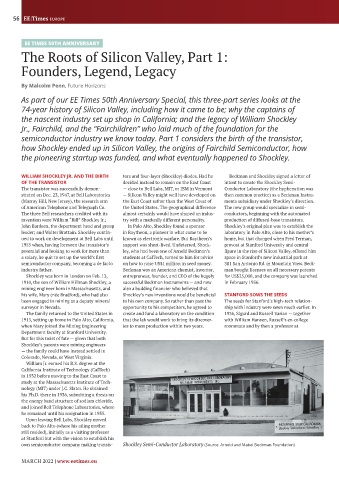
           a salary, he quit to set up the world’s first   students at CalTech, turned to him for advice   space in Stanford’s new industrial park at
           semiconductor company, becoming a de facto   on how to raise US$1 million in seed money.   381 San Antonio Rd. in Mountain View. Beck-
           industry father.                    Beckman was an American chemist, inventor,   man bought licenses on all necessary patents
             Shockley was born in London on Feb. 13,   entrepreneur, founder, and CEO of the hugely   for US$25,000, and the company was launched
           1910, the son of William Hillman Shockley, a   successful Beckman Instruments — and now   in February 1956.
           mining engineer born in Massachusetts, and   also a budding financier who believed that
           his wife, Mary (née Bradford), who had also   Shockley’s new inventions would be beneficial   STANFORD SOWS THE SEEDS
           been engaged in mining as a deputy mineral   to his own company. So rather than pass the   The seeds for Stanford’s high-tech relation-
           surveyor in Nevada.                 opportunity to his competitors, he agreed to   ship with industry were sewn much earlier. In
             The family returned to the United States in   create and fund a laboratory on the condition   1936, Sigurd and Russell Varian — together
           1913, setting up home in Palo Alto, California,   that the lab would work to bring its discover-  with William Hansen, Russell’s ex-college
           when Mary joined the Mining Engineering   ies to mass production within two years.  roommate and by then a professor at
           Department faculty at Stanford University.
           But for this twist of fate — given that both
           Shockley’s parents were mining engineers
           — the family could have instead settled in
           Colorado, Nevada, or West Virginia.
             William Jr. earned his B.S. degree at the
           California Institute of Technology (CalTech)
           in 1932 before moving to the East Coast to
           study at the Massachusetts Institute of Tech-
           nology (MIT) under J.C. Slater. He obtained
           his Ph.D. there in 1936, submitting a thesis on
           the energy band structure of sodium chloride,
           and joined Bell Telephone Laboratories, where
           he remained until his resignation in 1955.
             Upon leaving Bell Labs, Shockley moved
           back to Palo Alto (where his ailing mother
           still resided), initially as a visiting professor
           at Stanford but with the vision to establish his
           own semiconductor company making transis-  Shockley Semi-Conductor Laboratory (Source: Arnold and Mabel Beckman Foundation)

           MARCH 2022 | www.eetimes.eu

