


Page 54 - EE Times Europe March 2022
P. 54
54 EE|Times EUROPE


            SEMICONDUCTOR INDUSTRY
           Unlocking the Potential of Molecular Beam

           Epitaxy


           By Anne-Françoise Pelé


                  nprecedented demand for more
                  powerful and energy-efficient
                  devices has spurred the need for
          Ucompound semiconductors such as
           gallium arsenide, gallium nitride, and silicon
           carbide. Such materials require ultra-pure
           thin films grown by epitaxy. Although molec-
           ular beam epitaxy (MBE), one of three types of
           epitaxy equipment, has long been considered
           niche, it is poised to transition to volume
           applications.
             During a recent webinar, Riber, French
           provider of MBE equipment serving the semi-
           conductor industry, and Yole Développement,
           French research and strategy consulting firm,
           presented the current status and outlook of
           the global MBE equipment market.

           MOCVD, HTCVD, MBE
           The epitaxy equipment market is segmented
           by technology. Metal-organic chemical-
           vapor deposition (MOCVD) epitaxy equip-
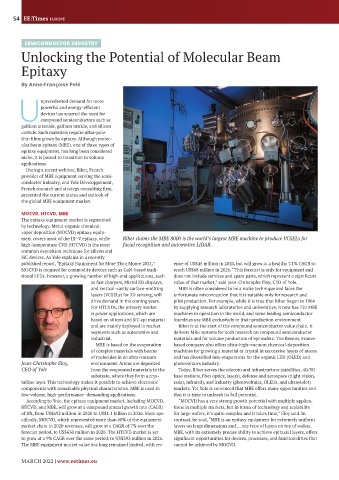
           ment covers most of the III–V epitaxy, while   Riber claims the MBE 8000 is the world’s largest MBE machine to produce VCSELs for
           high-temperature CVD (HTCVD) is the most   facial recognition and automotive LiDAR.
           common deposition technique for silicon and
           SiC devices. As Yole explains in a recently
           published report, “Epitaxy Equipment for More Than Moore 2021,”   enue of US$45 million in 2020, but will grow at a healthy 7.1% CAGR to
           MOCVD is required for commodity devices such as GaN-based tradi-  reach US$68 million in 2026. “This forecast is only for equipment and
           tional LEDs. However, a growing number of high-end applications, such   does not include services and spare parts, which represent a significant
                                    as fast chargers, MicroLED displays,   value of that market,” said Jean-Christophe Eloy, CEO of Yole.
                                    and vertical-cavity surface-emitting   MBE is often considered to be a niche technique and faces the
                                    lasers (VCSELs) for 3D sensing, will   unfortunate misconception that it is suitable only for research and
                                    drive demand in the coming years.   pilot production. For example, while it is true that Riber began in 1964
                                    For HTCVDs, the primary market   by supplying research laboratories and universities, it now has 750 MBE
                                    is power applications, which are   machines in operation in the world, and some leading semiconductor
                                    based on silicon and SiC epi material   foundries use MBE exclusively in their production environment.
                                    and are mainly deployed in market   Riber is at the start of the compound semiconductor value chain. It
                                    segments such as automotive and   delivers MBE systems for both research on compound semiconductor
                                    industrial.                  materials and for volume production of epi wafers. The Bezons, France-
                                     MBE is based on the evaporation   based company also offers ultra-high–vacuum chemical-deposition
                                    of complex materials with beams   machines for growing a material or crystal in successive layers of atoms
                                    of molecules in an ultra-vacuum   and has diversified into evaporators for the organic LED (OLED) and
           Jean-Christophe Eloy,    environment. Atoms are deposited   photovoltaics industry.
           CEO of Yole              from the evaporated materials to the   Today, Riber serves the telecom and infrastructure (satellites, 4G/5G
                                    substrate, where they form a crys-  base stations, fiber optics, lasers), defense and aerospace (night vision,
           talline layer. This technology makes it possible to achieve electronic   radar, infrared), and industry (photovoltaics, OLEDs, and ultraviolet)
           components with remarkable physical characteristics. MBE is used in   markets. Yet Yole is convinced that MBE offers many opportunities and
           low-volume, high-performance–demanding applications.  that it is time to unleash its full potential.
             According to Yole, the epitaxy equipment market, including MOCVD,   “MOCVD has a very strong growth potential with multiple applica-
           HTCVD, and MBE, will grow at a compound annual growth rate (CAGR)   tions in multiple markets, but in terms of technology and scalability
           of 8%, from US$692 million in 2020 to US$1.1 billion in 2026. More spe-  for large wafers, it’s quite complex and it takes time,” Eloy said. In
           cifically, MOCVD, which represented more than 60% of the equipment   contrast, he said, “MBE is an epitaxy equipment for extremely uniform
           market share in 2020 revenues, will grow at a CAGR of 7% over the   layers on large dimensions and … any type of layers on top of wafers.
           forecast period, to US$630 million in 2026. The HTCVD market is set   MBE, with its extremely precise ability to achieve epitaxial layers, offers
           to grow at a 9% CAGR over the same period, to US$393 million in 2026.   significant opportunities for devices, processes, and functionalities that
           The MBE equipment market value has long remained limited, with rev-  cannot be achieved by MOCVD.

           MARCH 2022 | www.eetimes.eu

