


Page 61 - EE Times Europe March 2022
P. 61
EE|Times EUROPE   61


            EE TIMES 50TH ANNIVERSARY
           The Roots of Silicon Valley, Part 3: Startup Fever

           and Venture Capital


           By Malcolm Penn, Future Horizons

           The third and final part of our series explores the legacy of Silicon Valley as a result

           of the three key inventions that changed the world in the 1960s: the integrated circuit,
           startup fever, and venture capital.


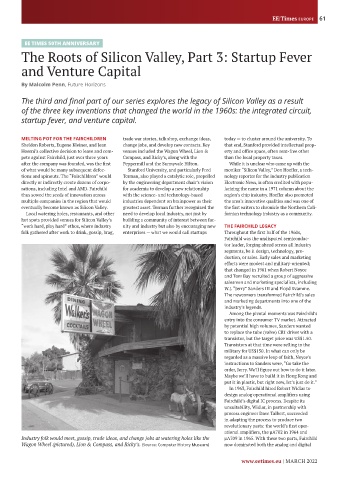
           MELTING POT FOR THE FAIRCHILDREN    trade war stories, talk shop, exchange ideas,   today — to cluster around the university. To
           Sheldon Roberts, Eugene Kleiner, and Jean   change jobs, and develop new contacts. Key   that end, Stanford provided intellectual prop-
           Hoerni’s collective decision to leave and com-  venues included the Wagon Wheel, Lion &   erty and office space, often rent-free other
           pete against Fairchild, just over three years   Compass, and Ricky’s, along with the    than the local property taxes.
           after the company was founded, was the first   Peppermill and the Sunnyvale Hilton.  While it is unclear who came up with the
           of what would be many subsequent defec-  Stanford University, and particularly Fred   moniker “Silicon Valley,” Don Hoefler, a tech-
           tions and spinouts. The “Fairchildren” would   Terman, also played a catalytic role, propelled   nology reporter for the industry publication
           directly or indirectly create dozens of corpo-  by the engineering department chair’s vision   Electronic News, is often credited with popu-
           rations, including Intel and AMD. Fairchild   for academia to develop a new relationship   larizing the name in a 1971 column about the
           thus sowed the seeds of innovation across   with the science- and technology-based   region’s chip industry. Hoefler also promoted
           multiple companies in the region that would   industries dependent on brainpower as their   the area’s innovative qualities and was one of
           eventually become known as Silicon Valley.  greatest asset. Terman further recognized the   the first writers to chronicle the Northern Cali-
             Local watering holes, restaurants, and other   need to develop local industry, not just by   fornian technology industry as a community.
           hot spots provided venues for Silicon Valley’s   building a community of interest between fac-
           “work hard, play hard” ethos, where industry   ulty and industry but also by encouraging new   THE FAIRCHILD LEGACY
           folk gathered after work to drink, gossip, brag,   enterprises — what we would call startups   Throughout the first half of the 1960s,
                                                                                   Fairchild was the undisputed semiconduc-
                                                                                   tor leader, forging ahead across all industry
                                                                                   segments, be it design, technology, pro-
                                                                                   duction, or sales. Early sales and marketing
                                                                                   efforts were modest and military-oriented;
                                                                                   that changed in 1961 when Robert Noyce
                                                                                   and Tom Bay recruited a group of aggressive
                                                                                   salesmen and marketing specialists, including
                                                                                   W.J. “Jerry” Sanders III and Floyd Kvamme.
                                                                                   The newcomers transformed Fairchild’s sales
                                                                                   and marketing departments into one of the
                                                                                   industry’s legends.
                                                                                     Among the pivotal moments was Fairchild’s
                                                                                   entry into the consumer TV market. Attracted
                                                                                   by potential high volumes, Sanders wanted
                                                                                   to replace the tube (valve) CRT driver with a
                                                                                   transistor, but the target price was US$1.50.
                                                                                   Transistors at that time were selling to the
                                                                                   military for US$150. In what can only be
                                                                                   regarded as a massive leap of faith, Noyce’s
                                                                                   instructions to Sanders were, “Go take the
                                                                                   order, Jerry. We’ll figure out how to do it later.
                                                                                   Maybe we’ll have to build it in Hong Kong and
                                                                                   put it in plastic, but right now, let’s just do it.”
                                                                                     In 1963, Fairchild hired Robert Widlar to
                                                                                   design analog operational amplifiers using
                                                                                   Fairchild’s digital IC process. Despite its
                                                                                   unsuitability, Widlar, in partnership with
                                                                                   process engineer Dave Talbert, succeeded
                                                                                   in adapting the process to produce two
                                                                                   revolutionary parts: the world’s first oper-
                                                                                   ational amplifiers, the µA702 in 1964 and
           Industry folk would meet, gossip, trade ideas, and change jobs at watering holes like the   µA709 in 1965. With these two parts, Fairchild
           Wagon Wheel (pictured), Lion & Compass, and Ricky’s. (Source: Computer History Museum)  now dominated both the analog and digital

                                                                                         www.eetimes.eu | MARCH 2022

