


Page 55 - EE Times Europe March 2022
P. 55
EE|Times EUROPE   55

                                                              Unlocking the Potential of Molecular Beam Epitaxy


             “In the medium and long term, there are potential game-changers   quantum computing, Philippe Ley, Riber’s chairman of the executive
           that are now in development and could move into very high-volume   board, told EE Times Europe that the group is developing a completely
           production,” Eloy added.                              new machine to deposit materials at low temperature. “Currently, it’s
             This perspective applies to Riber and its direct and only competitor,   about 800°C, and the target is to have some deposition at –100°C or
           Veeco Instruments.                                    –200°C,” said Ley. In that respect, Riber and the CNRS Laboratory for
             Indeed, Riber and Veeco Instruments are the only two players offer-  Analysis and Architecture of Systems in Toulouse, France, established
           ing high-capacity/high-throughput MBE production tools for volume   a joint laboratory in June 2021. Dubbed Epicentre, the laboratory aims
           manufacturing. Other MBE manufacturers such as DCA Instruments   to develop a series of in situ measurement tools, as well as a dedicated
           Oy, SVT Associates, Eiko, and VJ Technologies offer R&D or pilot pro-  solution for growing superconductor materials for quantum computing.
           duction systems.                                      Expected within the next two years, the co-developed solution will be
                                                                 made available to all research centers in the world, Ley said.
           GROWTH DRIVERS                                          In parallel, Riber is conducting a project on the convergence of sili-
           Yole’s MBE market growth forecast of approximately US$68 million by           con and compound semiconductors
           2026 is encouraging, but the best is yet to come. Opportunities related       to overcome the current limita-
           to MicroLEDs, VCSELs, and quantum computing are indeed expected               tions of silicon. Various materials
           after 2026.                                                                   are emerging because they offer
             “MBE is well-entrenched in the RF and photonics business because            extremely high-performance
           the market started tens of years before,” Eloy told EE Times Europe           switching-speed properties with
           during the Q&A session. “Photonics is really driven by data centers and       virtually zero optical losses, the
           high-performance computing, and it’s here to stay for the next                company says. This is opening up
           20 years. It’s very stable.”                                                  possibilities for applications that
             He continued, “New growth opportunities are significant because             have never been considered, such
           MicroLEDs are about to turn the display industry upside down.”                as light-beam shaping, holography,
           MicroLED displays are set to move into volume production in the               and the production of networks of
           2025–2026 timeframe.                                                          programmable optical neurons (AI,
             VCSEL is a more short-term application, while quantum computing   Philippe Ley, Riber’s    quantum computing, recognition).
           is a more long-term volume application.               chairman of the executive   Dubbed Rosie, the project aims to
             All in all, these different areas of development “can add a lot of value   board  develop the first 300-mm machine,
           and a lot of equipment on top of what is already on the market,” said         making it possible to create thin
           Eloy. The prospect is “very significant in terms of business upside.”  films of these materials with an epitaxy process on silicon, Ley said.
                                                                   “Arsenide, nitride, and blue LEDs are grown by MOCVD, but if you
           QUANTUM LEAP                                          wish to grow oxide, then there is an issue with the precursors and the
           Quantum computing promises to be a game-changer for MBE, said   MOCVD by itself,” said Grandjean. “I do see [an opportunity for] MBE
           Nicolas Grandjean, professor of physics at the École polytechnique   to really compete, maybe not on nitride, but more for functional oxides
           fédérale de Lausanne (EPFL) and vice chairman of the supervisory   and superconductors where MOCVD simply can’t grow those materials,
           board at Riber.                                       as far as I know. This is not a short-term business — maybe five years
             When asked about Riber’s current and future developments in   for functional oxide on silicon.” ■


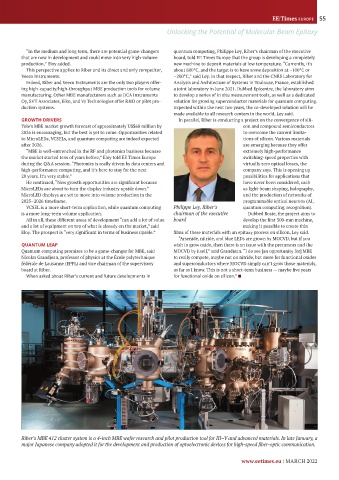
           Riber’s MBE 412 cluster system is a 4-inch MBE wafer research and pilot production tool for III–V and advanced materials. In late January, a
           major Japanese company adopted it for the development and production of optoelectronic devices for high-speed fiber-optic communication.

                                                                                         www.eetimes.eu | MARCH 2022

