


Page 51 - EE Times Europe March 2022
P. 51
EE|Times EUROPE   51


            SEMICONDUCTOR INDUSTRY
           EU Must Continue to Invest in Microelectronics,

           Says SEMI Europe President


           By Anne-Françoise Pelé


                urope has strategic assets in the semi-  Development: A Key Driver of Innovation   semiconductor equipment, materials, and
                conductor value chain, but revitalizing   and Resilience           raw materials. What kind of strategies?
                the manufacturing economy, fostering   •  Semiconductor Supply Chains — Global   Are European countries sometimes too
          Eand protecting innovation, and bridging   Partnerships for a Global Industry  protective of their technological advances
           the talent shortage are essential factors for   •  Upskilling and reskilling as a fundament   to the point of hindering pooling?
           sustainable European technology sovereignty.   for the Industrial Alliance for Processors   Altimime: The automotive industry chip
             In the 1990s, Europe experienced a surge in   and Semiconductor Technologies and the   shortage triggered by Covid-19 has tran-
           new fab installations. The flow then reversed,   Chips Act              sitioned from being a seemingly minor
           and the continent has fallen far behind in                              irritation in December 2020 to a full-blown
           semiconductor manufacturing capacity over   EE TIMES EUROPE: If you were to prioritize   global supply chain crisis up and down
           the past two decades. According to consulting   SEMI Europe’s four recommendations,   the value chain, including semiconductor
           firm Kearney, Europe’s share in global chip   what would be the top priority?   equipment, materials, and raw materials and
           manufacturing has dropped from 25% in 2000   Laith Altimime: Semiconductors must   components.
           to 8% today. An even more drastic decline has   remain at the core of Europe’s industrial and   In our recommendations, SEMI suggests
           occurred in advanced semiconductor technol-  technological ambitions. With the launch   establishing mechanisms for increased aware-
           ogy, with Europe’s market share falling from   of the Industrial Alliance for Processors   ness of supply chain bottlenecks in both the
           19% in 2000 to zero today.          and Semiconductor Technologies and the   semiconductor industry and end-user sectors.
             Europe’s dependence on Asian semicon-  announcement of the Chips Act, Europe has   By introducing means to share best practices
           ductors has become too pervasive and has   taken a pivotal step in securing supply chain   on supply chain monitoring and bottleneck
           had a ripple effect on the broader automotive   resilience and the future competitiveness   mitigation, potential disruptions and risks
           and consumer electronics                        of the microelectronics   could be [promptly] identified and alternative
           sectors. In response, the                       ecosystem.              means of supply secured. To remain competi-
           European Union has set a                          I believe all four of   tive and advance our strategic position in the
           strategic ambition to more                      our recommendations go   digital age, we also suggest that Europe must
           than double its share of                        together in order to main-  continue to invest in the microelectronics
           semiconductor manufactur-                       tain Europe’s leadership and   industry to advance innovations, new mate-
           ing in 2030.                                    achieve the goal to produce   rials, designs, equipment, and manufacturing
             Laith Altimime, president                     20% of the world’s micro-  to maintain global leadership and further
           of SEMI Europe, is a promi-                     chips by 2030. European   strengthen the resilience of our supply chain.
           nent presence in that effort.                   Commission President      The European Commission president also
           Altimime has a constant                         Ursula von der Leyen, in   highlighted this as the fourth focus area,
           pulse on the semiconductor                      her address at the Davos   noting: “We will improve our toolbox to antic-
           industry. He leads SEMI’s                       Agenda, reaffirmed the   ipate and respond to shortages and crises in
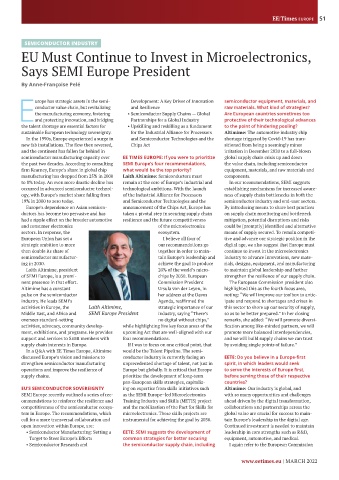
           activities in Europe, the   Laith Altimime,     strategic importance of our   this sector to shore up our security of supply,
           Middle East, and Africa and   SEMI Europe President  industry, saying “There’s   so as to be better prepared.” In her closing
           oversees standard-setting                       no digital without chips,”   remarks, she added: “We will promote diversi-
           activities, advocacy, community develop-  while highlighting five key focus areas of the   fication among like-minded partners, we will
           ment, exhibitions, and programs. He provides   upcoming Act that are well-aligned with our   promote more balanced interdependencies,
           support and services to SEMI members with   four recommendations.       and we will build supply chains we can trust
           supply chain interests in Europe.     If I was to focus on one critical point, that   by avoiding single points of failure.”
             In a Q&A with EE Times Europe, Altimime   would be the Talent Pipeline. The semi-
           discussed Europe’s vision and missions to   conductor industry is currently facing an   EETE: Do you believe in a Europe-first
           strengthen semiconductor manufacturing   unprecedented shortage of talent, not just in   spirit, in which leaders would seek
           operations and improve the resilience of   Europe but globally. It is critical that Europe   to serve the interests of Europe first,
           supply chains.                      prioritize the development of long-term   before serving those of their respective
                                               pan-European skills strategies, capitaliz-  countries?
           EU’S SEMICONDUCTOR SOVEREIGNTY      ing on expertise from skills initiatives such   Altimime: Our industry is global, and
           SEMI Europe recently outlined a series of rec-  as the SEMI Europe–led Microelectronics   with so many opportunities and challenges
           ommendations to reinforce the resilience and   Training Industry and Skills (METIS) project   ahead driven by the digital transformation,
           competitiveness of the semiconductor ecosys-  and the mobilization of the Pact for Skills for   collaborations and partnerships across the
           tem in Europe. The recommendations, which   microelectronics. These skills projects are   global value are crucial for success to main-
           call for a more transversal collaboration and   instrumental for achieving the goal by 2030.  tain Europe’s leadership in the digital age.
           open innovation within Europe, are:                                     Continued investment is needed to maintain
             •   Semiconductor Manufacturing: Setting a   EETE: SEMI suggests the development of   leadership in core strengths such as R&D,
              Target to Steer Europe’s Efforts  common strategies for better securing   equipment, automotive, and medical.
             •   Semiconductor Research and    the semiconductor supply chain, including   I again refer to the European Commission

                                                                                         www.eetimes.eu | MARCH 2022

