


Page 27 - EETEurope FlipBook February
P. 27
EE|Times EUROPE — CES 2021  27


               OPINION | CES 2021 REVIEW
                                                                                       such as vineyard grapes. Pellenc, in southern
                                                                                       France, developed such robotic gear, which
               Data Drives                                                             transformed farmers into data scientists.
                                                                                         Indeed, once automation was in place
               Agriculture 4.0                                                         for this new generation of farmers, they
                                                                                       had the opportunity to go the extra step,
                                                                                       not just looking passively at their yield but
                                                                                       acting proactively to improve the quality
               Farmers are harvesting sensor data to shift                             and quantity of their agricultural produce.
                                                                                       Whereas the small-scale farming operations
               from preventive to predictive agriculture.                              of the past could rely on the farmer’s eyes
                                                                                       and intuition to monitor everyday activities,
               By Pierre Cambou and Dimitrios Damianos                                 today’s gigantic farming operations can no
                                                                                       longer rely on human senses. Data technology
                                                                                       has become central to steering the farm in the
                      ince its inception, the Industrial Revolution has centered on automat-  right direction. Whether it is for herding, crop
                      ing production processes. Now that we have entered the era of Industry   production, or high-end production such as
                                                                                       wine, data is the focus of Agriculture 4.0.
                      4.0, most industrial processes have become data-centric, generally
              Sinvolving five steps of data manipulation: collection, transmission,    With versatile data-centric
               storage, analysis, and, finally, display. This last step is to keep humans in the   technologies, agriculture is
               loop, but data can also be fed back to some actuating device, bringing the pro-
               cess into the realm of robotics.                                        becoming an industry that is
                                                                                       piloted in the same manner as
                 Agriculture has not been immune to industrialization over the past two centuries, and in
               recent years, Agriculture 4.0 has gained momentum. Just as industrial production made the   automotive or aerospace. The
               transition toward data management, agriculture is now following that path. Companies that
               traditionally have served industrial segments now offer similar data-centric approaches to   farmer has become an engineer.
               the agriculture sector, and we are even seeing agricultural-equipment manufacturers expand
               into industrial-equipment manufacture. Although agriculture is often characterized by an
               unstructured environment with respect to traditional industrial manufacturing industries, the   CAMERA UTILIZATION IN AGRICULTURE
               versatility of new data-centric technologies is helping agriculture to become an industry that   One of the best examples of agricultural data
               is piloted in the same manner as automotive or aerospace. The farmer has become an engineer   management is the monitoring of fields using
               like any other engineer.                                                drones. Paris-based Parrot is a key player in
                 It all started in the 1990swith the first automation equipment for the high-value dairy   that domain, largely thanks to its U.S. subsidi-
               industry — primarily milking machines from the likes of Swedish manufacturer DeLaval and   ary, MicaSense. However, the French company
               Netherlands-based Lely. At the same time, optical sorters for grains, particularly rice, were devel-  announced in January that it had agreed to sell
               oped by companies such as Satake, headquartered in Japan, and Bühler, based in Switzerland.   MicaSense to AgEagle Aerial, a U.S.-based data
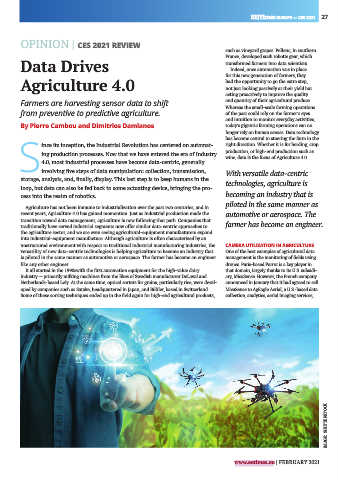
               Some of these sorting techniques ended up in the field again for high-end agricultural products,   collection, analytics, aerial imaging services,


                                                                                                                          IMAGE: SHUTTERSTOCK


                                                                                          www.eetimes.eu | FEBRUARY 2021

