


Page 49 - EE Times Europe Magazine | April2019
P. 49
EE|Times EUROPE — Boards & Solutions Insert   49


        OPINION


        Arm in the Data Center:


        Is This Finally the Year?


        By Sally Ward-Foxton


                            A recent high-profile product launch has pushed the concept of
                            using Arm-based CPUs in the data center back into the limelight.
                            Ampere, a Silicon Valley startup that focuses exclusively on Arm-
                            based CPUs for the data center, launched its Altra CPU. Built on
                            up to 80 Arm Neoverse N1 cores, Altra consumes 210 W at peak
                            workload.
                              Ampere designed the Altra specifically for hyperscalers that
                            need CPUs for their cloud offerings (an earlier Ampere CPU,
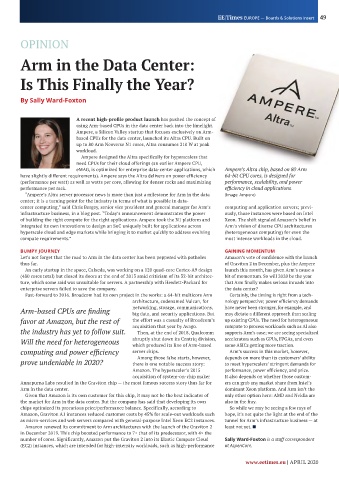
                            eMAG, is optimized for enterprise data-center applications, which   Ampere’s Altra chip, based on 80 Arm
        have slightly different requirements). Ampere says the Altra delivers on power efficiency   64-bit CPU cores, is designed for
        (performance per watt) as well as watts per core, allowing for denser racks and maximizing   performance, scalability, and power
        performance per rack.                                                   efficiency in cloud applications.
          “Ampere’s Altra server processor news is more than just a milestone for Arm in the data   (Image: Ampere)
        center; it is a turning point for the industry in terms of what is possible in data-
        center computing,” said Chris Bergey, senior vice president and general manager for Arm’s   computing and application servers; previ-
        infrastructure business, in a blog post. “Today’s announcement demonstrates the power   ously, those instances were based on Intel
        of building the right compute for the right applications. Ampere took the N1 platform and   Xeon. The shift signaled Amazon’s belief in
        integrated its own innovations to design an SoC uniquely built for applications across   Arm’s vision of diverse CPU architectures
        hyperscale cloud and edge markets while bringing it to market quickly to address evolving   (heterogeneous computing) for even the
        compute requirements.”                                                  most intense workloads in the cloud.
        BUMPY JOURNEY                                                           GAINING MOMENTUM
        Let’s not forget that the road to Arm in the data center has been peppered with potholes   Amazon’s vote of confidence with the launch
        thus far.                                                               of Graviton 2 in December, plus the Ampere
          An early startup in the space, Calxeda, was working on a 120 quad-core Cortex-A9 design   launch this month, has given Arm’s cause a
        (480 cores total) but closed its doors at the end of 2013 amid criticism of its 32-bit architec-  bit of momentum. So will 2020 be the year
        ture, which some said was unsuitable for servers. A partnership with Hewlett-Packard for   that Arm finally makes serious inroads into
        enterprise servers failed to save the company.                          the data center?
          Fast-forward to 2016. Broadcom had its own project in the works: a 64-bit multicore Arm   Certainly, the timing is right from a tech-
                                                architecture, codenamed Vulcan, for   nology perspective; power efficiency demands
        Arm-based CPUs are finding              networking, storage, communications,   have never been stronger, for example, and
                                                                                may dictate a different approach than scaling
                                                big data, and security applications. But
        favor at Amazon, but the rest of        the effort was a casualty of Broadcom’s   up existing CPUs. The need for heterogeneous
        the industry has yet to follow suit.    acquisition that year by Avago.   compute to process workloads such as AI also
                                                 Then, at the end of 2018, Qualcomm
                                                                                supports Arm’s case; we are seeing specialized
        Will the need for heterogeneous         abruptly shut down its Centriq division,   accelerators such as GPUs, FPGAs, and even
                                                which produced its line of Arm-based
                                                                                some ASICs getting more traction.
        computing and power efficiency          server chips.                     Arm’s success in this market, however,
                                                 Among those false starts, however,
        prove undeniable in 2020?               there is one notable success story:   depends on more than its customers’ ability
                                                                                to meet hyperscalers’ stringent demands for
                                                Amazon. The hyperscaler’s 2015   performance, power efficiency, and price.
                                                acquisition of system-on-chip maker   It also depends on whether those custom-
        Annapurna Labs resulted in the Graviton chip — the most famous success story thus far for   ers can grab any market share from Intel’s
        Arm in the data center.                                                 dominant Xeon platform. And Arm isn’t the
          Given that Amazon is its own customer for this chip, it may not be the best indicator of   only other option here: AMD and Nvidia are
        the market for Arm in the data center. But the company has said that developing its own   also in the fray.
        chips optimized its precarious price/performance balance. Specifically, according to    So while we may be seeing a few rays of
        Amazon, Graviton A1 instances reduced customer costs by 45% for scale-out workloads such   hope, it’s not quite the light at the end of the
        as micro-services and web servers compared with general-purpose Intel Xeon EC2 instances.   tunnel for Arm’s infrastructure business — at
          Amazon renewed its commitment to Arm architectures with the launch of the Graviton 2   least not yet. ■
        in December 2019. This chip boosted performance to 7× that of its predecessor, with 4× the
        number of cores. Significantly, Amazon put the Graviton 2 into its Elastic Compute Cloud   Sally Ward-Foxton is a staff correspondent
        (EC2) instances, which are intended for high-intensity workloads, such as high-performance   at AspenCore.

                                                                                       www.eetimes.eu | APRIL 2020

