


Page 53 - EE Times Europe Magazine | April2019
P. 53
EE|Times EUROPE — Boards & Solutions Insert   53


         INTERNET OF THINGS
        Thermal and Vibration Energy


        Powers IoT Devices

        By Maurizio Di Paolo Emilio


               chieving so-called zero-power   enables output voltages of 0.2 mV/K per
               sensors will require harvesting   cell, while higher values are obtained if the
               energy from sources in the environ-  thermoelectric converter uses multiple p and
        A ment. After narrowing down one’s   n pairs (20 mV using 10 cells at ∆T = 10K). The
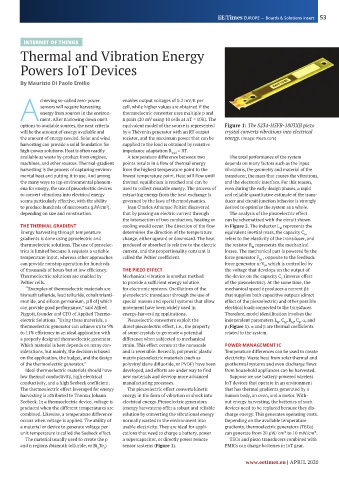
        options to available sources, the next criteria   equivalent model of the source is represented   Figure 1: The S234-H5FR-1803XB piezo
        will be the amount of energy available and   by a Thévenin generator with an RT output   crystal converts vibrations into electrical
        the amount of energy needed. Solar and wind   resistor, and the maximum power that can be   energy. (Image: Piezo.com)
        harvesting can provide a solid foundation for   supplied to the load is obtained by resistive
        high-power solutions. Heat is often readily   impedance adaptation R load  = RT.
        available as waste by-product from engines,   A temperature difference between two   The total performance of the system
        machines, and other sources. Thermal-gradient   points results in a flow of thermal energy   depends on many factors such as the input
        harvesting is the process of capturing environ-  from the highest temperature point to the   vibrations, the geometry and material of the
        mental heat and putting it to use. And among   lowest temperature point. Heat will flow until   transducer, the mass that causes the vibrations,
        the many ways to tap environmental phenom-  thermal equilibrium is reached and can be   and the electronic interface. For this reason,
        ena for energy, the use of piezoelectric devices   used to collect reusable energy. The process of   even during the early design phases, a rapid
        to convert vibrations into electrical energy   extracting energy from the heat exchange is   and reliable quantitative estimate of the trans-
        seems particularly effective, with the ability   governed by the laws of thermodynamics.  ducer and circuit junction behavior is strongly
        to produce hundreds of microwatts (µW/cm ),   Jean Charles Athanase Peltier discovered   desired to optimize the system as a whole.
                                      2
        depending on size and construction.  that by passing an electric current through   The analysis of the piezoelectric effect
                                            the intersection of two conductors, heating or   can be schematized with the circuit shown
        THE THERMAL GRADIENT                cooling would occur. The direction of the flow   in Figure 2. The inductor L  represents the
                                                                                                   M
        Energy harvesting through temperature   determines the direction of the temperature   equivalent inertial mass, the capacity C
                                                                                                            M
        gradients is done using pyroelectric and   change, either upward or downward. The heat   refers to the elasticity of the transducer, and
        thermoelectric solutions. The use of pyroelec-  produced or absorbed is relative to the electric   the resistor R  represents the mechanical
                                                                                         M
        trics is limited because it requires a variable   current, and the proportionality constant is   losses. The mechanical part is powered by the
        temperature input, whereas other approaches   called the Peltier coefficient.  force generator F  , opposite to the feedback
                                                                                            IN
        can provide nonstop operation for hundreds                              force generator α-V , which is controlled by
                                                                                              P
        of thousands of hours but at low efficiency.   THE PIEZO EFFECT         the voltage that develops on the output of
        Thermoelectric solutions are enabled by   Mechanical vibration is another method   the device on the capacity C  (inverse effect
                                                                                                    P
        Peltier cells.                      to provide a sufficient energy solution   of the piezoelectric). At the same time, the
           “Examples of thermoelectric materials are   for electronic systems. Oscillations of the   mechanical speed ż produces a current βż
        bismuth telluride, lead telluride, cobalt trianti-  piezoelectric transducer through the use of   that supplies both capacitive outputs (direct
        monide, and silicon germanium, [all of] which   special masses and special systems that allow   effect of the piezoelectric) and other possible
        can provide good performance,” said Alfred   movement have been widely used in    electrical loads connected to the transducer.
        Piggott, founder and CTO of Applied Thermo-  energy-harvesting applications.  Therefore, model identification involves the
        electric Solutions. “Using these materials, a   Piezoelectric converters exploit the   independent parameters L , C , R , C , α, and
                                                                                                          P
                                                                                                     M
                                                                                                       M
                                                                                                  M
        thermoelectric generator can achieve up to 9%   direct piezoelectric effect, i.e., the property   β (Figure 1). α and β are thermal coefficients
        to 11% efficiency in an ideal application with   of some crystals to generate a potential   related to the system.
        a properly designed thermoelectric generator.   difference when subjected to mechanical
        Which material is best depends on many con-  strain. This effect occurs at the nanoscale   POWER MANAGEMENT IC
        siderations, but mainly, the decision is based   and is reversible. Recently, polymeric plastic   Temperature differences can be used to create
        on the application, the budget, and the design   matrix piezoelectric materials (such as   electricity. Waste heat from solar thermal and
        of the thermoelectric generator.”   polyvinylidene difluoride, or PVDF) have been   geothermal systems and even discharge flows
          Ideal thermoelectric materials should have   developed, and efforts are under way to find   from household appliances can be harvested.
        low thermal conductivity, high electrical   new materials and develop more advanced   Suppose we use battery-powered wireless
        conductivity, and a high Seebeck coefficient.   manufacturing processes.  IoT devices that operate in an environment
        The thermoelectric effect leveraged for energy   The piezoelectric effect converts kinetic   that has thermal gradients generated by a
        harvesting is attributed to Thomas Johann   energy in the form of vibration or shock into   human body, an oven, and a motor. With-
        Seebeck. In a thermoelectric device, voltage is   electrical energy. Piezoelectric generators   out energy harvesting, the batteries of such
        produced when the different temperatures are   (energy harvesters) offer a robust and reliable   devices need to be replaced because they dis-
        combined. Likewise, a temperature difference   solution by converting the vibrational energy   charge energy. This generates operating costs.
        occurs when voltage is applied. The ability of   normally wasted in the environment into   Depending on the available temperature
        a material or device to generate voltage per   usable electricity. They are ideal for appli-  gradients, thermoelectric generators (TEGs)
        unit temperature is called the Seebeck effect.  cations that need to charge a battery, power   can generate from 20 µW/ cm² to 10 mW/cm².
          The material usually used to create the p   a supercapacitor, or directly power remote   TEGs and piezo transducers combined with
        and n regions (bismuth telluride, or Bi Te )   sensor systems (Figure 1).  PMICs can charge batteries in IoT gear.
                                   2  3
                                                                                       www.eetimes.eu | APRIL 2020

