


Page 52 - EE Times Europe Magazine | April2019
P. 52
52 EE|Times EUROPE — Boards & Solutions Insert


         MICROCONTROLLERS
        Added Arm Core Yields a More Flexible


        iMOTION Controller

        By Maurizio Di Paolo Emilio


                anufacturers increasingly tend to consider the actual
                motor control unit as a basic functional block rather than
                a diversifying feature of the final product; this is particu-
       Mlarly apparent for auxiliary systems such as water drainage
        pumps or fans normally found in domestic appliances. Infineon
        Technologies’ new IMC300 combines the iMOTION Motion Control
        Engine (MCE) motor with an additional microcontroller based on the
        Arm Cortex-M0 core. The IMC300 portfolio targets variable-speed
        drives that require high application flexibility.
          Controlling a motor’s speed and direction presupposes the mode
        of operation of the motor in use and requires different techniques
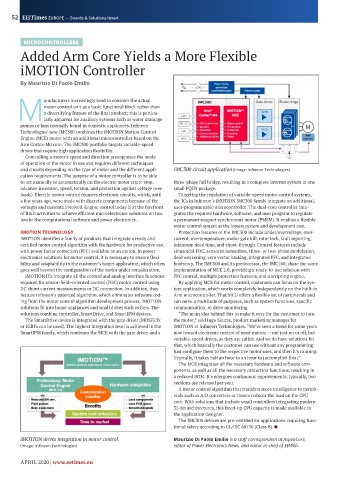
        and circuits depending on the type of motor and the different appli-  IMC300 circuit application (Image: Infineon Technologies)
        cation requirements. The purpose of a motor controller is to be able
        to act manually or automatically on the electric motor (start-stop,   three-phase full bridge, resulting in a complete inverter system in one
        advance-inversion, speed, torsion, and protection against voltage over-  small PQFN package.
        loads). Electric-motor control requires electronic circuits, which, until   Targeting the regulation of variable-speed motor control systems,
        a few years ago, were made with discrete components because of the   the ICs in Infineon’s iMOTION IMC300 family integrate an additional,
        voltages and currents involved. Engine control today is at the forefront   user-programmable microcontroller. The dual-core controller inte-
        of R&D activities to achieve efficient microelectronic solutions on two   grates the required hardware, software, and user program to regulate
        levels: the computational software and power electronics.  a permanent-magnet synchronous motor (PMSM). It enables a flexible
                                                              motor control system at the lowest system and development cost.
        iMOTION TECHNOLOGY                                      Protection features of the IMC300 include under/overvoltage, over-
        iMOTION identifies a family of products that integrate a ready and   current, overtemperature, motor gate kill, rotor lock, fault reporting,
        certified motor control algorithm with the hardware for productive use,   minimum dead time, and shoot-through. Control features include
        with power factor correction (PFC) available as an option. In power   sinusoidal FOC, sensored/sensorless, three- or two-phase modulation,
        electronics solutions for motor control, it is necessary to ensure flexi-  field weakening, zero vector braking, integrated PFC, and integrated
        bility and adaptability to the customer’s target application, which often   bootstrap. The IMC300 and its predecessor, the IMC100, share the same
        goes well beyond the configuration of the motor under consideration.  implementation of MCE 2.0, providing a ready-to-use solution with
          iMOTION ICs integrate all the control and analog interface functions   PFC control, multiple protection features, and a scripting engine.
        required for sensor-field–oriented control (FOC) motor control using   By applying MCE for motor control, customers can focus on the sys-
        DC shunt current measurements or DC connection. In addition, they   tem application, which works completely independently on the built-in
        feature Infineon’s patented algorithm, which eliminates software cod-  Arm microcontroller. That MCU offers a flexible set of peripherals and
        ing from the motor control algorithm development process. iMOTION   can serve a multitude of purposes, such as system functions, specific
        solutions fit into home appliances and small drives such as fans. The   communication, or drive monitoring.
        solutions combine controller, SmartDrive, and SmartIPM devices.  “The main idea behind this to make it easy for the customer to turn
          The SmartDrive device is integrated with the gate driver (MOSFETs   the motor,” said Ingo Skuras, product marketing manager for
        or IGBTs can be used). The highest integration level is achieved in the   iMOTION at Infineon Technologies. “We’ve seen a trend for some years
        SmartIPM family, which combines the MCE with the gate driver and a   now toward electronic control of most motors — not just on or off, but
                                                              variable-speed drives, as they are called. And we do have solutions for
                                                              that, which basically the customer can use without any programming:
                                                              Just configure them to the respective motor uses, and then it’s running.
                                                              Typically, it takes half an hour to an hour to [accomplish this].”
                                                                The MCE integrates all the necessary hardware and software com-
                                                              ponents, as well as all the necessary protection functions, resulting in
                                                              a reduced BOM. It undergoes continuous improvements; typically, two
                                                              versions are released per year.
                                                                A motor control algorithm that transfers more intelligence to periph-
                                                              erals such as A/D converters or timers reduces the load on the CPU
                                                              core. With solutions that include small controllers integrating modern
                                                              32-bit architectures, this freed-up CPU capacity is made available to
                                                              the application designer.
                                                                The IMC300 devices are pre-certified for applications requiring func-
                                                              tional safety according to UL/IEC 60730 (Class B). ■

        iMOTION drives integration in motor control.          Maurizio Di Paolo Emilio is a staff correspondent at AspenCore,
        (Image: Infineon Technologies)                        editor of Power Electronics News, and editor-in-chief of EEWeb.

        APRIL 2020 | www.eetimes.eu

