


Page 46 - EE Times Europe Magazine | April2019
P. 46
46 EE|Times EUROPE — Boards & Solutions Insert


         SPECIAL REPORT: AI AT THE EDGE
        Putting AI into the Edge Is a No-Brainer;


        Here’s Why

        By Duncan Stewart and Jeff Loucks


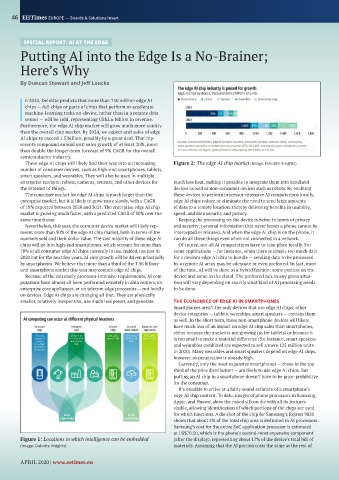
          n 2020, Deloitte predicts that more than 750 million edge AI
          chips — full chips or parts of chips that perform or accelerate
          machine-learning tasks on-device, rather than in a remote data
       Icenter — will be sold, representing US$2.6 billion in revenue.
        Furthermore, the edge AI chip market will grow much more quickly
        than the overall chip market. By 2024, we expect unit sales of edge
        AI chips to exceed 1.5 billion, possibly by a great deal. That rep-
        resents compound annual unit sales growth of at least 20%, more
        than double the longer-term forecast of 9% CAGR for the overall
        semiconductor industry.
          These edge AI chips will likely find their way into an increasing   Figure 2: The edge AI chip market (Image: Deloitte Insights)
        number of consumer devices, such as high-end smartphones, tablets,
        smart speakers, and wearables. They will also be used in multiple
        enterprise markets: robots, cameras, sensors, and other devices for   much less heat, making it possible to integrate them into handheld
        the internet of things.                               devices as well as non-consumer devices such as robots. By enabling
          The consumer market for edge AI chips is much larger than the   these devices to perform processor-intensive AI computations locally,
        enterprise market, but it is likely to grow more slowly, with a CAGR   edge AI chips reduce or eliminate the need to send large amounts
        of 18% expected between 2020 and 2024. The enterprise edge AI chip   of data to a remote location, thereby delivering benefits in usability,
        market is growing much faster, with a predicted CAGR of 50% over the   speed, and data security and privacy.
        same time frame.                                        Keeping the processing on the device is better in terms of privacy
          Nevertheless, this year, the consumer device market will likely rep-  and security; personal information that never leaves a phone cannot be
        resent more than 90% of the edge AI chip market, both in terms of the   intercepted or misused. And when the edge AI chip is on the phone, it
        numbers sold and their dollar value. The vast majority of these edge AI   can do all these things even when not connected to a network.
        chips will go into high-end smartphones, which account for more than   Of course, not all AI computations have to take place locally. For
        70% of all consumer edge AI chips currently in use. Indeed, not just in   some applications — for instance, when there is simply too much data
        2020 but for the next few years, AI chip growth will be driven principally   for a device’s edge AI chip to handle — sending data to be processed
        by smartphones. We believe that more than a third of the 1.56 billion-   by a remote AI array may be adequate or even preferred. In fact, most
        unit smartphone market this year may contain edge AI chips.  of the time, AI will be done in a hybrid fashion: some portion on the
          Because of the extremely processor-intensive requirements, AI com-  device and some in the cloud. The preferred mix in any given situa-
        putations have almost all been performed remotely in data centers, on   tion will vary depending on exactly what kind of AI processing needs
        enterprise core appliances, or on telecom edge processors — not locally   to be done.
        on devices. Edge AI chips are changing all that. They are physically
        smaller, relatively inexpensive, use much less power, and generate   THE ECONOMICS OF EDGE AI IN SMARTPHONES
                                                              Smartphones aren’t the only devices that use edge AI chips; other
                                                              device categories — tablets, wearables, smart speakers — contain them
                                                              as well. In the short term, these non-smartphone devices will likely
                                                              have much less of an impact on edge AI chip sales than smartphones,
                                                              either because the market is not growing (as for tablets) or because it
                                                              is too small to make a material difference (for instance, smart speakers
                                                              and wearables combined are expected to sell a mere 125 million units
                                                              in 2020). Many wearables and smart speakers depend on edge AI chips,
                                                              however, so penetration is already high.
                                                                Currently, only the most expensive smartphones — those in the top
                                                              third of the price distribution — are likely to use edge AI chips. But
                                                              putting an AI chip in a smartphone doesn’t have to be price-prohibitive
                                                              for the consumer.
                                                                It’s possible to arrive at a fairly sound estimate of a smartphone’s
                                                              edge AI chip content. To date, images of phone processors in Samsung,
                                                              Apple, and Huawei show the naked silicon die with all its features
                                                              visible, allowing identification of which portions of the chips are used
                                                              for which functions. A die shot of the chip for Samsung’s Exynos 9820
                                                              shows that about 5% of the total chip area is dedicated to AI processors.
                                                              Samsung’s cost for the entire SoC application processor is estimated
                                                              at US$70.50, which is the phone’s second-most expensive component
        Figure 1: Locations in which intelligence can be embedded    (after the display), representing about 17% of the device’s total bill of
        (Image: Deloitte Insights)                            materials. Assuming that the AI portion costs the same as the rest of

        APRIL 2020 | www.eetimes.eu

