


Page 45 - EE Times Europe Magazine | April2019
P. 45
EE|Times EUROPE — Boards & Solutions Insert   45


         SPECIAL REPORT: AI AT THE EDGE
        Edge Intelligence Ticks Many Boxes for AI


        By Dennis Goldenson


               s adoption rates rise for artificial intelligence
               and machine learning (ML), the ability to process
               large amounts of data in the form of algorithms
        A for computational purposes becomes increasingly
        important.
          To help make the expanding use of data applications across
        billions of connected devices more efficient and valuable,
        there is growing momentum to migrate the processing from
        centralized third-party cloud servers to decentralized and
        localized processing on-device, commonly referred to as edge
        computing. According to SAR Insight & Consulting’s latest AI/
        ML embedded chips database, the global number of AI-en-
        abled devices with edge computing will grow at a compound
        annual growth rate of 64.2% during the 2019–2024 period.

        DATA COMPUTATION AT THE EDGE, NO NETWORK
        NEEDED
        Edge AI takes the algorithms and processes the data as close
        as possible to the physical system — in this case, locally on
        the hardware device. The advantage is that the processing of
        data does not require a connection. The computation of data
        happens near the network edge, where the data is developed,
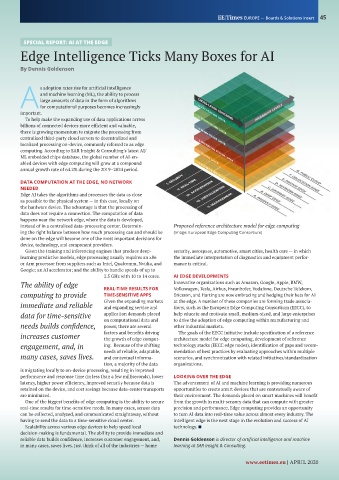
        instead of in a centralized data-processing center. Determin-  Proposed reference architecture model for edge computing
        ing the right balance between how much processing can and should be   (Image: European Edge Computing Consortium)
        done on the edge will become one of the most important decisions for
        device, technology, and component providers.
          Given the training and inferencing engines that produce deep-   security, aerospace, automotive, smart cities, health care — in which
        learning predictive models, edge processing usually requires an x86   the immediate interpretation of diagnostics and equipment perfor-
        or Arm processor from suppliers such as Intel, Qualcomm, Nvidia, and   mance is critical.
        Google; an AI accelerator; and the ability to handle speeds of up to
                                      2.5 GHz with 10 to 14 cores.  AI EDGE DEVELOPMENTS
        The ability of edge           REAL-TIME RESULTS FOR   Innovative organizations such as Amazon, Google, Apple, BMW,
                                                              Volkswagen, Tesla, Airbus, Fraunhofer, Vodafone, Deutsche Telekom,
        computing to provide          TIME-SENSITIVE APPS     Ericsson, and Harting are now embracing and hedging their bets for AI
        immediate and reliable        Given the expanding markets   at the edge. A number of these companies are forming trade associa-
                                      and expanding service and
                                                              tions, such as the European Edge Computing Consortium (EECC), to
        data for time-sensitive       application demands placed   help educate and motivate small, medium-sized, and large enterprises
                                      on computational data and
                                                              to drive the adoption of edge computing within manufacturing and
        needs builds confidence,      power, there are several   other industrial markets.
                                                                The goals of the EECC initiative include specification of a reference
        increases customer            factors and benefits driving   architecture model for edge computing, development of reference
                                      the growth of edge comput-
        engagement, and, in           ing.  Because of the shifting   technology stacks (EECC edge nodes), identification of gaps and recom-
        many cases, saves lives.      needs of reliable, adaptable,   mendation of best practices by evaluating approaches within multiple
                                      and contextual informa-
                                                              scenarios, and synchronization with related initiatives/standardization
                                      tion, a majority of the data   organizations.
        is migrating locally to on-device processing, resulting in improved
        performance and response time (in less than a few milliseconds), lower   LOOKING OVER THE EDGE
        latency, higher power efficiency, improved security because data is   The advancement of AI and machine learning is providing numerous
        retained on the device, and cost savings because data-center transports   opportunities to create smart devices that are contextually aware of
        are minimized.                                        their environment. The demands placed on smart machines will benefit
          One of the biggest benefits of edge computing is the ability to secure   from the growth in multi-sensory data that can compute with greater
        real-time results for time-sensitive needs. In many cases, sensor data   precision and performance. Edge computing provides an opportunity
        can be collected, analyzed, and communicated straightaway, without   to turn AI data into real-time value across almost every industry. The
        having to send the data to a time-sensitive cloud center.  intelligent edge is the next stage in the evolution and success of AI
          Scalability across various edge devices to help speed local    technology. ■
        decision-making is fundamental. The ability to provide immediate and
        reliable data builds confidence, increases customer engagement, and,   Dennis Goldenson is director of artificial intelligence and machine
        in many cases, saves lives. Just think of all of the industries — home   learning at SAR Insight & Consulting.

                                                                                       www.eetimes.eu | APRIL 2020

