


Page 24 - EE Times Europe Magazine | April2019
P. 24
24 EE|Times EUROPE

        Wide-Bandgap Application in EV Chargers


        GaN. These isolated gate drivers are based on ADI’s proven iCoupler   combine the outputs from the V OUT  and V OUT_SRC  pins, one isolated gate
        isolation technology, combined with high-speed CMOS and monolithic   driver is able to have two easily selectable slew rates.
        transformer technology. The ADuM4122 device, an isolated dual-out-  The EVAL-ADuM4122EBZ board tests the propagation delay, drive
        put driver, provides 5-kV RMS true galvanic isolation between the input   strength, slew rate selection, and input logic of the device.
        and output regions.
          Gate drivers are required for achieving fast rise times for switching   WIRELESS CHARGING
        device gates. As shown in Figure 2, ADuM4122 achieves isolation   Wireless EV charging uses an inductor, usually placed under the
        between the control side and the output side of the gate driver by   asphalt, and a receiver onboard the vehicle. Charging occurs automati-
        using a high-frequency carrier that transmits data across the isolation   cally through magnetic plates that continuously recharge the batteries,
        barrier with iCoupler chip-scale transformer coils separated by layers of   whether the vehicle is standing still or in motion.
        polyimide isolation.                                    In the area of wireless power transfer, engineers need solutions with
          The EVAL-ADuM4122EBZ evaluation board (Figure 3) supports the   high-power and high-efficiency GaN-based approaches. GaN Systems’
        ADuM4122 isolated gate driver with slew rate control. The evaluation   broad portfolio of transistors provides high-power wireless charging
        board supplies jumpers and screw terminals to configure different drive   solutions to design smaller, cheaper, and more efficient power systems
        conditions, accepting both square waves and DC values on the V  and   for demanding applications. ■
                                                      IN+
        SRC pins. The SRC pin controls whether the V OUT_SRC  pin is either set to
        high-Z or follows the logic of the user-supplied pulse-width modu-  Maurizio Di Paolo Emilio is a staff correspondent at AspenCore,
        lation (PWM) input at V . When the external series gate resistors   editor of Power Electronics News, and editor-in-chief of EEWeb.
                         IN+


         POWER ELECTRONICS
        Wide-Bandgap Semiconductors


        Find Homes in Space

        By Maurizio Di Paolo Emilio


                  ide-bandgap (WBG) semiconductors, such as gallium
                  nitride (GaN) and silicon carbide (SiC), are proving to
                  be the most promising materials in the field of power
        Welectronics since silicon was introduced. These materials
        have several advantages over traditional silicon-based technology, such
        as the ability to manage high power levels, insensitivity to radiation,
        high-temperature operation, high switching frequencies, low noise, low
        power losses, and high efficiency.
          WBG semiconductors are of strategic importance to the develop-
        ment of next-generation space-borne systems. Gallium nitride, in its
        enhanced-mode version (eGaN), is widely used in the development of
        FETs and HEMTs for space applications.

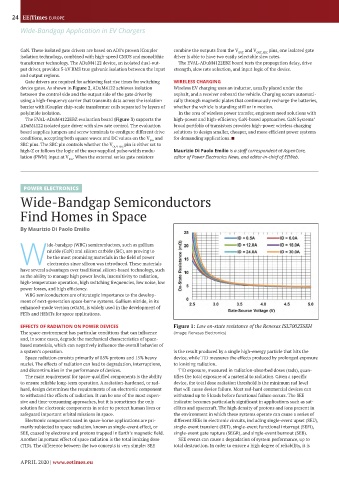
        EFFECTS OF RADIATION ON POWER DEVICES                 Figure 1: Low on-state resistance of the Renesas ISL70023SEH
        The space environment has particular conditions that can influence   (Image: Renesas Electronics)
        and, in some cases, degrade the mechanical characteristics of space-
        based materials, which can negatively influence the overall behavior of
        a system’s operation.                                 is the result produced by a single high-energy particle that hits the
          Space radiation consists primarily of 85% protons and 15% heavy   device, while TID measures the effects produced by prolonged exposure
        nuclei. The effects of radiation can lead to degradation, interruptions,   to ionizing radiation.
        and discontinuities in the performance of devices.      TID exposure, measured in radiation-absorbed doses (rads), quan-
          The main requirement for space-qualified components is the ability   tifies the total exposure of a material to radiation. Given a specific
        to ensure reliable long-term operation. A radiation-hardened, or rad-  device, the total dose radiation threshold is the minimum rad level
        hard, design determines the requirements of an electronic component   that will cause device failure. Most rad-hard commercial devices can
        to withstand the effects of radiation. It can be one of the most expen-  withstand up to 5 krads before functional failure occurs. The SEE
        sive and time-consuming approaches, but it is sometimes the only   indicator becomes particularly significant in applications such as sat-
        solution for electronic components in order to protect human lives or   ellites and spacecraft. The high density of protons and ions present in
        safeguard important orbital missions in space.        the environment in which these systems operate can cause a series of
          Electronic components used in space-borne applications are pri-  different SEEs in electronic circuits, including single-event upset (SEU),
        marily subjected to space radiation, known as single-event effect, or   single-event transient (SET), single-event functional interrupt (SEFI),
        SEE, caused by electrons and protons trapped in Earth’s magnetic field.   single-event gate rupture (SEGR), and single-event burnout (SEB).
        Another important effect of space radiation is the total ionizing dose   SEE events can cause a degradation of system performance, up to
        (TID). The difference between the two concepts is very simple: SEE   total destruction. In order to ensure a high degree of reliability, it is

        APRIL 2020 | www.eetimes.eu

