


Page 29 - EE Times Europe Magazine | April2019
P. 29
EE|Times EUROPE   29


         INTERNET OF THINGS
        Semtech’s LoRa Edge Speeds IoT Applications


        By Maurizio Di Paolo Emilio


              he development of the IoT brings with it design challenges
              that many companies are trying to solve by providing design-
              ers with relevant tools. Over the next decade, more than 500
        T billion devices will be connected to the internet, and a robust
        corporate strategy will be needed to provide devices with location
        capability and proper energy management.
          IoT will affect all aspects of life, covering applications from wearable
        connected devices to asset management, monitoring, and sensors that
        communicate with one or more gateways over distances of up to several
        kilometers. These devices are usually intended for service of up to
        eight years, so it necessary to choose a network connectivity approach
        that will be supported during this period. Typical IoT applications
        require data transmission in certain situations only, depending on the
        parameters to be measured, and do not require high bit rates. These
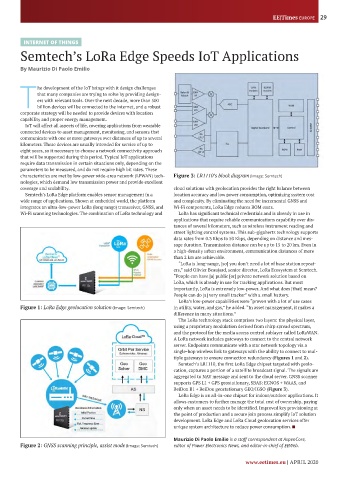
        characteristics are met by low-power wide-area network (LPWAN) tech-  Figure 3: LR1110’s block diagram (Image: Semtech)
        nologies, which demand low transmission power and provide excellent
        coverage and scalability.                             cloud solutions with geolocation provides the right balance between
          Semtech’s LoRa Edge platform enables sensor management in a   location accuracy and low power consumption, optimizing system cost
        wide range of applications. Shown at embedded world, the platform   and complexity. By eliminating the need for incremental GNSS and
        integrates an ultra-low-power LoRa (long range) transceiver, GNSS, and   Wi-Fi components, LoRa Edge reduces BOM costs.
        Wi-Fi scanning technologies. The combination of LoRa technology and   LoRa has significant technical credentials and is already in use in
                                                              applications that require reliable communications capability over dis-
                                                              tances of several kilometers, such as wireless instrument reading and
                                                              street lighting control systems. This sub-gigahertz technology supports
                                                              data rates from 0.3 Kbps to 50 Kbps, depending on distance and mes-
                                                              sage duration. Transmission distance can be up to 15 to 20 km. Even in
                                                              a high-density urban environment, communication distances of more
                                                              than 2 km are achievable.
                                                                “LoRa is long-range, [so] you don’t need a lot of base station repeat-
                                                              ers,” said Olivier Beaujard, senior director, LoRa Ecosystem at Semtech.
                                                              “People can have [a] public [or] private network solution based on
                                                              LoRa, which is already in use for tracking applications. But most
                                                              importantly, LoRa is extremely low-power. And what does [that] mean?
                                                              People can do [a] very small tracker” with a small battery.
                                                                LoRa’s low-power capabilities were “proven with a lot of use cases
        Figure 1: LoRa Edge geolocation solution (Image: Semtech)  in utility, water, and gas,” he added. “In asset management, it makes a
                                                              difference in many situations.”
                                                                The LoRa technology stack comprises two layers: the physical layer,
                                                              using a proprietary modulation derived from chirp spread spectrum,
                                                              and the protocol for the media access control sublayer called LoRaWAN.
                                                              A LoRa network includes gateways to connect to the central network
                                                              server. Endpoints communicate with a star network topology via a
                                                              single-hop wireless link to gateways with the ability to connect to mul-
                                                              tiple gateways to ensure connection redundancy (Figures 1 and 2).
                                                                Semtech’s LR1110, the first LoRa Edge chipset targeted with geolo-
                                                              cation, captures a portion of a satellite broadcast signal. The signals are
                                                              aggregated to NAV message and sent to the cloud server. GNSS scanner
                                                              supports GPS L1 + GPS geostationary, SBAS: EGNOS + WAAS, and
                                                              BeiDou B1 + BeiDou geostationary GEO/IGSO (Figure 3).
                                                                LoRa Edge is an all-in-one chipset for indoor/outdoor applications. It
                                                              allows customers to further manage the total cost of ownership, paying
                                                              only when an asset needs to be identified. Improved key provisioning at
                                                              the point of production and a secure join process simplify IoT solution
                                                              development. LoRa Edge and LoRa Cloud geolocation services offer
                                                              unique system architecture to reduce power consumption. ■

                                                              Maurizio Di Paolo Emilio is a staff correspondent at AspenCore,
        Figure 2: GNSS scanning principle, assist mode (Image: Semtech)  editor of Power Electronics News, and editor-in-chief of EEWeb.

                                                                                       www.eetimes.eu | APRIL 2020

