


Page 16 - EE Times Europe Magazine | April2019
P. 16
16 EE|Times EUROPE

        EC to Bet on Hydrogen Fuel-Cell Vehicles


          Figure 1 shows a general layout of a hydrogen vehicle. Reverse
        electrolysis takes place in the fuel cell: Hydrogen comes from a tank, air
        from the surrounding environment. Fuel cells do not provide thermal
        combustion but an electric current that produces non-altered water as
        the only waste.
          Fuel cells receive two incoming flows: hydrogen from the negative
        pole and oxygen from the positive pole. The catalyst contained in the
        hydrogen engine causes the electrons to separate from the nucleus, and
        this reaction releases electricity. The electrons move to the positive
        pole and join the oxygen atoms, which receive a negative charge.
          The union of hydrogen with oxygen produces a chemical reaction
        whose final product is water. What is emitted is water vapor, which
        can be released directly into the atmosphere by hydrogen-fueled cars
        (Figures 3 and 4).
          The current generated in the fuel cell can directly power the vehicle
        or charge a battery (smaller than a conventional battery) that acts as an
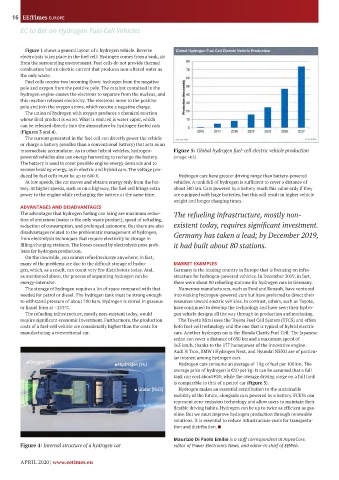
        intermediate accumulator. As in other hybrid vehicles, hydrogen-   Figure 5: Global hydrogen fuel-cell electric vehicle production
        powered vehicles also use energy harvesting to recharge the battery.   (Image: HIS)
        The battery is used to cover possible engine energy demands and to
        recover braking energy, as in electric and hybrid cars. The voltage pro-
        duced by fuel cells must be up to 600 V.                Hydrogen cars have greater driving range than battery-powered
          At low speeds, the car moves and obtains energy only from the bat-  vehicles. A tank full of hydrogen is sufficient to cover a distance of
        tery. At higher speeds, such as on a highway, the fuel cell brings extra   about 500 km. Cars powered by a battery reach this value only if they
        power to the engine while recharging the battery at the same time.  are equipped with huge batteries, but this will result in higher vehicle
                                                              weight and longer charging times.
        ADVANTAGES AND DISADVANTAGES
        The advantages that hydrogen fueling can bring are maximum reduc-  The refueling infrastructure, mostly non-
        tion of emissions (water is the only waste product), speed of refueling,
        reduction of consumption, and prolonged autonomy. But there are also   existent today, requires significant investment.
        disadvantages related to the problematic management of hydrogen,   Germany has taken a lead; by December 2019,
        from electrolysis techniques that require electricity to storage in
        filling/charging stations. The losses caused by electrolysis pose prob-  it had built about 80 stations.
        lems for hydrogen production.
          On the downside, you cannot refuel/recharge anywhere; in fact,
        many of the problems are due to the difficult storage of hydro-  MARKET EXAMPLES
        gen, which, as a result, can count very few distributors today. And,   Germany is the leading country in Europe that is focusing on infra-
        as mentioned above, the process of separating hydrogen can be   structure for hydrogen-powered vehicles. In December 2019, in fact,
        energy-intensive.                                     there were about 80 refueling stations for hydrogen cars in Germany.
          The storage of hydrogen requires a lot of space compared with that   Numerous manufacturers, such as Ford and Renault, have ventured
        needed for petrol or diesel. The hydrogen tank must be strong enough   into making hydrogen-powered cars but have preferred to direct their
        to withstand pressure of about 700 bars. Hydrogen is stored in gaseous   resources toward electric vehicles. In contrast, others, such as Toyota,
        or liquid form at –253°C.                             have continued to develop the technology and have seen their hydro-
          The refueling infrastructure, mostly non-existent today, would   gen vehicle designs all the way through to production and marketing.
        require significant economic investment. Furthermore, the production   The Toyota Mirai uses the Toyota Fuel Cell System (TFCS) and offers
        costs of a fuel-cell vehicle are considerably higher than the costs for   both fuel-cell technology and the one that is typical of hybrid electric
        manufacturing a conventional car.                     cars. Another hydrogen car is the Honda Clarity Fuel Cell. The Japanese
                                                              sedan can cover a distance of 650 km and a maximum speed of
                                                              165 km/h, thanks to the 177 horsepower of the innovative engine.
                                                              Audi H Tron, BMW i Hydrogen Next, and Hyundai NEXO are of particu-
                                                              lar interest among hydrogen cars.
                                                                Hydrogen cars consume an average of 1 kg of fuel per 100 km. The
                                                              average price of hydrogen is €10 per kg: It can be assumed that a full
                                                              tank can cost about €50, while the average driving range on a full tank
                                                              is comparable to that of a petrol car (Figure 5).
                                                                Hydrogen makes an essential contribution to the sustainable
                                                              mobility of the future, alongside cars powered by a battery. FCEVs can
                                                              represent zero-emission technology and allow users to maintain their
                                                              flexible driving habits. Hydrogen can be up to twice as efficient as gas-
                                                              oline. But we must improve hydrogen production through renewable
                                                              solutions. It is essential to reduce infrastructure costs for transporta-
                                                              tion and distribution. ■

                                                              Maurizio Di Paolo Emilio is a staff correspondent at AspenCore,
        Figure 4: Internal structure of a hydrogen car        editor of Power Electronics News, and editor-in-chief of EEWeb.

        APRIL 2020 | www.eetimes.eu

