


Page 15 - EE Times Europe Magazine | April2019
P. 15
EE|Times EUROPE   15


         AUTOMOTIVE
        EC to Bet on Hydrogen Fuel-Cell Vehicles


        By Maurizio Di Paolo Emilio


          n its push to become climate-neutral by 2050, the European
          Commission has unveiled an industrial strategy called the Clean
          Hydrogen Alliance. The public-private partnership among the EC,
       IEurope’s fuel-cell and hydrogen industry, and research organizations
        will drive the region’s efforts to ensure Europe’s energy independence
        and develop zero-emission cars.
        FROM ELECTRIC VEHICLES TO HYDROGEN-POWERED CARS?
        Next-generation vehicles that produce less harmful substances and less
        noise are universal goals, and as a result, the whole world is exper-
        imenting with electric vehicles (EVs). But a drawback of EVs, which
        belong to the electro-mobility sector, is their long charging times.
          That’s a problem that might be solved by hydrogen fueling, also
        called cell fueling. Hydrogen cells exploit the same energy used by   Figure 2: Electric and hydrogen vehicle in comparison
                                      spacecraft to reach Earth’s   (Image: InsideEVs.com)
        An environmental              orbit. But how do hydrogen
        argument for hydrogen-        cars work? What are the
                                      strengths and weaknesses?
        powered vehicles is           THE HARDWARE OF A
        that they do not emit         HYDROGEN VEHICLE
        greenhouse gases. But         Hydrogen vehicles con-
                                      vert chemical energy into
        hydrogen is not exactly       mechanics. A hydrogen
                                      internal combustion engine
        a renewable resource;         vehicle (HICEV) uses a
        it must be produced.          hydrogen-fueled version
                                      of the traditional internal
                                      combustion engine. Alterna-
        tively, hydrogen can be used to cause a reaction with oxygen in a fuel
        cell, thus producing electricity. This type of vehicle is called a fuel-cell
        electric vehicle (FCEV), and in recent years, FCEVs have drawn the
        attention of many manufacturers. FCEVs are powered by an electric
        engine and have an on-board power plant to allow the production and
        management of hydrogen.
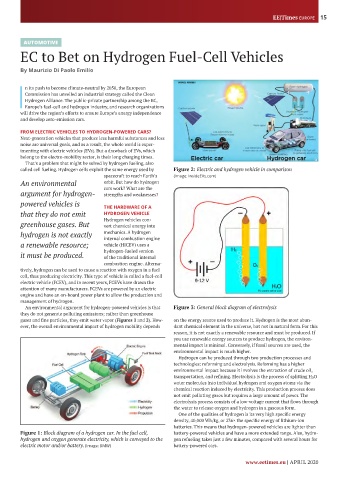
          An environmental argument for hydrogen-powered vehicles is that   Figure 3: General block diagram of electrolysis
        they do not generate polluting emissions; rather than greenhouse
        gases and fine particles, they emit water vapor (Figures 1 and 2). How-  on the energy source used to produce it. Hydrogen is the most abun-
        ever, the overall environmental impact of hydrogen mobility depends   dant chemical element in the universe, but not in natural form. For this
                                                              reason, it is not exactly a renewable resource and must be produced. If
                                                              you use renewable energy sources to produce hydrogen, the environ-
                                                              mental impact is minimal. Conversely, if fossil sources are used, the
                                                              environmental impact is much higher.
                                                                Hydrogen can be produced through two production processes and
                                                              technologies: reforming and electrolysis. Reforming has a higher
                                                              environmental impact because it involves the extraction of crude oil,
                                                              transportation, and refining. Electrolysis is the process of splitting H₂O
                                                              water molecules into individual hydrogen and oxygen atoms via the
                                                              chemical reaction induced by electricity. This production process does
                                                              not emit polluting gases but requires a large amount of power. The
                                                              electrolysis process consists of a low-voltage current that flows through
                                                              the water to release oxygen and hydrogen in a gaseous form.
                                                                One of the qualities of hydrogen is its very high specific energy
                                                              density, 40,000 Wh/kg, or 236× the specific energy of lithium-ion
                                                              batteries. This means that hydrogen-powered vehicles are lighter than
        Figure 1: Block diagram of a hydrogen car. In the fuel cell,    battery-powered vehicles and have a more extended range. Also, hydro-
        hydrogen and oxygen generate electricity, which is conveyed to the   gen refueling takes just a few minutes, compared with several hours for
        electric motor and/or battery. (Image: BMW)           battery-powered cars.

                                                                                       www.eetimes.eu | APRIL 2020

