


Page 10 - EE Times Europe Magazine | April2019
P. 10
10 EE|Times EUROPE

        Kemet’s CTO Talks Virtual Reality


          We’re involved with haptics,                                                     Everybody laughed a few
        but the other sensations of sight                                                years back with the Google Glass
        and sound and what you can do                                                    fiasco, but it looks like the whole
        with the vision systems and the                                                  idea of smart glasses is starting
        accelerometers and other tech-                                                   to come back. I think what’s
        nologies are equally important.                                                  happened is the electronics has
                                                                                         caught up, and miniaturization
        EP: Does the capability to feel                                                  has caught up.
        different textures open up                                                         That’s where very small-
        new opportunities?                                                               case-size ceramic and tantalum
        Lessner: I think it does. Without                                                polymer parts and other minia-
        a sense of touch, you’re sort of                                                 turized components are targeted.
        just poking into the air.
          We actually have a pilot                                                       EP: Designers tend to forget
        program to implement some                                                        about the passives and the
        VR systems for manufacturing                                                     interconnects, but these
        training to train technicians on                                                 components also have to
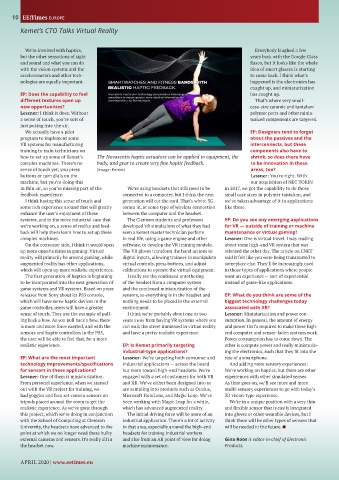
        how to set up some of Kemet’s   Thr Novasentis haptic actuators can be applied to equipment, the   shrink, so does there have
        complex machines. There’s no   body, and gear to create very fine haptic feedback.    to be innovation in these
        sense of touch yet; you press   (Image: Kemet)                                   areas, too?
        buttons or turn dials on the                                                     Lessner: You’re right. With
        machine, but you’re doing this                                                   our acquisition of NEC TOKIN
        in thin air, so you’re missing part of the   We’re using headsets that still need to be   in 2017, we got the capability to do those
        feedback experience.                connected to a computer, but I think the next   small case sizes in polymer tantalum, and
          I think having this sense of touch and   generation will cut the cord. That’s where 5G   we’ve taken advantage of it in applications
        some rich experience around that will greatly   comes in, or some type of wireless connection   like these.
        enhance the user’s enjoyment of these   between the computer and the headset.
        systems, and in the more industrial case that   The Clemson students and professors   EP: Do you see any emerging applications
        we’re working on, a sense of reality and feed-  developed VR simulations of what they had   for VR — outside of training or machine
        back will help them learn how to set up these   seen a Kemet master technician perform   maintenance or virtual gaming?
        complex machines.                   in real life, using a game engine and other   Lessner: One is virtual travel. I was reading
          On the consumer side, I think it would open   software, to develop the VR training module.   about some high-end VR system that was
        up more opportunities in gaming. Virtual   The VR gloves transform the hand actions to   released the other day. The article on CNET
        reality will primarily be around gaming, while   digital inputs, allowing trainees to manipulate   said it felt like you were being transported to
        augmented reality has other applications,   virtual controls, press buttons, and adjust   someplace else. They’ll be increasingly used
        which will open up more realistic experiences.  calibrations to operate the virtual equipment.  in those types of applications where people
          The first generation of haptics is beginning   I really see the continued untethering   want an experience — sort of experiential
        to be incorporated into the next generation of   of the headset from a computer system   instead of game-like applications.
        game systems and VR systems. Based on press   and the continued miniaturization of the
        releases from Sony about its PS5 console,   sensors, so everything is in the headset and   EP: What do you think are some of the
        which will have some haptic devices in the   nothing needs to be placed in the external   biggest technology challenges today
        game controller, users will have a greater   environment.               associated with XR?
        sense of touch. They use the example of pull-  I think we’re probably about one or two   Lessner: Miniaturization and power con-
        ing back a bow. As you pull back a bow, there   years away from having VR systems where you   sumption. In general, the amount of energy
        is more and more force exerted, and with the   can walk the street immersed in virtual reality   and power that’s required to make these high-
        sensors and haptic controllers in the PS5,   and have a pretty realistic experience.  end computer and sensor-laden systems work.
        the user will be able to feel that, for a more                          Power consumption has to come down. The
        realistic experience.               EP: Is Kemet primarily targeting    other is compute power and really miniaturiz-
                                            industrial-type applications?       ing the electronics, such that they fit into the
        EP: What are the most important     Lessner: We’re targeting both consumer and   size of a smartphone.
        technology improvements/specifications   industrial applications — across the board   And adding more sensory experiences:
        for sensors in these applications?  but more toward high-end headsets. We’re   We’re working on haptics, but there are other
        Lessner: One of them is miniaturization.   engaged with a set of customers for both VR   experiences with other simulated senses.
        From personal experience, when we started   and XR. We’ve either been designed into or   As time goes on, we’ll see more and more
        out with the VR project for training, we   are sampling into products such as Oculus,   multi-sensory experiences to go with today’s
        had goggles and four set camera sensors on   Microsoft HoloLens, and Magic Leap. We’ve   3D vision-type experience.
        tripods placed around the room to get the   been working with Magic Leap for a while,   We’re in a unique position with a very thin
        realistic experience. As we’ve gone through   which has advanced augmented reality.  and flexible sensor that is easily integrated
        this project, which we’re doing in conjunction   The initial driving force will be more of an   into gloves or other wearable devices, but I
        with the School of Computing at Clemson   industrial application. There’s a lot of activity   think there will be other types of sensors that
        University, the headsets have advanced to the   in that area, especially around the high-end   will be needed in the future. ■
        point at which we no longer need these bulky   headsets for training industrial workers
        external cameras and sensors. It’s really all in   and also from an AR point of view for doing   Gina Roos is editor-in-chief of Electronic
        the headset now.                    machine maintenance.                Products.

        APRIL 2020 | www.eetimes.eu

