


Page 16 - PEN eBook February 2024
P. 16
SMART ENERGY                                                                                                                                                                                                      SMART ENERGY

          is a rarity, it’s abundantly found all around us, bonded   hydrogen and oxygen, with the electricity required           While green hydrogen can be produced with minimal   or platinum alloy catalyst. PEM fuel cells offer a quick
          with other atoms—as water, as biomass like wood and   coming from renewable energies like wind, solar and              emissions, it then needs to be transported to where   startup time, low operating temperatures and electrical
          in hydrocarbons like petroleum, gas and coal.       hydropower. This means it has a minimal carbon                     it will be consumed. To limit the emissions footprint   efficiency of about 45% to 65%, and they are smaller
                                                              footprint, so it is the best choice to reduce emissions,           as much as possible, the locations of production and   and lighter than other fuel cells.
           Today, hydrogen is used in many industrial processes,   but it also means that large-scale production is              consumption should be physically close together, which
          such as fertilizer production and petroleum refining.   constrained by the limited availability of electricity         may not be practical.                               KOHLER HYDROGEN SYSTEMS
          It’s also used as a rocket propellant, as well as in fuel   from renewable sources. We’re going to see hydrogen                                                             Kohler’s power systems business is focused on
          cells in vehicles and electricity generation.       production, therefore, scale at the same speed, or                  These challenges mean that today, we’re not yet    providing its customers with sustainable energy
                                                              maybe slightly behind, the pace of the adoption of                 seeing high adoption rates of hydrogen, but the     resilience. Hydrogen fits with that product portfolio,
           To use hydrogen as a fuel and release the energy   renewables.                                                        potential is there. For example, hydrogen fuel cells are   providing reliable power with zero carbon emissions at
          it stores, we can burn it through a process like                                                                       starting to be used to power cars, but it’s early days—  the point of use.
          combustion in an engine or we can use it in a fuel   White hydrogen, defined as hydrogen that is naturally             and there are still very few hydrogen fueling stations.
          cell. Using hydrogen can greatly reduce greenhouse   produced or present underground, is another attractive            U.S. government figures say there are only 58 hydrogen   Kohler’s hydrogen power system uses a PEM fuel cell
          gas emissions compared with traditional fossil fuels,   option and is starting to create a lot of interest.            fueling stations open, and 57 of those are in California.   for high-efficiency energy conversion and is modular,
          which are made of hydrocarbons, and thus release    The technology to extract it is not yet commercialized,            If you are lucky enough to find somewhere to fill up   flexible and scalable to suit a broad range of mission-
          CO  when burned. Importantly, hydrogen’s waste      but the potential is enormous for large-scale, low-cost            with hydrogen, however, it is much quicker than waiting   critical power users, including hospitals, data centers
            2
          product is only water when it is used in a fuel-cell   production.                                                     for your electric car to recharge, typically taking five   and water-treatment plants. The system can be used
          system.                                                                                                                minutes or less.                                    as a prime or backup power source, for peak shaving or
                                                              WORKING WITH HYDROGEN                                                                                                  as part of a distributed energy network.
          HYDROGEN PRODUCTION                                  Compared with traditional fuels, hydrogen’s energy                HYDROGEN FUEL CELLS
           About 10 million tons of hydrogen are produced     density is very low at atmospheric pressure. This                   Fuel cells are more energy-efficient than combustion   The power system can operate in an extended range
          in the U.S. each year. Typically, hydrogen is defined   means that we must store a lot of it to get the same           engines and can achieve more than 60% efficiency    of temperatures, from –30°C to 45°C. It is designed
          with a color that indicates both its source and the   kind of power output as from fossil fuels. Storage is            in converting the chemical energy in their fuel into   for low-maintenance operation and reduced through-
          technology used to make it. There are many colors   therefore a challenge, and it requires high pressure to            electrical energy. They have zero CO  emissions, with   life costs, with a 20-year design life. It has a compact,
                                                                                                                                                                2
          used today, including black, brown, gray, purple, pink,   compress the hydrogen to occupy a reasonable space.          their only waste product being water.               durable steel housing featuring lockable access doors
          blue, white and green.                                                                                                                                                     and a textured paint finish for corrosion and abrasion
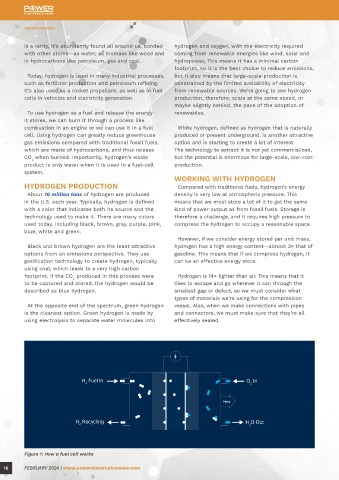
                                                               However, if we consider energy stored per unit mass,               Figure 1 shows a conceptual overview of how a fuel   protection.
           Black and brown hydrogen are the least attractive   hydrogen has a high energy content—almost 3× that of              cell works. Hydrogen molecules enter at the anode (the
          options from an emissions perspective. They use     gasoline. This means that if we compress hydrogen, it              negative electrode) and oxygen molecules enter at the   With this robust, scalable power system, hydrogen
          gasification technology to create hydrogen, typically   can be an effective energy store.                              cathode (the positive electrode). The hydrogen atoms   fuel-cell technology for power generation will enable
          using coal, which leads to a very high carbon                                                                          in the hydrogen molecules split into electrons and   Kohler’s customers to achieve the emissions reductions
          footprint. If the CO  produced in this process were   Hydrogen is 14× lighter than air. This means that it             positively charged hydrogen protons.                they need without compromising their mission-critical
                           2
          to be captured and stored, the hydrogen would be    likes to escape and go wherever it can through the                                                                     power supplies.
          described as blue hydrogen.                         smallest gap or defect, so we must consider what                    The electrolyte membrane allows only hydrogen
                                                              types of materials we’re using for the compression                 protons to pass through. The electrons are forced
           At the opposite end of the spectrum, green hydrogen   vessel. Also, when we make connections with pipes               through an external circuit, thus generating an electric
          is the cleanest option. Green hydrogen is made by   and connectors, we must make sure that they’re all                 current. This flow of electrons reaches the cathode,
          using electrolysis to separate water molecules into   effectively sealed.                                              where the negatively charged electrons combine with
                                                                                                                                 the positively charged hydrogen protons and oxygen
                                                                                                                                 from the air to form water. This process also dissipates
                                                                                                                                 heat.


                                                                                                                                  Different materials can be used as the electrolyte,
                                                                                                                                 leading to different characteristics of the fuel cell and
                                                                                                                                 making it suitable for various applications. For example,
                                                                                                                                 polymer electrolyte membrane (PEM) fuel cells use an
                                                                                                                                 acid membrane and a solid polymer as an electrolyte,
                                                                                                                                 with porous carbon electrodes containing a platinum
                                                                                                                                                                                     Figure 2: Kohler hydrogen fuel-cell power system


                                                                                                                                 References


                                                                                                                                      ▶ For more information, visit sustainablefuture.kohlerpower.com.
          Figure 1: How a fuel cell works

  16      FEBRUARY 2024 | www.powerelectronicsnews.com                                                                                                                                        FEBRUARY 2024 | www.powerelectronicsnews.com  17

