


Page 13 - PEN eBook February 2024
P. 13
SEMICONDUCTORS                                                                                    SEMICONDUCTORS


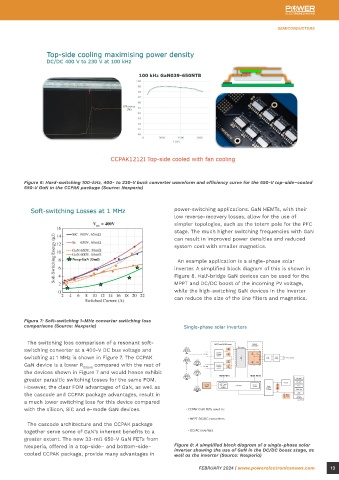
          Figure 6: Hard-switching 100-kHz, 400- to 230-V buck converter waveform and efficiency curve for the 650-V top-side–cooled
          650-V GaN in the CCPAK package (Source: Nexperia)
 Figure 5: Comparing board reliability during temperature cycling between the CCPAK and QFN/DFN packages (Source:
 Nexperia)
                                                              power-switching applications. GaN HEMTs, with their
                                                              low reverse-recovery losses, allow for the use of
 ▶  A lower thermal resistance (R ) and package-  level benefits. The total source-drain inductance   simpler topologies, such as the totem pole for the PFC
 th
 added electrical resistance. The large cross-  in the CCPAK1212 package is only 1.2 nH.   stage. The much higher switching frequencies with GaN
 sectional area of Cu improves both electrical and   In comparison, the same for a competitor’s SiC   can result in improved power densities and reduced
 thermal performance compared with traditional   device in a leadless TOLL package was 2 nH.  system cost with smaller magnetics.
 wire-bonded packages. This is true even though
 the package can be much smaller in size in   ▶  Improved board-level reliability compared with   An example application is a single-phase solar
 comparison. Soldering the clip directly to the   traditional QFN/DFN surface-mounted packages.   inverter. A simplified block diagram of this is shown in
 source connection on the die helps prevent areas   As shown in Figure 5, the CCPAK has exposed,   Figure 8. Half-bridge GaN devices can be used for the
 of high current density seen with bond wires   flexible, gull-winged leads. This allows the   MPPT and DC/DC boost of the incoming PV voltage,
 and the resultant hot spots. This also improves   CCPAK pins to absorb stress related to thermal   while the high-switching GaN devices in the inverter
 reliability at higher power levels. As an example,   expansions and contractions from temperature   can reduce the size of the line filters and magnetics.
 the maximum junction to mounting base   cycling. In contrast, the fully encapsulated leads
 (R th(j-mb) ) of the Nexperia TO-247–packaged 650-V   in the QFN/DFN packages do not allow any
 GaN device GAN041-650WSB, rated at a typical   movement in the leads, meaning the solder joint   Figure 7: Soft-switching 1-MHz converter switching loss
 on-state resistance R DS(on)  of 35 mΩ, is specified   absorbs a lot of the stress, creating risks of joint   comparisons (Source: Nexperia)
 at 0.8 K/W. The datasheet of the upcoming 650-V   degradation with temperature cycling. Cracks in
 CCPAK1212 top-side–cooled device   the mold also create the risk of early failure in   The switching loss comparison of a resonant soft-
 GAN039-650NTB, rated at a typical R DS(on)  of   the package.  switching converter at a 400-V DC bus voltage and
 33 mΩ, specifies the maximum R th(j-mb)  at 0.5 K/W.  switching at 1 MHz is shown in Figure 7. The CCPAK
          GaN device is a lower R DS(on)  compared with the rest of
 ▶  Lower parasitic inductance. Compared with   CASCODE GaN PERFORMANCE IN   the devices shown in Figure 7 and would hence exhibit
 wire-bonded packages, the parasitic package   CCPAK  greater parasitic switching losses for the same FOM.
 inductance of the Cu-clip packages can be up   The 650-V top-side–cooled CCPAK GaN performance   However, the clear FOM advantages of GaN, as well as
 to 3× lower. This results in improved switching   was evaluated under both hard-switching and soft-  the cascode and CCPAK package advantages, result in
 efficiency and lower electromagnetic interference   switching conditions. Figure 6 shows the switching   a much lower switching loss for this device compared
 during switching transitions. This can be   performance of a hard-switching 400-V to 230-V buck   with the silicon, SiC and e-mode GaN devices.
 especially important in GaN power devices. Their   converter operating a 100-kHz switching frequency.
 low device capacitances and improved switching   The excellent R  allows for high efficiency (>98%) in this   The cascode architecture and the CCPAK package
 th
 figures of merit (FOMs) allow for much faster   fan-cooled application for power as high as 6 kW.   together serve some of GaN’s inherent benefits to a
 switching frequencies and transitions. Having low   The switching waveform shows a fast rise time of about   greater extent. The new 33-mΩ 650-V GaN FETs from
 package inductances enables this to be achieved   7 ns, with an overshoot of less than 20 V.  Nexperia, offered in a top-side– and bottom-side–  Figure 8: A simplified block diagram of a single-phase solar
                                                              inverter showing the use of GaN in the DC/DC boost stage, as
 at smaller overshoot levels, providing system-  cooled CCPAK package, provide many advantages in   well as the inverter (Source: Nexperia)

 12  FEBRUARY 2024 | www.powerelectronicsnews.com                      FEBRUARY 2024 | www.powerelectronicsnews.com  13

