


Page 21 - PEN eBook February 2024
P. 21
AUTOMOTIVE                                                                                            AUTOMOTIVE


 Figure 1: EV charging standards (Source: NXP Semiconductors)

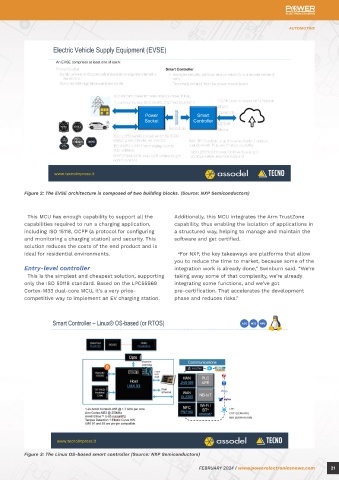
          Figure 2: The EVSE architecture is composed of two building blocks. (Source: NXP Semiconductors)
 like a little robot, but it could be a charging device that   For implementing the smart controller, different
 comes up from the ground, from the side or from above   approaches are available today. In his talk, Swinburn
 like a pantograph. Therefore, the ISO 15118 standard is   proposed the following three NXP solutions.  This MCU has enough capability to support all the   Additionally, this MCU integrates the Arm TrustZone
 now taking over all of the functionality of charging that   capabilities required to run a charging application,   capability, thus enabling the isolation of applications in
 was previously managed by different standards.  Linux OS-based smart controller  including ISO 15118, OCPP (a protocol for configuring   a structured way, helping to manage and maintain the
 This solution is based on the i.MX93 applications   and monitoring a charging station) and security. This   software and get certified.
 EVSE BUILDING BLOCKS  processor family, capable of delivering efficient ML   solution reduces the costs of the end product and is
 From NXP’s perspective, when we start thinking about   acceleration and advanced security. The i.MX 93   ideal for residential environments.  “For NXP, the key takeaways are platforms that allow
 how to design and build an EV charging system, we can   application processors are the initial ones in the   you to reduce the time to market, because some of the
 identify two distinct blocks, as shown in Figure 2. On   i.MX portfolio to incorporate the adaptable Arm   Entry-level controller  integration work is already done,” Swinburn said. “We’re
 the left-hand side, we have the power socket, which   Cortex-A55 core, which enhances the performance   This is the simplest and cheapest solution, supporting   taking away some of that complexity, we’re already
 manages the energy flow from the grid into the vehicle   and energy efficiency of Linux-based edge   only the ISO 50118 standard. Based on the LPC55S69   integrating some functions, and we’ve got
 and accurately measures the transferred energy. On   applications. Additionally, they feature the Arm   Cortex-M33 dual-core MCU, it’s a very price-  pre-certification. That accelerates the development
 the right-hand side, isolated from the left, we have the   Ethos-U65 microNPU—which empowers developers   competitive way to implement an EV charging station.   phase and reduces risks.”
 smart controller, where all of the higher services, such as   to design ML applications that are more capable,
 communication, payment services, Plug & Charge or V2G,   cost-effective and energy-efficient—and an Arm
 are running.  Cortex-M33 low-power security MCU.


 As shown, each of the blocks is regulated by its   The i.MX93 processor (Figure 3) features a four-lane
 standards.  low-voltage differential-signaling interface, meaning
 it’s tolerant to a high-noise environment, so you can
 NXP’S SOLUTIONS  have your controller in one part of the system and
 NXP Semiconductors has a wide portfolio of products   your display can be separated from the first, ensuring
 and solutions that can address the requirements of the   high noise immunity. It also integrates all of the
 building blocks shown in Figure 2.  different communication standards that are used in
 EV charging.
 For metering and energy measurement, NXP showcased
 at Fortronic 2023 a power socket board suitable for   RTOS-based smart controller
 implementing a three-phase 22-kW charger. It is based   This solution is based on the MIMXRT1062DVJ6B
 on the MKM35Z256VLQ7 microcontroller (MCU), enabling   crossover MCU with Arm Cortex-M7 core with
 single-chip one-, two- and three-phase electricity   scalable flash and SRAM memories. This real-
 meters, as well as flow meters and other precision   time MCU operates at up to 600 MHz, offering 2D
 measurement applications. The MCU also provides   graphics, a camera, various memory interfaces and a
 security with active and passive tamper detection with   wide range of connectivity interfaces.
 time stamping.  Figure 3: The Linux OS-based smart controller (Source: NXP Semiconductors)

 20  FEBRUARY 2024 | www.powerelectronicsnews.com                      FEBRUARY 2024 | www.powerelectronicsnews.com  21

