


Page 10 - PEN eBook May 2023
P. 10
COVER STORY – DESIGN                                                                                                                                                                                        COVER STORY – DESIGN

                                                              by up to 64%. Additionally, the maximum temperature                 The advances in overall device performance are
                                                              at the hotspot of the converter on the primary side                remarkable, resulting from significant improvements at   May 9–11, 2023: Visit us at PCIM Europe in Nuremberg
                                                              decreases by 7.5°C.                                                a device technology level. These improvements led to
                                                                                                                                 the creation of a unique device structure, the first to   You’re invited to join Infineon’s presentation of the latest
                                                              EFFICIENCY MEASUREMENTS UNDER                                      employ a 3D charge compensation in conjunction with    trends in silicon power semiconductors and wide-bandgap
                                                              SOFT-SWITCHING CONDITIONS:                                         a metal gate in a trench power MOSFET. As a result,    technologies at our demo stations, specifically tailored to your
                                                              TESTING A 1-KW IBC FOR DATA                                        this technology reduces on-resistance, dramatically    application of interest. Discover how our solutions address
                                                              CENTERS                                                            lowers gate- and gate-drain charges and improves the   today’s challenges in green and digital
                                                               This 1-kW, 4:1, fixed-frequency LLC IBC operates as a             switching homogeneity across the device area. These    transformation through our new product
                                                              DCX from an input that may vary from 42 V to 60 V.                 achievements translate into a significant enhancement   demos, live TechTalks on stage or
          Figure 6: Schematic of the 1-kW IBC board with an FB LLC on   The soft-switching techniques employed in the            in system efficiency in various applications across    personal conversations with our experts.
          the primary side                                    LLC resonant topology allow a significant efficiency               different load conditions.                             Meet us at Messe Nürnberg event
                                                              improvement in telecom and server power supplies. 6–8                                                                     grounds (Hall 7, Booth 412).
           The primary side uses Infineon’s latest trench MOSFET                                                                  The efficiency measurements carried out on several
          technology, OptiMOS™ 6, employing 100-V devices     In Figure 6, two OptiMOS™ 6 80-V power MOSFETs                     SMPS applications under both hard- and soft-switching
          (ISC030N10NM6) with R DS(on),max  = 3.0 mΩ. These devices   housed in a SuperSO8 package are paralleled on the         conditions confirm the remarkable findings at the
          come in a SuperSO8 package (PQFN 5 × 6 mm ) and     primary-side FB. An FB configuration is formed using               semiconductor device level. Depending on the topology
                                                 2
          replace the BSC050N10NS5 from the predecessor       four OptiMOS™ 5 25-V IQE006NE2LM5 source-down                      and load condition, it is possible to raise efficiency   To learn more about the latest power MOSFET
          OptiMOS™ 5 technology, which had a higher R DS(on),max    devices (PQFN 3.3 × 3.3 mm ) in parallel as SRs. The         by up to 1%, further highlighting the superiority of   technology family and its potential to revolutionize the
                                                                                       2
          of 5.0 mΩ (also coming in a SuperSO8 package). On   turns ratio of the transformer is 4:1. The resonant                this new technology. Additionally, the much-improved   telecom power arena and other application fields, we
          the secondary side, the system uses 80-V MOSFETs    frequency of the LLC converter is 310 kHz. The                     device performance reduces the number of devices    encourage you to visit our webpage.
          as SRs. It utilizes either four paralleled OptiMOS™ 5   switching frequency is fixed to match the resonance            required by up to 50% without any adverse effect on
          BSC040N08NS5 devices with R DS(on),max  = 4 mΩ and a   frequency of the tank. Zero-voltage switching for               the device temperature, demonstrating its potential to
          SuperSO8 package from the predecessor technology, or   the primary switches and zero-voltage/zero-current              significantly lower costs and improve overall system
          four paralleled OptiMOS™ 6 ISZ053N08NM6 devices with   switching for the SR switches are thus achieved by              reliability.
                                                      i
          the industry’s lowest R DS(on),max  of 5.3 mΩ and a smaller   design.
          PQFN 3.3 × 3.3-mm  package.
                          2
                                                               The significantly improved device parameters of
           The results obtained from the comparison of        the new OptiMOS™ 6 80 V not only improve the
          measured efficiencies, presented in Figure 5, highlight   overall efficiency of the converter but also allow the
          the advantages of adopting OptiMOS™ 6 technology.   two paralleled SuperSO8 OptiMOS™ 5 80-V power
          Compared with the previous generation, the solution   MOSFETs BSC030N08NS5 with R DS(on),max  = 3 mΩ on
          employing OptiMOS™ 6 technology demonstrates        the primary side to be replaced by just one OptiMOS™
          impressive efficiency improvements in excess of 0.4%   6 ISC014N08NM6 device,  with the industry’s lowest
                                                                                    i
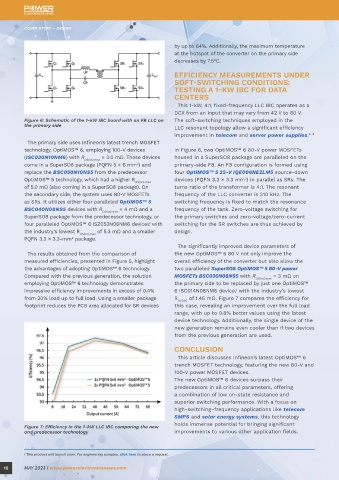
          from 20% load up to full load. Using a smaller package   R DS(on)  of 1.45 mΩ. Figure 7 compares the efficiency for
          footprint reduces the PCB area allocated for SR devices   this case, revealing an improvement over the full load       References
                                                              range, with up to 0.8% better values using the latest
                                                              device technology. Additionally, the single device of the
                                                              new generation remains even cooler than if two devices                  ▶ 1Williams et al. (2017). “The Trench Power MOSFET: Part I - History, Technology, and Prospects.” IEEE
                                                              from the previous generation are used.                                Transactions on Electron Devices, Vol. 64, No. 3, pp. 674–691.
                                                                                                                                      ▶ 2Ejury, J., Hirler, F., & Larik, J. (2001). “New P-Channel MOSFET Achieves Conventional N-Channel MOSFET
                                                              CONCLUSION                                                            Performance.” PCIM.

                                                               This article discusses Infineon’s latest OptiMOS™ 6                    ▶ 3Schlögl et al. (2005). “A new robust power MOSFET family in the voltage range 80 V – 150 V with superior
                                                              trench MOSFET technology, featuring the new 80-V and                  low RDSon, excellent switching properties and improved body diode.” EPE.
                                                              100-V power MOSFET devices.
                                                              The new OptiMOS™ 6 devices surpass their                                ▶ 4Siemieniec et al. (2022). “A new power MOSFET technology achieves a further milestone in efficiency.”
                                                              predecessors in all critical parameters, offering                     EPE.
                                                              a combination of low on-state resistance and                            ▶ 5Li, S. (2020). “Intermediate Bus Converters for High-Efficiency Power Conversion: A Review.” IEEE Texas
                                                              superior switching performance. With a focus on                       Power and Energy Conference (TPEC).
                                                              high-switching–frequency applications like telecom
                                                              SMPS and solar energy systems, this technology                          ▶ 6Liu, R., & Lee, C.Q. (1988). “Analysis and design of LLC-type series resonant converter.” IEE Electron

          Figure 7: Efficiency in the 1-kW LLC IBC comparing the new   holds immense potential for bringing significant             Device Letters, Vol. 24, No. 24, pp. 1517–1519.
          and predecessor technology                          improvements to various other application fields.                       ▶ 7Yang et al. (2002). “LLC resonant converter for front end DC/DC conversion.” APEC.
                                                                                                                                      ▶ 8Jung, J., & Kwon, J. (2007). “Theoretical Analysis and Optimal Design of LLC Resonant Converter.” EPE.

          i This product will launch soon. For engineering samples, click here to place a request.

  10      MAY 2023 | www.powerelectronicsnews.com                                                                                                                                                  MAY 2023 | www.powerelectronicsnews.com  11

