


Page 8 - PEN eBook May 2023
P. 8
COVER STORY – DESIGN                                                                                                                                                                                        COVER STORY – DESIGN

          plate, which was isolated from the gate electrode and   low- and medium-voltage power MOSFETs. In order to
          instead electrically connected to the source potential   also further reduce the FOM  = R DS(on)  × Q  and
                                                                                       g
                                                                                                  g
          (Figure 1d). While the charge compensation principle   FOM  = R DS(on)  × Q  values, the gate trench underwent
                                                                              gd
                                                                  gd
          operates as before, the buried field plate does not   a complete redesign to minimize its lateral extension.
          introduce any additional contributions to the       However, the substantially smaller dimensions of the
          gate-drain capacitance. Instead, the field plate shields   gate impose a new challenge, as the use of polysilicon
          the gate electrode from the drain potential, which   as gate material would result in unacceptably large
          reduces the gate-drain capacitance C  and related   internal gate resistances. The introduction of gate
                                           gd
          charges. These devices, at the time of their introduction   fingers usually solves this issue, but these reduce the
          to the market, showed best-in-class performance with   active area available for current conduction.
          low gate charge and gate-drain charge characteristics,
          high switching speeds and good avalanche ruggedness. 3  Instead, a new metal gate system has been introduced
                                                              to avoid any loss of active area, which otherwise would
          INFINEON’S INNOVATIVE APPROACH                      be rather significant. This system not only reduces the
          TO RAISING POWER MOSFET DESIGN                      internal gate resistance but also enhances the gate
          TO THE NEXT LEVEL                                   resistance uniformity across the chip.  Furthermore,
                                                                                               4
           To reach the next level in power MOSFET evolution,   the field plates are directly connected to the source
          new MOSFET devices are required to provide          metal, ensuring a rapid and homogeneous transition at
          improvements across all FOMs. This is needed to enable   turn-on and turn-off. This minimizes switching losses         Figure 3: System diagram of the IBA
          high-frequency switched-mode power supply (SMPS)    and mitigates the risk of an undesired dv/dt-induced
          operation, whereby losses are associated with charges   parasitic turn-on of the MOSFET.                               digital loads (xPUs and ASICs).  Depending on the end   in these applications, showing typical peak efficiencies
                                                                                                                                                           5
          (switching) and on-state resistance (conduction). To                                                                   application, PoL converters can be optimized to operate   that exceed 98%, much higher than their regulated
          meet these more demanding requirements, a novel     BOOSTING END-TO-END CONVERSION                                     either with a narrow or wide input voltage range.   counterparts.
          cell-design approach has been developed and         EFFICIENCY IN TELECOM AND DATA                                     In telecom systems, where the –48-V bus shows wide
          implemented, which explores for the first time a true   CENTER SYSTEMS                                                 tolerance, it has been common for the PoL regulators   DEVICE BEHAVIOR AND EFFICIENCY
          3D charge compensation.                              Intermediate bus converters (IBCs) are considered a               to operate with a narrow input voltage range (e.g., 12 V),   MEASUREMENTS UNDER
                                                              demanding application for power MOSFETs. As part of                thus requiring a regulated IBC. Taking the burden of the   HARD-SWITCHING CONDITIONS:
           First, a direct connection of the field-plate electrodes   the intermediate bus architecture (IBA), the IBC is a      regulation from a wide input range                  TESTING A 600-W IBC FOR TELECOM
          to the top-side source metal is required, as illustrated   DC/DC converter that performs an intermediate               (–36 V to –75 V), the IBC tends to be rather inefficient   APPLICATIONS
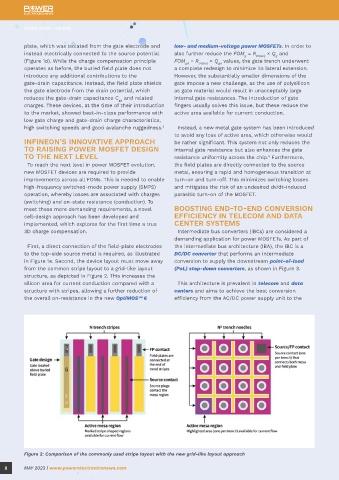
          in Figure 1e. Second, the device layout must move away   conversion to supply the downstream point-of-load             and plays an important role in defining the          The IBC in this application operates as an isolated
          from the common stripe layout to a grid-like layout   (PoL) step-down converters, as shown in Figure 3.                end-to-end conversion efficiency. Improving the IBC   DC/DC IBC with a nominal –48-V input (overall range
          structure, as depicted in Figure 2. This increases the                                                                 efficiency is thus paramount to boosting the overall   from –36 V to –75 V) and a 12-V output voltage bus.
          silicon area for current conduction compared with a   This architecture is prevalent in telecom and data               conversion efficiency.                              The fully regulated converter in the industry’s standard
          structure with stripes, allowing a further reduction of   centers and aims to achieve the best conversion                                                                  quarter-brick form factor operates at a switching
          the overall on-resistance in the new OptiMOS™ 6     efficiency from the AC/DC power supply unit to the                  In modern data center systems or advanced AI       frequency of 250 kHz and can deliver an output current
                                                                                                                                 hardware accelerators, extremely high currents have   of a maximum of 50 A. The IBC is based on a
                                                                                                                                 to be supplied to sub-1-V digital loads. The efficiency   hard-switching full-bridge (FB) topology with a
                                                                                                                                 of the two stages can be maximized by playing with the   center-tapped (CT) synchronous rectifier (SR) on the
                                                                                                                                 down-conversion ratio of the IBC and with the burden   secondary side, schematically shown in Figure 4.
                                                                                                                                 of regulation being transferred to the multiphase
                                                                                                                                 PoL/voltage regulator module. Indeed, unregulated IBCs
                                                                                                                                 in the form of DC transformers (DCX) are employed


                                                                                                                                 Figure 4: Simplified schematic of the 600-W IBC board in   Figure 5: Efficiency in the 600-W IBC comparing the new and
          Figure 2: Comparison of the commonly used stripe layout with the new grid-like layout approach                         FB-CT configuration                                 predecessor technology

   8      MAY 2023 | www.powerelectronicsnews.com                                                                                                                                                  MAY 2023 | www.powerelectronicsnews.com  9

